
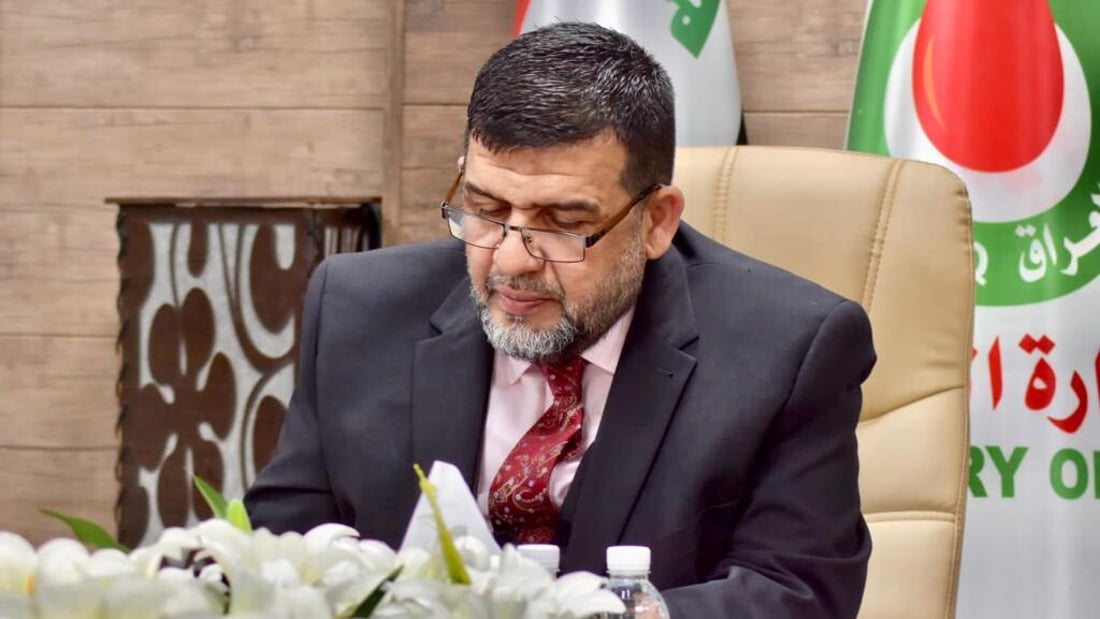
Ali Abdul Karim al-Mousawi, former director general of Iraq’s Oil Pipelines Company, who was arrested in connection with the Jurf al-Sakhar oil-smuggling investigation.
Ousted Iraqi pipeline chief arrested in Jurf al-Sakhar probe, source says
BAGHDAD — Ali Abdul Karim al-Mousawi, the ousted director general of Iraq’s state-owned Oil Pipelines Company, has been arrested after confessions to the judiciary about oil smuggling in Jurf al-Sakhar in Babil governorate, a source told 964media on Thursday.
The source did not say when or where he was detained, who had made the confessions or which authority carried out the arrest. It was not clear whether a judge had issued a warrant or what charges Mousawi might face. 964media found no official statement on the arrest by Thursday evening.
Prime Minister Ali al-Zaidi relieved nine security and oil officials of their duties on Saturday after a government inquiry confirmed oil smuggling and refineries in the area and found cases of manipulation, said Sabah al-Numan, spokesperson for the commander-in-chief of the armed forces. Zaidi also ordered those accused referred to the courts.
The statement named none of the nine but listed their posts. They included Babil’s police chief, the governorate’s intelligence and security directors, its Popular Mobilization Forces commander, the commander of the Energy Police’s 6th Brigade and the director of the Oil Ministry’s Oil Pipelines Company, the post Mousawi held.
Mousawi entered Jurf al-Sakhar with the government’s investigating committee and was filmed saying the pipes there had no problem. The company said Sunday that the remark covered only the 200 to 300 meters he had inspected, not the whole pipe, which runs for about 5,100 meters.
The clip had been filmed without the company’s knowledge and showed only an excerpt of what he said, the company said. His remark was not a full technical assessment, and final findings rest with the committee, it said.
The case broke on Nov. 9, when an Interior Ministry intelligence report began circulating. The report, by the ministry’s Federal Intelligence and Investigations Agency, cites satellite images from 2021 to 2026 and alleges that pipelines in Jurf al-Sakhar were holed and the oil carried away in tanker trucks.
On Sunday, government spokesperson Haider al-Aboudi named Kataib Hezbollah as the party behind the smuggling. Three branches of the strategic Basra-Haditha pipeline run through the area the Iran-aligned faction controls, he said.
Kataib Hezbollah denies smuggling oil and has accused Zaidi’s office of spreading “fabricated reports.” At a news conference inside Jurf al-Sakhar on Tuesday, senior faction figure Abu Talib al-Saeedi accused the investigators of falsifying their findings. Standing at the site the government links to the smuggling, he called it “a primitive plant,” said it was about 5 kilometers from the pipelines and said it had stood idle for many months.
On Monday, Zaidi ordered the armed forces into Jurf al-Sakhar and gave the faction a short deadline to leave, the government said. It has not said when the deadline expires.
On Wednesday, Zaidi’s media office said the Energy Police would take over guarding the pipeline, the force holding the area would be replaced and the government’s investigations into violations on the pipeline would go to the judiciary. Documents obtained by 964media show Zaidi has approved a plan dividing Jurf al-Sakhar among the army, the Federal Police and PMF brigades.
Under an executive order from Zaidi, a new joint command takes control of the area at 6 a.m. Friday, answering to the Federal Police, Numan said. The armed forces went on “Alert C” on Thursday, said Lt. Gen. Saad Maan, who speaks for the security forces.
A judicial committee inspected the suspected smuggling sites on Tuesday, joining the government’s committee, an official source told the state-run Iraqi News Agency. Its findings have not been made public.
Kataib Hezbollah has brigades in the PMF, the state-sanctioned umbrella of mostly Shiite armed groups formed in 2014 to fight the Islamic State group. The United States designated the faction in 2009.
Jurf al-Sakhar was officially renamed Jurf al-Nasr in 2014 after Iraqi forces and allied armed groups recaptured it from Isis. It has been closed since then, and many of its displaced residents still cannot return.