
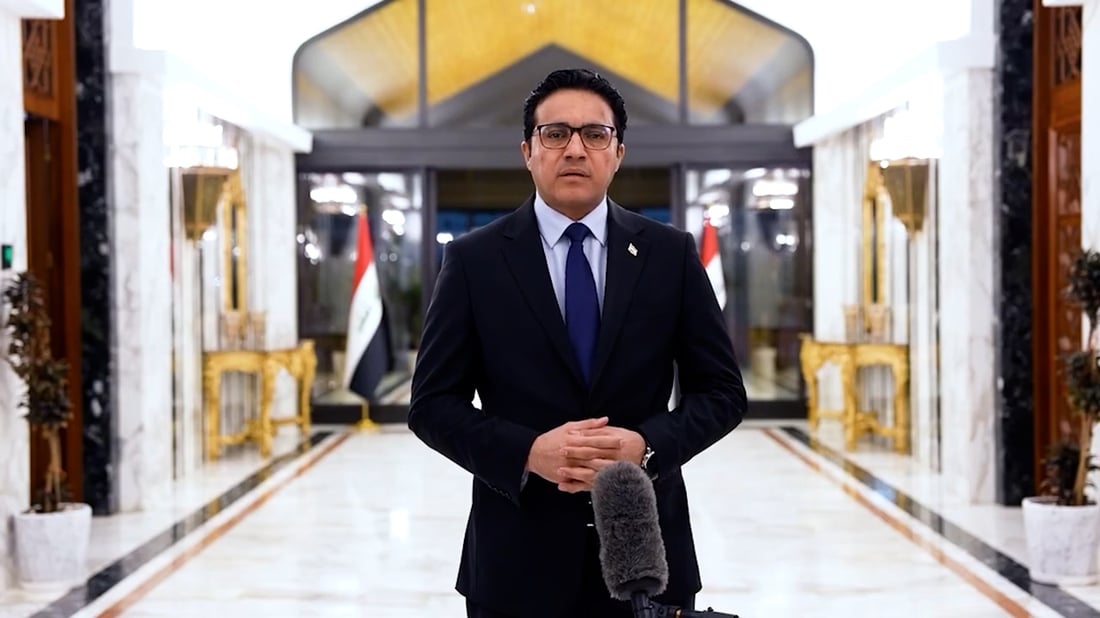
Government spokesperson Haider al-Aboudi
Oil smuggling crackdown
Iraq PM ‘orders’ troops into Jurf al-Sakhar, gives faction short deadline
BAGHDAD — Prime Minister Ali al-Zaidi has ordered the armed forces into Jurf al-Sakhar and given the armed faction that holds the northern Babil area a short deadline to leave, his government said Monday.
The government also said army forces could “enter” parts of the Kurdistan Region as its crackdown on suspected oil smuggling widens, though it announced no deployment there. The remarks did not receive further elaboration.
“The armed forces will enter the Jurf al-Nasr area, and the decision on that has been made,” government spokesperson Haider al-Aboudi told the state-run Iraqi News Agency, using the area’s official name.
Asked about a deadline for Kataib Hezbollah to leave, Aboudi said one had been set and it “is not far off.” He did not say when it expires or what would follow if the faction stayed.
On Sunday, he named Kataib Hezbollah as the party behind the smuggling in a televised interview and said the area would soon return to the authority of the security forces. The Iran-aligned faction has brigades in the Popular Mobilization Forces and is widely regarded as controlling Jurf al-Sakhar.
Jurf al-Sakhar had for years been described as a closed issue, Aboudi said, but the government acted on the smuggling suspicions under its legal powers and its constitutional duty to protect public money.
Zaidi’s order followed the findings of a high-level investigative committee, Aboudi said. The committee inspected six sites named in a Federal Intelligence and Investigations Agency report and found evidence of tampering with pipelines, along with attempts to hide the damage by burying its traces.
It also found two refineries, a tanker and fuel storage tanks inside Jurf al-Sakhar, he said.
Zaidi ordered those implicated referred to the judiciary and told the Federal Commission of Integrity to join the investigation, Aboudi said. Security agencies were told to stop tanker trucks suspected of carrying smuggled crude or oil products from leaving the areas concerned.
The orders cover every area where smuggling is suspected, from Zakho in the far north to Basra in the south, not only Jurf al-Sakhar, Aboudi said. Security agencies have already begun investigating suspected smuggling elsewhere in Iraq, he said.
He called the deployment the natural state of affairs for running Iraq’s cities and districts, saying security falls to legally authorized forces under the commander-in-chief’s orders.
On the Kurdistan Region, Aboudi said there was coordination with the Region and what he called acceptable signs of cooperation with the federal security officials assigned to the case. Army forces could enter areas of the Region, he said, but he did not announce a deployment, name any place or say what would lead to one.
The federal government was handling the case under the constitutional provisions that govern relations between Baghdad and Erbil, he said, and the Region’s powers do not place it outside the constitutional framework of the Iraqi state.
Anyone obstructing the security forces assigned to the case would face the law, Aboudi said.
The Kurdistan Region was already part of the parliamentary inquiry. Parliament Speaker Haibat al-Halbousi on Wednesday ordered a committee of lawmakers to investigate the Jurf al-Sakhar report and intelligence on oil smuggled from the Kirkuk fields and the Kurdistan Region through Iran to Afghanistan. On Sunday, the committee questioned Oil Minister Basim al-Abadi and senior ministry officials about smuggling in Jurf al-Sakhar, Kirkuk and the Region, and about attacks on the Khor Mor gas field in Sulaymaniyah governorate and what they mean for Iraq’s energy security.
Kataib Hezbollah denied smuggling oil from Jurf al-Sakhar on Sunday and accused Zaidi’s office of spreading “fabricated reports.” It said the committee “found no tampering with the oil pipelines” and had documented only fuel tanks and “a simple plant, of which there are hundreds like it in Iraq, that works to improve quality.” It said the plant fuels the faction’s military vehicles.
The row deepened after Zaidi relieved nine security and oil officials of their duties on Saturday over the committee’s findings. They included Babil’s police chief, the governorate’s National Security Service and intelligence service directors, its PMF commander and the director of the Oil Pipelines Company.
The committee’s access to the area had itself been disputed. Sources told 964media that Kataib Hezbollah refused to let Zaidi’s first committee in, and that under a deal with PMF Chief of Staff Abdul Aziz al-Muhammadawi, a Popular Mobilization Commission official took the chair and investigators visited only sites agreed in advance.
Talib al-Yasari, a senior figure in former Prime Minister Mohammed Shia al-Sudani’s Reconstruction and Development Coalition, warned Sunday that the two sides could clash within days unless Zaidi reaches a deal with the faction. He proposed that government forces go in alongside Kataib Hezbollah, as was done with Saraya al-Salam in Samarra. Saraya al-Salam, the armed wing of Shiite cleric Muqtada al-Sadr, handed security in Samarra to state forces under the government’s weapons plan.
The inquiry followed the intelligence report that began circulating Nov. 9. It alleges that crude is drawn from a pipeline in Jurf al-Sakhar through an unauthorized opening and carried away in tanker trucks.
The PMF is the state-sanctioned umbrella of mostly Shiite armed groups formed in 2014 to fight the Islamic State group.
Jurf al-Sakhar was officially renamed Jurf al-Nasr in 2014 after Iraqi forces and allied armed groups recaptured it from the Islamic State group. It has been closed since then, and many of its displaced residents still cannot return.