
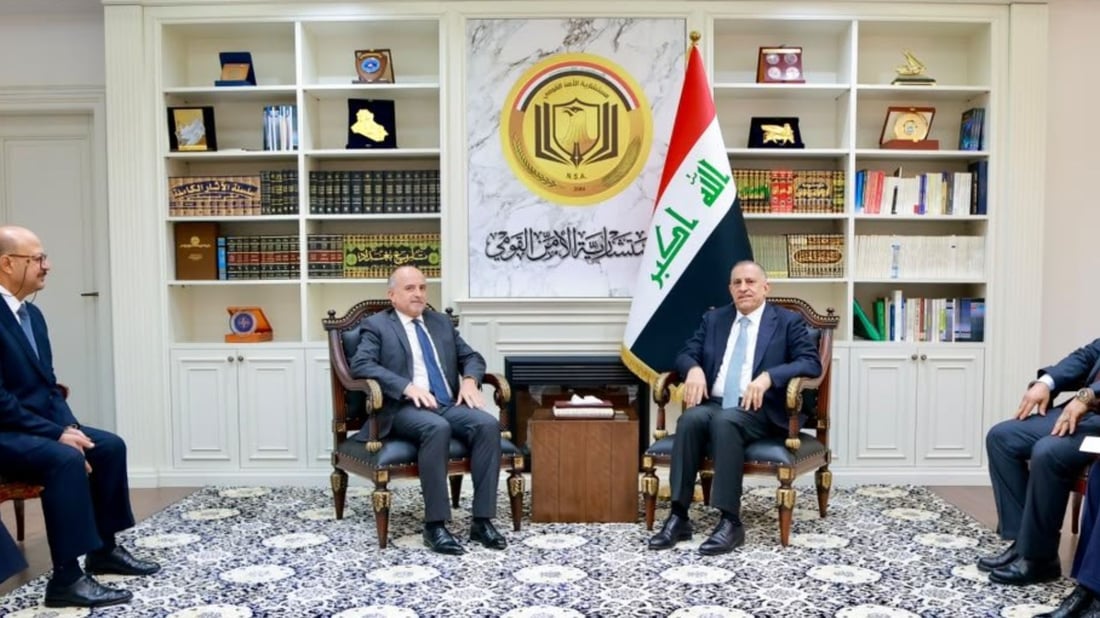
Constitution ‘bars’ armed groups threatening neighbors, Iraq tells French envoy
BAGHDAD — Iraq’s constitution bars armed groups that threaten neighboring countries or any other state, National Security Adviser Qasim al-Aboudi told French Ambassador Alexandre Garcia on Monday, a day after Baghdad said it would soon retake Jurf al-Sakhar from Kataib Hezbollah.
Prime Minister Ali al-Zaidi is pressing ahead with his government’s program to restrict weapons to the state, fight corruption and protect public money, Aboudi said, according to a statement from his office after the two met there.
Garcia, who was named ambassador in September, praised the role of the Iraqi government and the Supreme Judicial Council in completing the investigation of Islamic State group prisoners, the statement said. He also said France supported the Iraqi government’s program.
Baghdad’s Karkh Criminal Court sentenced 10 French nationals for Isis membership in two hearings last month, nine of them to life in prison, which is 20 years under Iraqi law. They were among 47 French defendants Iraq received from prisons in northeast Syria, the judicial council said.
Justice Minister Khalid Shwani told Garcia on Sunday that Iraq wanted to sign a memorandum of understanding with France on transferring convicted prisoners between the two countries, the Justice Ministry said.
“Relations with France are historic, and we look forward to continued cooperation and partnership in all fields, particularly economy and investment, as well as arms,” Aboudi told the ambassador.
France agreed in September to keep military cooperation with Iraq going after the U.S.-led coalition’s mission ended, and Iraq’s Defense Ministry signed a letter of intent with the French company Harmattan AI on air defense systems.
“The security situation in the region has had a negative impact on the world and caused economic crises, especially in the field of energy,” Aboudi said. He called for support for dialogue and diplomacy to bring lasting stability.
Iraq had fought terrorism on behalf of the world and now had wide capability and expertise in counterterrorism, Aboudi said, adding that it was ready to cooperate with the international community in the field.
On Sunday, government spokesperson Haider al-Aboudi said security forces would soon retake Jurf al-Sakhar, an area in northern Babil governorate officially renamed Jurf al-Nasr in 2014. He named Kataib Hezbollah as the party behind oil smuggling there, saying three branches of the Basra-Haditha pipeline run through the area. The faction denied smuggling oil and said a plant in the area improved the quality of fuel for its vehicles.
Qasim al-Aboudi told the Meri Forum, the Middle East Research Institute’s annual conference in Erbil, on Oct. 13 that Iraq would not let its territory be used for attacks on neighboring countries or by armed opposition groups targeting them. He said military decisions must rest with the commander-in-chief alone.
Kataib Hezbollah and Harakat al-Nujaba have refused to hand over their weapons under Zaidi’s timetable. The plan set a 90-day suspension of attacks from Sept. 30, the day the coalition’s mission ended, followed by a six-month handover to the state ending June 30, 2027. Some factions taking part had begun returning weapons stored in one another’s depots so they would not be answerable for arsenals belonging to groups that refuse, sources told 964media on Nov. 10.