
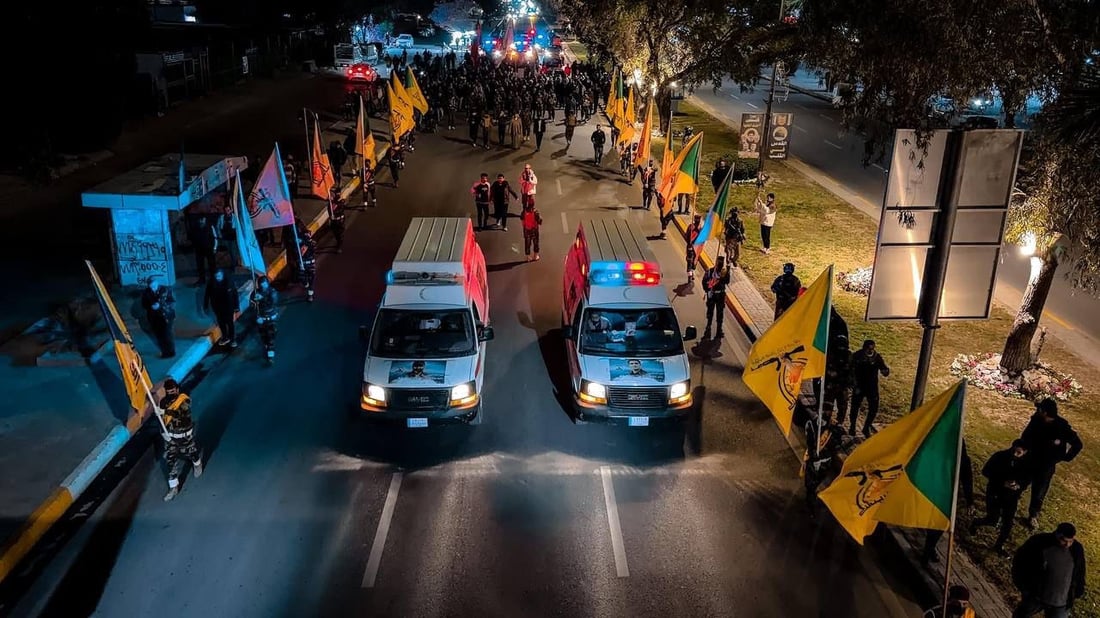
FILES: Supporters of Kataib Hezbollah carry flags and march during a funeral procession in Baghdad for two fighters killed in airstrikes on Jurf al-Sakher, Feb. 28, 2026.
Kataib Hezbollah denies Jurf al-Sakhar oil smuggling, accuses Iraq PM
BAGHDAD — The Iran-aligned faction Kataib Hezbollah on Sunday denied smuggling oil in Babil’s Jurf al-Sakhar and accused Prime Minister Ali al-Zaidi of breaking his pledge to it and his office of spreading “fabricated reports” about the area.
The statement came a day after Zaidi relieved nine security and oil officials of their duties and ordered everyone accused of oil smuggling in Jurf al-Sakhar referred to the courts. His inquiry had confirmed information in a Federal Intelligence and Investigations Agency report on oil smuggling and the existence of oil refineries, and found cases of manipulation, Sabah al-Numan, spokesperson for the commander-in-chief of the armed forces, said Saturday. That statement did not mention Kataib Hezbollah, which is widely regarded as controlling the area, or say who ran the smuggling.
“Despite our entry into negotiations on regulating weapons and signing the sovereignty agreement with members of the Framework and the government, its head broke his pledge,” Kataib Hezbollah said. The Coordination Framework is the ruling alliance of Shiite parties. The statement did not say what the agreement contained.
Zaidi’s office, the faction said, had been “fabricating lies” in reports carried by “Emirati and Saudi channels, some local channels and the hired mouthpieces that followed them.” It called this “the biggest blackmail operation” to make it give up “the weapons of dignity,” its term for its arms.
“The issues of Nasr city and the weapons of the resistance must remain outside the political conflict, and we will not budge from this principle, however much the pressure from the UAE, Saudi Arabia and the Americans grows through Zaidi’s government,” the statement said, using the faction’s name for Jurf al-Sakhar.
The committee that entered the area “found no tampering with the oil pipelines passing through it, which proves conclusively that the smuggling claims are lies,” Kataib Hezbollah said. All that was documented in photos and on site, it said, was “fuel tanks and a simple plant, of which there are hundreds like it in Iraq, that works to improve quality.”
The plant supplies military vehicles, heavy machinery, diesel generators and war machines, the faction said. It said the plant makes up for “shortfalls during crises or shortages of the fuel received from the Popular Mobilization Forces” for “a sensitive military sector stretching from northern Babil to al-Qaim on the Iraqi-Syrian border.”
“We did not hide the plant’s tanks from the committee. They were, and still are, exposed and close to the roads used by visitors and the security agencies, and they are more than 5,000 meters from the oil pipeline in the city,” the statement said. It also said some media, “a number of which are supposed to be friendly,” had published “fabricated pictures of a fuel basin” and claimed they came from the committee.
The state-owned Oil Pipelines Company said Sunday that its director general’s on-camera remark during the inspection, that the pipes in Jurf al-Sakhar had no problem, covered only the 200 to 300 meters he inspected. The pipe there runs for about 5,100 meters, the company said.
Sources told 964media that the committee visited only sites agreed in advance, under a deal that put a Popular Mobilization Commission official in the chair after Kataib Hezbollah refused to let Zaidi’s first committee in. The commission is the state body that runs the PMF. Babil Governor Ali Turki, who said Thursday that he had resigned over the case, said Tuesday that the site named in the intelligence report was an old fuel station used to fuel Federal Police and PMF vehicles.
Kataib Hezbollah said it hoped the judiciary would “do justice to those hit by the penalties because the committee’s report refuted the accusations and did not go along with some people’s inclinations.” The government has not named the nine officials.
The faction renewed its demand for “a serious investigation into the corruption cases of soldiers’ food, ration card items and the partnership contract with Adnoc,” the UAE’s state oil company. Iraq’s ration card is its public food distribution system.
In a Nov. 3 statement, the group’s security official, Abu Mujahid al-Assaf, said Iraq’s ruling alliances had approved the country’s part in a blockade of Iran. He also asked Framework leaders about what he called contracts to sell oil to Adnoc at a $47-a-barrel discount. Assaf gave no evidence for either claim. 964media found no response from the prime minister’s office to Sunday’s statement by Sunday evening.
The intelligence report began circulating Monday. It alleges that oil is drawn from a pipeline in Jurf al-Sakhar through an unauthorized opening and carried away in tanker trucks. The Federal Intelligence and Investigations Agency, an Interior Ministry body, was one of five bodies Zaidi named Wednesday to carry out the inquiry.
A parliamentary inquiry made up of members of seven committees questioned Oil Minister Basim al-Abadi on Sunday and will host the interior and defense ministers on Monday, Taha al-Difai, head of parliament’s Integrity Committee, told the state-run Iraqi News Agency.
The government’s plan for the factions calls for a 90-day halt to attacks from Sept. 30, followed by a six-month handover of weapons ending June 30, 2027. Kataib Hezbollah and Harakat al-Nujaba have refused to hand over their weapons. The PMF is the state-sanctioned umbrella of mostly Shiite armed groups formed in 2014 to fight the Islamic State group. Kataib Hezbollah has brigades in the PMF, and the United States designated it a terrorist organization in 2009.
Jurf al-Sakhar, in northern Babil, was officially renamed Jurf al-Nasr in 2014 after Iraqi forces and allied armed groups recaptured it from Isis. It has been closed since then, and many of its displaced residents still cannot return.