
Sites pre-agreed
Iraqi PM let PMF official lead Jurf al-Sakhar probe after deal, sources say
BAGHDAD — Prime Minister Ali al-Zaidi let a Popular Mobilization Forces security official take over the inquiry into suspected oil smuggling in Jurf al-Sakhar after Kataib Hezbollah refused to let his first committee in, sources told 964media.
Under the deal, reached with PMF Chief of Staff Abdul Aziz al-Muhammadawi, the committee was enlarged, and open inspections gave way to visits to sites agreed in advance, the sources said. Investigators found small installations that looked like oil facilities but could not establish for themselves what they were used for.
The first committee was chaired by Lt. Gen. Saad Mohsen Uraibi, secretary of the Office of the Commander-in-Chief of the Armed Forces, and was made up of senior officers and security officials, one source said. Its plan gave it freedom of movement inside Jurf al-Sakhar. It was to visit and examine on its own every site named in the intelligence report behind the inquiry, and to audit fuel records and related documents.
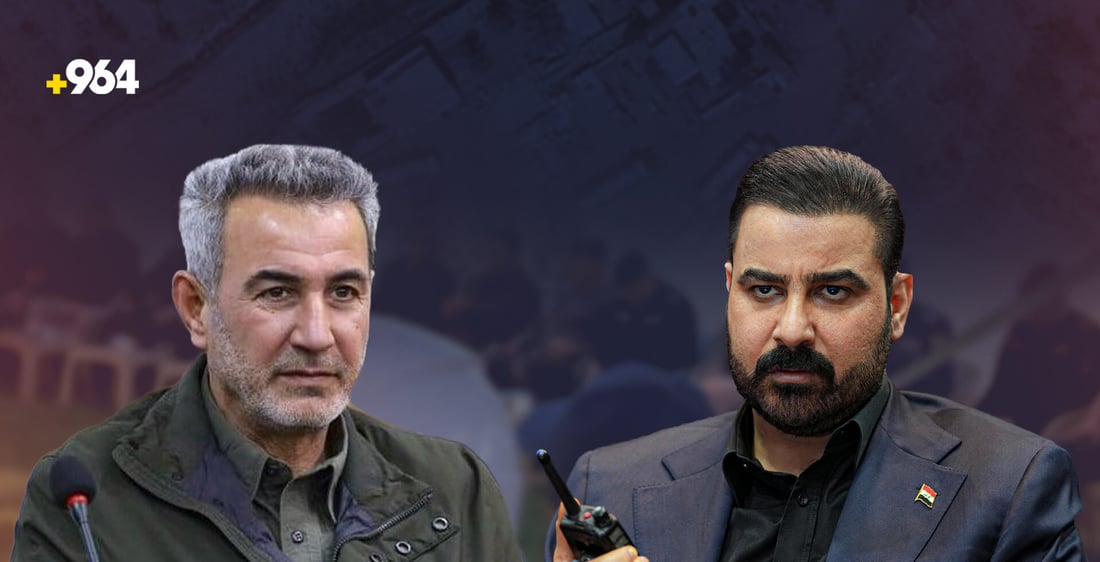
Kataib Hezbollah refused to let that committee enter, the source said. Zaidi then met Muhammadawi, known as Abu Fadak, in Baghdad. The two agreed to hand the chair to Ali Mayah al-Zaidi, the director general of discipline and security at the Popular Mobilization Commission, the state body that runs the PMF.
In return, the prime minister set conditions, the source said. The main ones were more participating bodies and representatives of lower military and administrative rank than on the first committee.
When Zaidi ordered the inquiry Wednesday, he named five bodies to carry it out: the Federal Police, the Energy Police, the Federal Commission of Integrity, the Federal Intelligence and Investigations Agency and the PMF Commission. A document dated Thursday lists 11 members and puts the PMF Commission’s director general of discipline and security in the chair.
The PMF is the state-sanctioned umbrella of mostly Shiite armed groups formed in 2014 to fight the Islamic State group.
After the meeting, Muhammadawi coordinated the committee’s entry into Jurf al-Sakhar under a new formula, the source said. The sites the committee would visit were fixed beforehand. It could no longer move freely between all the locations named in the intelligence report.
The source suggested that the wider membership may have been meant to make up for the PMF taking the chair, and to let as many state institutions as possible see what goes on inside Jurf al-Sakhar. Zaidi rejected a PMF proposal that the committee submit only one main report, with no reports from its members, the source said.
A second source said the advance agreement fixed which sites would be visited. Kataib Hezbollah also refused to let investigators interview PMF personnel and workers near those sites, the source said, and that limited their chances of getting first-hand accounts of what happens there.
The committee spent several hours inside the area, the second source said. It reviewed tanker movements and fuel supply records, which were presented to it as routine activity, and collected physical evidence. It could not visit every site the intelligence report named.
The committee found violations that it will record in its final report and inspected small, clearly visible installations resembling oil facilities, the source said. “However, the information it received about the nature of these facilities and the purposes they are used for was general,” the source said. The committee could not check that information itself or establish for certain what goes on inside them.
Each member will send a separate report on what they saw to their own institution, alongside the joint report, the source said. That lets more than one government and security body see the findings even though the PMF chairs the committee.
The committee is writing its final report at the commander-in-chief’s office, and the report will record the violations it found despite the limits on its inspection, the source said. The source expected the report to open the way to further government action in Jurf al-Sakhar but did not say what that would be or when it would start.
On Thursday, the prime minister’s media office said Zaidi had met Muhammadawi, Badr Organization leader Hadi al-Amiri and PMF Commission Chairman Falih al-Fayyadh to discuss coordination among security agencies. The statement did not mention Jurf al-Sakhar. The sources did not say whether the deal was reached at that meeting. The committee entered Jurf al-Sakhar under a large military escort Friday.
The U.S. State Department designated Muhammadawi in 2021 and described him as a former secretary-general of Kataib Hezbollah. The Iran-aligned faction has brigades in the PMF and is widely regarded as controlling Jurf al-Sakhar.
Jurf al-Sakhar, in northern Babil, was officially renamed Jurf al-Nasr in 2014 after Iraqi forces and allied armed groups recaptured it from Isis. It has been closed since then, and many of its displaced residents still cannot return.
The intelligence report began circulating Monday. It alleges that oil is drawn from a pipeline in Jurf al-Sakhar through an unauthorized opening and carried away in tanker trucks. 964media could not verify the report or confirm which agency prepared it.
Babil Governor Ali Turki rejected the allegations Tuesday, then said Thursday that he had resigned over the case. A source told 964media he quit under pressure from Qais al-Khazali, leader of the Iran-aligned faction Asaib Ahl al-Haq. Parliament Speaker Haibat al-Halbousi has ordered a separate committee of lawmakers to look into the report. Neither committee has announced findings.