
(Photo: 964media)
Speed alone does not decide the race as Iraqi horses compete in Mosul
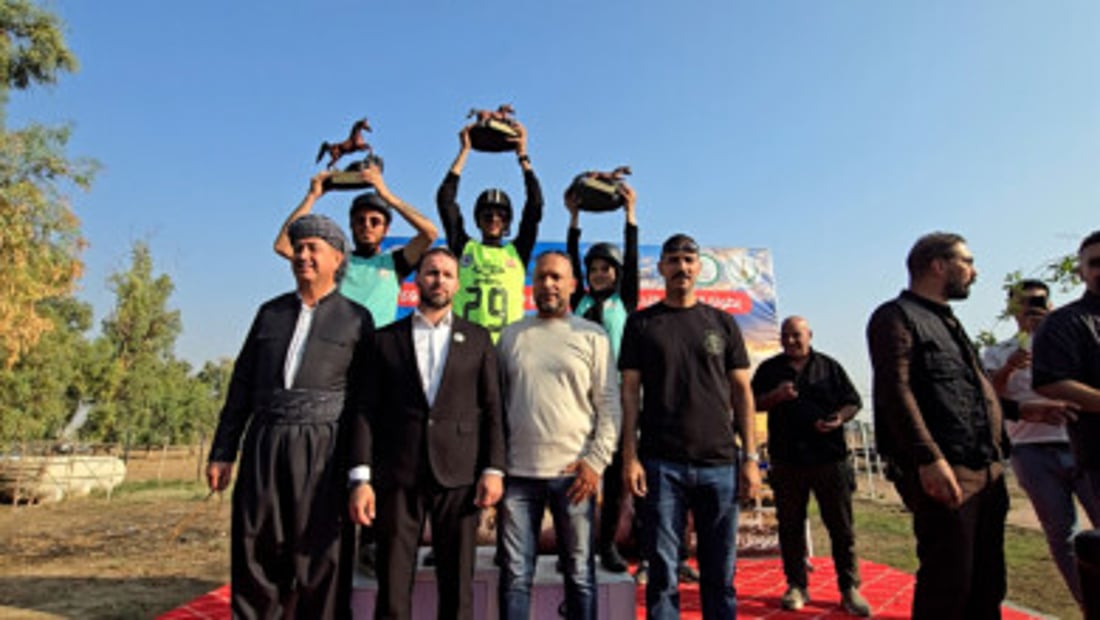
NINEVEH — Mosul Equestrian Club rider Hamid Riyadh won a 60-kilometer horse endurance race in Mosul’s Shallalat area, where riders from Nineveh, Basra, Salah al-Din and Erbil were scored by an electronic system that tracks horses’ vital signs.
The Mosul Equestrian Club hosted the race under the supervision of the Iraqi Equestrian Federation, the second endurance event the federation has overseen at the club. Riders came from clubs and academies in the four governorates.
“The competition included 43 participants, with the course divided into three stages of 20 kilometers each and a speed limit of 18 kilometers per hour,” Jihad al-Nuaimi, the club’s director and the race organizer, told 964media.
After each stage, riders had 20 minutes to cool and rest their horses before veterinary checks, Nuaimi said. The leaders were decided by their arrival times and by passing those checks.
“Since Mosul’s liberation, we have held four endurance competitions, but this is the second one organized under the sponsorship and supervision of the Iraqi Equestrian Federation,” he said. Iraqi forces retook the city from the Islamic State group in 2017.
The electronic system, used in international endurance racing, records each horse’s data and ranks riders on points, veterinarian Saad al-Hilali said.
“The system’s server is located outside Iraq and requires staff to operate it. Data is entered for each horse, including arrival and departure times, heart rate and the time required for cooling and inspection,” Hilali told 964media. He said the system could be developed into an Iraqi-made platform using newer technology.
Vets check each horse’s heart rate, skin, back and intestines and watch how it moves. A one-minute trotting test checks for lameness, and lame horses are disqualified.
“The maximum heart rate is set at 64 beats per minute. If the rate is higher, the horse is given a second opportunity to cool down and rest before another examination, but this did not occur during the race,” Hilali said. The 64-beat ceiling is the standard limit in international endurance rules.
Judges and the veterinary committee took a training course a few days before the race. “We previously held a training course for judges and the veterinary inspection committee a few days before the competition, during which we applied international regulations,” Hilali said.
Riyadh told 964media it was his second win of the year. “I previously won first place in Basra this year, and today I achieved it for the second time in my hometown of Mosul. The competition was successful and well organized,” he said.
Tabarak Abdul Hussein, a rider from the Bayt al-Mulla Academy in Basra, finished third. “This is my first participation in Mosul, and I came from Bayt al-Mulla Academy in Basra. The judging was very fair, and I was impressed by the racecourse and the rest and cooling stations,” she told 964media. She said she had won a similar race in Basra and finished second in Erbil.
The Shallalat area hosted its first horse race, an 1,800-meter event for 14 riders from across Nineveh, in October 2025.
Iraqi horses have been barred from international competition since the early 1990s, a ban tied to the sanctions imposed after Iraq’s 1990 invasion of Kuwait and to outbreaks of glanders, a contagious horse disease. Nineveh’s agriculture directorate began registering horses as a step toward lifting the restrictions in late 2025.