
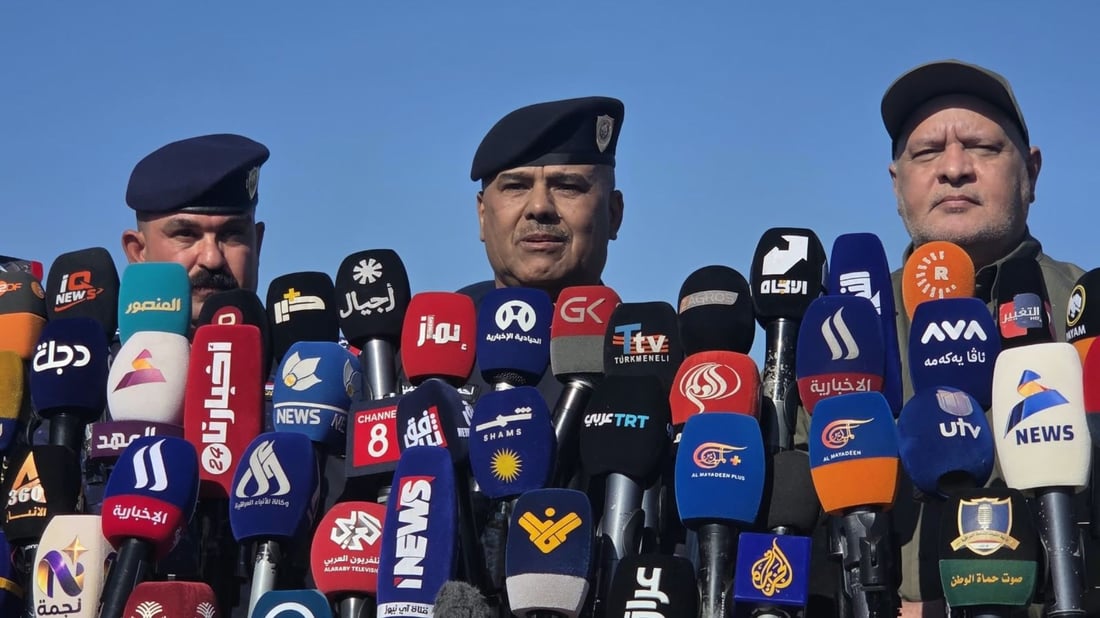
Iraqi security officials address reporters during a joint news conference in Jurf al-Sakhar, Babil governorate, on Nov. 20, 2026, announcing the start of a phased security redeployment and the activation of a new joint command.
New command takes Jurf al-Sakhar as forces swap and Karbala road reopens
BABIL — Iraq began replacing the Kataib Hezbollah brigades that hold Jurf al-Sakhar on Friday, as a new joint command took charge and the Energy Police said it now fully controls the oil pipeline through the area.
All security units in the northern Babil area, officially renamed Jurf al-Nasr in 2014, will be replaced on a timetable over the coming days, the Interior Ministry said. The aim is for the state to take over security and bring normal life back, it said.
The Federal Police, which leads the new command, said it had finished preparing the headquarters two days earlier and that its units and supplies were ready to run the sector.
At a joint news conference inside Jurf al-Sakhar on Friday morning, Lt. Gen. Saad Maan, head of the Security Media Cell, said the Energy Police had taken over the pipeline and that the replacement of units and the redeployment would begin that day. Lt. Gen. Ahmed Hatem Hamid, the command’s chief, said the same.
Sabah al-Numan, spokesperson for the commander-in-chief of the armed forces, called the handover a “historic moment.” He said Prime Minister Ali al-Zaidi had given the command’s chief full powers to impose security in the area, and that services and development projects would follow.
Maan said the road from Fadhiliya toward Karbala would reopen at 6 a.m. Saturday, to civilian vehicles at first. Trucks will stay barred, officials said. Maan also said Jurf al-Sakhar’s displaced residents would return to their homes soon, without giving a date.
The Energy Police said it had been guarding 95 kilometers of a 100-kilometer pipeline corridor running from Valve 442 toward Dora. The other 5 kilometers lie inside Jurf al-Sakhar. A police commando regiment sent on the orders of the commander-in-chief’s office and the interior minister has arrived, scouted the area Thursday and now holds the whole corridor, it said.
Photos obtained by 964media on Friday morning showed the PMF’s 72nd Brigade and Federal Police units on the edge of Jurf al-Sakhar, waiting to move in after the news conference. Army Chief of Staff Gen. Abdul Amir Rashid Yarallah also arrived with senior officers to oversee the redeployment and the replacement of the units holding the area, the Defense Ministry said.
Yasser al-Issawi, the Popular Mobilization Forces’ deputy chief of staff for operations, told the news conference that the 45th, 46th and 47th brigades were an inseparable part of the PMF and obeyed the commander-in-chief. The three are Kataib Hezbollah’s units in Jurf al-Sakhar. He said he hoped the handover would “silence all the voices that wanted to stir up strife among all the brothers.”
None of the speakers said where the three brigades would go or when the handover would be complete.
Numan had said Thursday night that the faction would leave. “Kataib Hezbollah will withdraw from Jurf, and this is a normal process of replacing security units, as happens in other armies,” he told Al-Hadath television, according to a translation of his Arabic remarks.
He said a reconnaissance force from the new units had already inspected its positions, that Zaidi would personally oversee the deployment and that all roads would be reopened once the units held the ground. Displaced residents would be allowed back after security vetting, he said.
Zaidi met Defense Minister Nayef al-Shammari, Interior Minister Yasser al-Maliki and PMF Chairman Falih al-Fayyadh late Thursday to review preparations for the handover, his media office said. He urged commanders to act professionally and protect residents and their property.
The faction had spoken with two voices the day before. In a statement Thursday by Kataib Hezbollah Secretary-General Abu Hussein al-Hamidawi, read out in Jurf al-Sakhar, he said differences with Zaidi would be handled through private channels and told his fighters to return to their duties as they had been before the alert. It followed consultations with Iran’s Quds Force commander Esmail Qaani, Badr Organization leader Hadi al-Amiri and Fayyadh.
Before the statement was read, senior faction figure Abu Talib al-Saeedi said in a speech there that the faction would not leave. “Kataib Hezbollah’s exit will be over their bodies,” he said, addressing what he called “the deluded sitting in the Green Zone,” the Baghdad district that houses the government. “You will leave for London, Dubai and Paris, and we will remain in Jurf al-Sakhar.”
“Anyone who thinks of taking a single bullet is in fact taking it from the families of the martyrs,” Saeedi said, adding that the faction had lost 200 fighters killed and 850 wounded in the area.
Footage obtained by 964media showed Kataib Hezbollah fighters firing heavily, some with anti-aircraft guns, as supporters chanted after the statement was read.
Later that evening, the PMF announced that its Operations Command would begin replacing the units in Jurf al-Sakhar on Friday morning. Under a plan Zaidi approved Wednesday, the area is divided among the army’s 38th Brigade, the Federal Police’s 17th Brigade and the PMF’s 72nd and 79th brigades, with an Energy Police regiment guarding the pipelines. The plan also reopens the road from Musayyib to Amiriyat al-Fallujah through Bahbahani and Fadhiliya, which has been under security restrictions for years.
The government is also preparing to look into what the area holds, a senior government official told 964media Thursday. Zaidi wants to “bring what is in Jurf out into the open,” not just replace the force that holds it, the official said.
The official said land and farm contracts changed while residents were away would be reviewed, and a committee would check reports of missing people and of unofficial detention sites. Defence Industries Commission experts, Environment Ministry teams and mine-clearance crews are to inspect old military sites, some from Saddam Hussein’s rule.
The authorities’ list of missing people does not mean those people are in Jurf al-Sakhar, and reports of secret prisons are not proof on their own, the official said. The UN Committee on Enforced Disappearances said in 2023 that it had received allegations of secret detention sites, including in Jurf al-Sakhar, which it could not verify; the Iraqi government denied running any.
Former Babil Gov. Ali Turki, who resigned last week after denying that oil was being smuggled from the area, said Thursday that he had been forced out. “Just 30 minutes after the video was posted, an order came that I must resign,” he told the Al-Etejah channel, referring to footage of his Nov. 10 visit to Jurf al-Sakhar. He would not say who gave the order.
A source told 964media at the time that Turki quit under pressure from Asaib Ahl al-Haq leader Qais al-Khazali.
The standoff began after an Interior Ministry intelligence report began circulating Nov. 9, alleging that oil was being drawn from pipelines in Jurf al-Sakhar and carried away in tanker trucks. Zaidi dismissed nine security and oil officials after a government investigation reported tampering with the pipelines and two refineries in the area. On Thursday, a source told 964media that authorities had arrested Ali Abdul Karim al-Mousawi, the dismissed director general of the state-owned Oil Pipelines Company.
Kataib Hezbollah denies smuggling oil and has accused Zaidi’s office of circulating fabricated reports.
Iraqi forces and allied armed groups recaptured Jurf al-Sakhar from the Islamic State group in 2014. It has been closed since, and many of its displaced residents have been unable to return.