
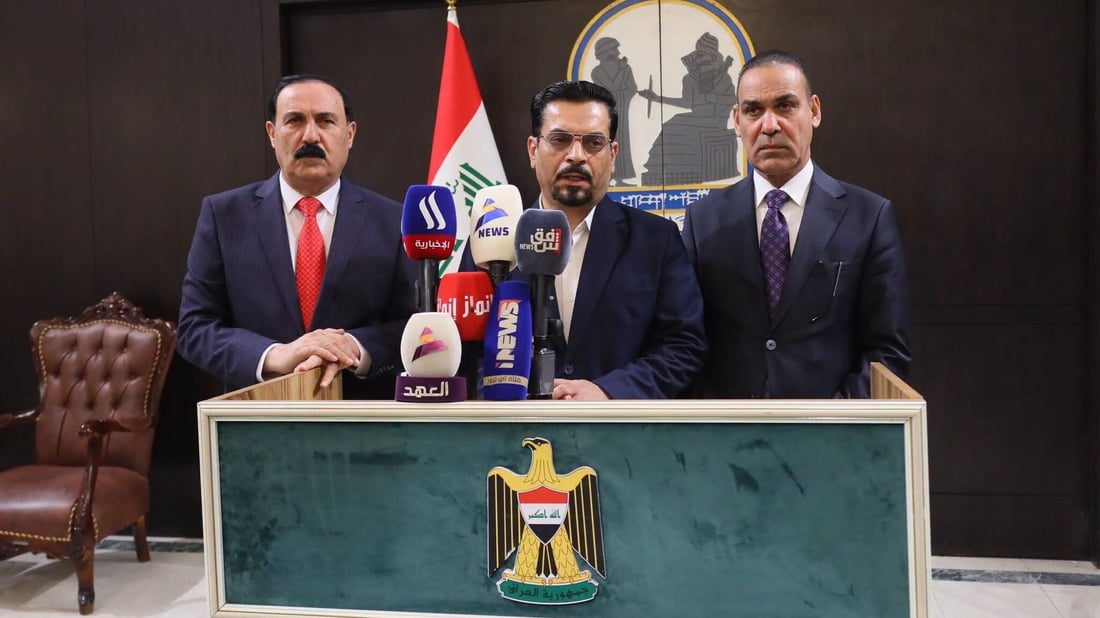
Babil council elects Asaib candidate for governor after Jurf al-Sakhar row
BABIL — The Babil Provincial Council accepted the resignation of Gov. Ali Turki late Tuesday and elected Mahdi al-Ardawi, another Asaib Ahl al-Haq candidate, to replace him, days after Turki quit over the Jurf al-Sakhar oil-smuggling case.
Both votes passed by an absolute majority at an extraordinary session. A council source had said Monday that no formal resignation letter had reached the council and that Turki was still legally in office.
Turki announced his resignation Thursday. A source told 964media at the time that he quit under pressure from Asaib leader Qais al-Khazali, who was angered when the governor publicly denied that oil was being smuggled from Jurf al-Sakhar and rejected a government intelligence report on it.
On Monday, Turki posted a message thanking Babil’s residents, provincial staff and security and service personnel “for all the days you allowed us to be in your service.” The message appeared to signal that he was leaving office.
Turki, a former lawmaker, was elected governor by the council in January as the candidate of Sadiqoun, Asaib’s political wing. Asaib is an Iran-aligned armed faction with brigades in the Popular Mobilization Forces, the state-sanctioned umbrella of mostly Shiite armed groups formed in 2014 to fight the Islamic State group.
The case began Nov. 9, when a report attributed to the Interior Ministry’s Federal Intelligence and Investigations Agency began circulating in the media. Citing satellite images from 2021 to 2026, it alleged that oil was being drawn from pipelines in Jurf al-Sakhar and carried away in tanker trucks holding 36,000 liters each. Jurf al-Sakhar is a closed area in northern Babil that was officially renamed Jurf al-Nasr in 2014.
The next day, Turki took journalists on an unannounced visit to the site named in the report. He said it was an old fuel station called al-Madina al-Munawwara, which had been used officially for about four years to fuel Federal Police and PMF vehicles, and that checks had found no irregularities on nearby pipelines.
Security expert Sarmad al-Bayati disputed that account Nov. 11 in an interview with presenter Yasser Amer. He said the report was genuine, had been prepared by professional officers and had been submitted three months earlier.
Prime Minister Ali al-Zaidi ordered an inquiry the same day, and his 11-member committee entered Jurf al-Sakhar under heavy military escort Friday. On Saturday, Zaidi relieved nine security and oil officials, among them Babil’s police chief, the PMF commander in Babil and the director of the Oil Ministry’s Oil Pipelines Company. He also ordered everyone accused of the smuggling referred to the courts.
Government spokesperson Haider al-Aboudi on Sunday named Kataib Hezbollah as the party behind the smuggling. The Iran-aligned faction is widely regarded as controlling Jurf al-Sakhar.
On Monday, Aboudi said the committee had found tampering with pipelines at six sites and attempts to bury its traces, along with two refineries, a tanker and storage tanks. He said Zaidi had ordered the armed forces into the area and given the faction a short deadline to leave. He did not say when the deadline expires.
Kataib Hezbollah denied the allegations Sunday and accused Zaidi’s office of spreading “fabricated reports.” On Tuesday, senior Kataib Hezbollah figure Abu Talib al-Saeedi held a news conference inside Jurf al-Sakhar in front of what he called a “primitive plant.” He said it had been abandoned for months and was about 5 kilometers from the pipelines. Saeedi also told AFP the faction would not leave the area.
Hours later, Ali al-Hamdani, the PMF’s commander of Middle Euphrates operations, said Kataib Hezbollah was ready to let the Energy Police guard the pipelines crossing the area. The Energy Police is the Interior Ministry force that guards oil and power sites.
A separate parliamentary inquiry set up by Parliament Speaker Haibat al-Halbousi has reviewed documents and drone footage showing that about 25 tanker trucks were used in the smuggling, committee member Ali Anhair said Monday. Together the trucks could carry about 900,000 liters, or roughly 5,700 barrels, in one load.
At a meeting Monday, leaders of the Coordination Framework, the ruling alliance of Shiite parties, turned down Zaidi’s plan to send combat forces into Jurf al-Sakhar, a source in the alliance told 964media. They proposed instead replacing the force that holds the area with other PMF units.
At a news conference in Najaf on Tuesday, Aboudi said the government was determined to “cleanse this place of any party or side tampering with this strategic wealth.”