
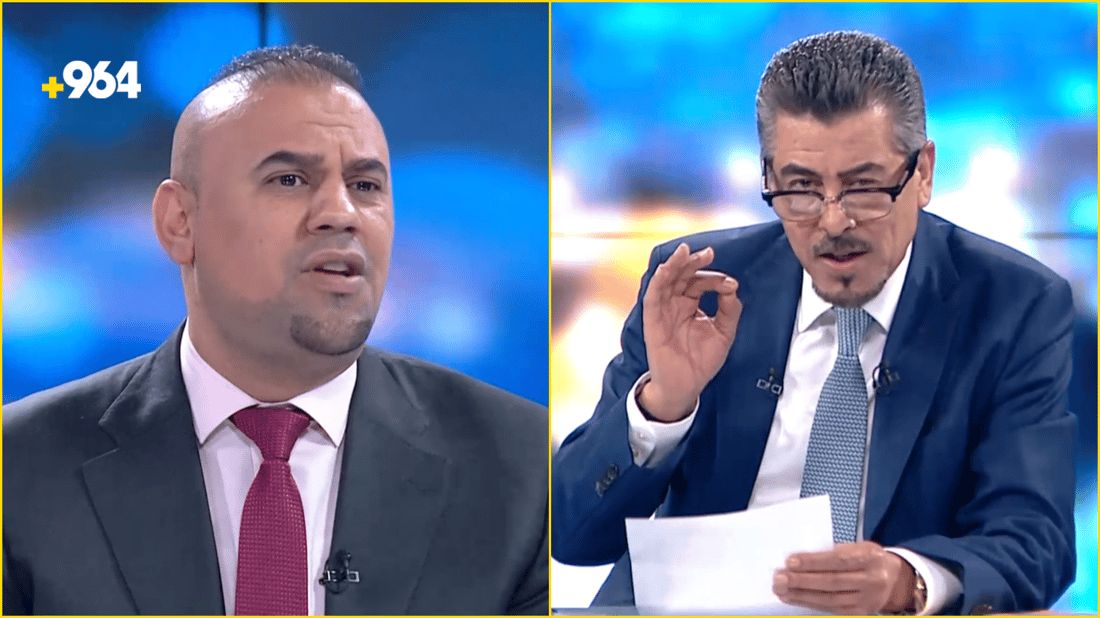
Lawmaker Ali Nuhair al-Saadi, left, speaks with journalist Ahmed Mulla Talal during an interview on UTV about the government investigation into oil smuggling in Jurf al-Sakhar.
Kataib Hezbollah barred probe from 2 Jurf al-Sakhar sites, MP says
BAGHDAD — Kataib Hezbollah barred government investigators from two of the six Jurf al-Sakhar sites they were sent to check, citing planted bombs, and allowed them only one camera, a lawmaker briefed on their findings said late Tuesday.
Ali Nuhair al-Saadi, a member of parliament’s Security and Defense Committee, described the government committee’s findings in an interview with presenter Ahmed Mulla Talal on UTV. He belongs to the Services Alliance, a bloc associated with Kataib al-Imam Ali leader Shibl al-Zaidi.
The committee’s technical report is due to reach parliament Thursday and will probably be discussed in a closed session, Saadi said. “There are some things we do not want the people to see for now, until we reach the truth that everyone hopes for,” he said.
The 11-member committee that Prime Minister Ali al-Zaidi set up to investigate oil smuggling entered Jurf al-Sakhar under a large military escort Friday with six sets of coordinates and no others, Saadi said. Its members told lawmakers they had faced “a lot of harassment” inside the closed area in northern Babil.
Kataib Hezbollah, the Iran-aligned faction widely regarded as controlling the area, told the investigators that explosive devices had been planted at some sites and asked them not to go there, Saadi said. That kept them from two locations. All cameras were barred except one used by the forensic evidence team, he said.
When the investigators checked the checkpoints around Jurf al-Sakhar, most of the cameras had no monthly recordings, and road cameras leading into the area stored only one day of footage, Saadi said.
The committee showed lawmakers footage of dozens of tanker trucks entering the area over nine days, he said. Authorities also had “images from space” and more than 25 advanced Chinese-made reconnaissance drones flying at 5 to 10 kilometers, he said.
Three pipelines from Basra run for 5,200 meters through Jurf al-Sakhar, Saadi said. The committee’s report, as presented to the Security and Defense Committee, found two holes in the pipelines and two refineries in the area, he said.
The refinery where Abu Talib al-Saeedi, a senior Kataib Hezbollah figure, appeared on Tuesday is 5 kilometers from the pipelines, Saadi said. The first investigating committee put its output at 4,000 barrels a day, while the Oil Ministry estimated 1,600, he said. The second refinery, 3.5 kilometers from the pipelines, produces 2,000 barrels a day by the committee’s estimate and 400 by the ministry’s.
Saeedi held a news conference inside Jurf al-Sakhar on Tuesday in front of what he called “a primitive plant,” about 5 kilometers from the pipelines. He said it runs only during fuel shortages and had been idle “for many months.” He accused Zaidi’s investigators of falsifying their findings and told AFP the faction would not leave the area “even over our bodies.”
Government spokesperson Haider al-Aboudi said Monday that Zaidi’s committee had found tampering with pipelines at six sites and attempts to bury the traces, along with two refineries, a tanker and fuel storage tanks.
Saadi, who also sits on parliament’s oil smuggling inquiry, said Monday that drone footage showed about 25 tanker trucks being used to smuggle oil from the area. In the interview, he said the earliest intelligence report on the case dated from early June. It alleged smuggling or unregulated sales, or that someone was supplying diesel to factories and fuel stations near the area, he said.
A Federal Intelligence and Investigations Agency report that began circulating Nov. 9 alleges that oil was drawn from pipelines in Jurf al-Sakhar and carried away in tanker trucks. The agency is part of the Interior Ministry.
Saadi warned that the crisis was “no less dangerous than the 2014 crisis” if it ended in a clash. “All this blood is pure blood, on both sides,” he said.
Zaidi took power as the Coordination Framework’s choice and through a peaceful transfer of power, and his orders as commander-in-chief must apply to everyone, Saadi said. “Whoever wears the military uniform must carry out the orders,” he said.
He said Kataib Hezbollah had resisted those orders. “The brothers in Jurf had some rivalry and haughtiness in dealing with the commander-in-chief’s orders,” he said.
He also called the faction “comrades of the road” who had been “the spearhead” in the battles of late 2014. He said the recapture of Jurf al-Sakhar had been the first victory over the Islamic State group under then-Prime Minister Haider al-Abadi’s government.
“For now we say, God willing, there will be no fighting,” Saadi said, adding that a political solution was possible. The Popular Mobilization Commission, the state body that runs the Popular Mobilization Forces, must play its part, he said. He described its chairman, Falih al-Fayyadh, as shrewd and on good terms with both sides.
Hours before the interview, Ali al-Hamdani, the PMF’s commander of Middle Euphrates operations, offered on the faction’s behalf to let the Interior Ministry’s Energy Police guard the pipelines through Jurf al-Sakhar. He also said the faction would dig along both sides of the pipelines to show they are intact.
Leaders of the Coordination Framework, Iraq’s ruling alliance of Shiite parties, turned down Zaidi’s insistence on combat forces at a meeting Monday evening, a source in the alliance told 964media. They proposed instead that other PMF units replace the force that holds Jurf al-Sakhar. Zaidi has given Kataib Hezbollah a short deadline to leave, but the government has not said when it expires.
Parliament Speaker Haibat al-Halbousi ordered a separate inquiry by lawmakers on Nov. 11. It has identified several smuggling sites in Jurf al-Sakhar and will send lawmakers to Kirkuk, Basra and Nineveh, a member said Tuesday.
Kataib Hezbollah denies smuggling oil and has accused Zaidi’s office of spreading “fabricated reports.” The faction has brigades in the PMF, the state-sanctioned umbrella of mostly Shiite armed groups formed in 2014 to fight Isis.
Jurf al-Sakhar was officially renamed Jurf al-Nasr in 2014 after Iraqi forces and allied armed groups recaptured it from Isis. It has been closed since then, and many of its displaced residents still cannot return.