
Kataib Hezbollah offers police control of Jurf al-Sakhar pipelines, PMF says
BABIL — Kataib Hezbollah is ready to let Iraq’s Energy Police guard the oil pipelines that cross Jurf al-Sakhar and to dig along them to show they are intact, a Popular Mobilization Forces commander said Tuesday.
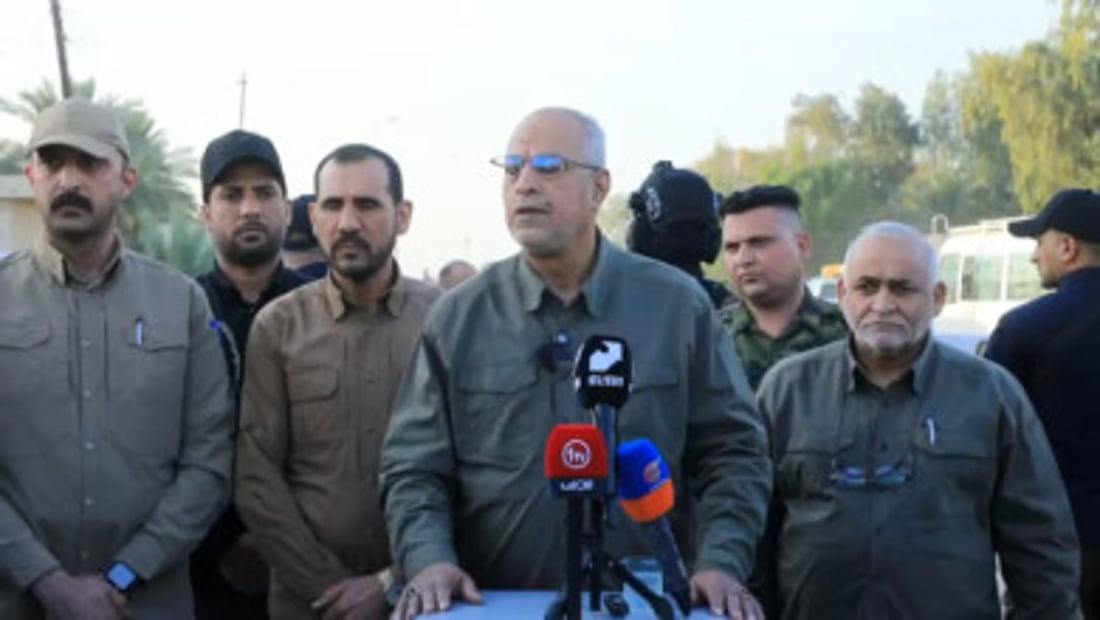
Ali al-Hamdani, commander of Middle Euphrates operations for the PMF, made the offer at a news conference in Jurf al-Sakhar. He spoke hours after a senior Kataib Hezbollah figure said the faction would not leave. The government has given the Iran-aligned faction a deadline to leave the northern Babil area altogether.
Hamdani said the faction was fully prepared for Energy Police regiments to be sent in “to hold the pipelines from where they first enter the Jurf sector to the end.” Kataib Hezbollah would also dig along both sides of the pipelines throughout the area to show they are intact, he said.
The Energy Police is the Interior Ministry force that guards oil and power sites. The commander of its 6th Brigade was among nine security and oil officials relieved Saturday by Prime Minister Ali al-Zaidi over the findings of his oil smuggling inquiry.
That inquiry found tampering with pipelines at six sites in Jurf al-Sakhar, along with attempts to hide the damage by burying its traces, government spokesperson Haider al-Aboudi said Monday. 964media found no government response to Hamdani’s offer by Tuesday evening.
Hamdani said the PMF and the security forces had fought side by side. “All the security agencies are brothers who love one another. We fought together with the army, the police, the Federal Police and the Counter-Terrorism Service, starting from this place until the day of the great victory,” he said.
Iraqi forces and allied armed groups retook Jurf al-Sakhar from the Islamic State group in 2014, and Iraq declared victory over the group in December 2017.
Earlier Tuesday, Abu Talib al-Saeedi, a senior Kataib Hezbollah figure, told AFP the faction would not leave Jurf al-Sakhar despite the government’s deadline, though he said there would be no fighting with the troops Zaidi has ordered in. He told the French news agency that “the dream they are dreaming, that the Kataib withdraw from Jurf al-Sakhar, will not come true, even over our bodies, our blood, our legacy, our wounded and our martyrs.”
The government said Monday that Zaidi had ordered the armed forces into Jurf al-Sakhar and given the faction a short deadline to leave. It has not said when the deadline expires. Abdul Amir Taiban, an adviser to Zaidi, told Dijlah TV on Monday that there would be no retreat from the decision to take control of the area.
The Coordination Framework, Iraq’s ruling alliance of Shiite parties, on Monday turned down Zaidi’s insistence on sending combat forces into Jurf al-Sakhar. It agreed instead to replace the armed force that holds the area, a source in the alliance told 964media.
The standoff began with a Federal Intelligence and Investigations Agency report that began circulating Nov. 9. The report alleges that oil was drawn from a pipeline in Jurf al-Sakhar through an unauthorized opening and carried away in tanker trucks holding 36,000 liters each. The agency is part of the Interior Ministry. Kataib Hezbollah has denied smuggling oil.
The PMF is the state-sanctioned umbrella of mostly Shiite armed groups formed in 2014 to fight Isis. Kataib Hezbollah has brigades in the PMF, and the United States designated it a terrorist organization in 2009. Jurf al-Sakhar was officially renamed Jurf al-Nasr in 2014 after its recapture. It has been closed since then, and many of its displaced residents still cannot return.