
Iraq won’t back down on Jurf al-Sakhar, PM adviser warns Kataib Hezbollah
BAGHDAD — An adviser to Prime Minister Ali al-Zaidi on Monday warned Kataib Hezbollah not to fight the forces ordered into Jurf al-Sakhar, after the faction answered a government deadline to leave with images of armed fighters and rocket workshops.
There would be no retreat from the decision to take control of the northern Babil area, whatever the sacrifices or losses, Abdul Amir Taiban told Dijlah TV. Security forces would take over the area and raise the Iraqi flag there, he said.
Taiban said the Counter-Terrorism Service, the army, the Federal Police and special units were ready for any confrontation. Killing a soldier or any other member of the security forces would mean killing the people, he said.
He called Kataib Hezbollah an ideological, religious group whose beliefs forbid shedding Iraqi blood or taking public money, and he urged its members to put Iraq’s interests first. The state was not targeting the faction or any other group, he said, and Zaidi had the backing of the people and of Iraq’s tribes.
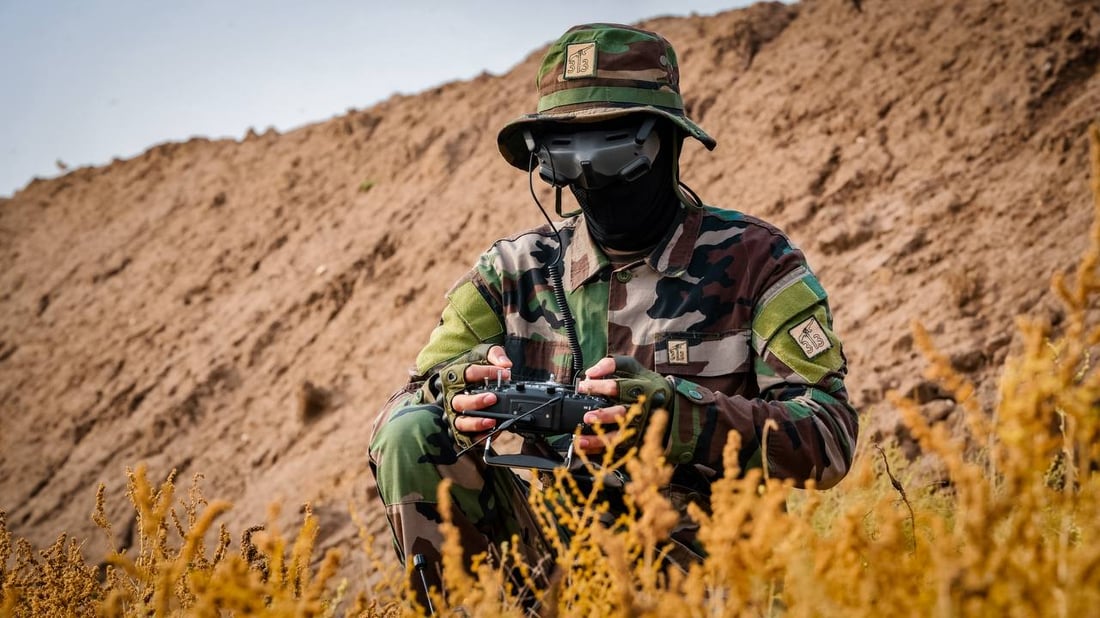
Earlier Monday, Kataib Hezbollah posted photographs on Telegram of its fighters in military uniforms under the caption “Our weapons are a right and will remain in the hands of our mujahideen.” Kaf, a Telegram channel linked to the faction, then released a video of fighters assembling rockets in workshops at undisclosed locations.
The posts came on the same day Iraq’s Communications and Media Commission ordered Telegram blocked across the country and gave the platform’s operator 30 days to settle its legal status.
Government spokesperson Haider al-Aboudi said Monday that Zaidi had ordered the armed forces into Jurf al-Sakhar and given the faction a deadline that “is not far off.” He did not say when it expires. The newspaper Al-Mada reported Monday, citing leaks, that the faction has until Friday. 964media has found no government statement setting a date.
The Coordination Framework, Iraq’s ruling alliance of Shiite parties, met with Zaidi on Monday evening at the office of Humam Hammoudi, head of the Islamic Supreme Council of Iraq. The alliance’s statement afterward did not mention Jurf al-Sakhar or announce any decision. A source in the alliance told 964media that the meeting discussed the standoff along with the federal budget.
Sources cited by 964’s Kurdish-language service said the meeting ended without agreement after heated exchanges over sending forces toward the area.
After the meeting, Hisham al-Rikabi, head of former Prime Minister Nouri al-Maliki’s media office, called for talks. “Our position is clear: We call for resolving the problem through understanding and dialogue in a way that protects the national wealth and safeguards Iraq’s interests,” he wrote on X. Nouri al-Maliki leads the State of Law Coalition, part of the Framework.
Rikabi’s post rejected any smuggling of oil or tampering with it and said anyone proven to be involved should bear responsibility. It also rejected letting the crisis slide into an armed confrontation. “The two sides are our brothers, and we care about both of them,” Rikabi wrote.
The deadline has also exposed a rift within Kataib Hezbollah, a source told 964’s Arabic-language service. The source said that Popular Mobilization Forces Chief of Staff Abdul Aziz al-Muhammadawi, known as Abu Fadak, favors a deal that would let federal forces take over parts of the area. The faction’s secretary-general, Ahmed al-Hamidawi, known as Abu Hussein, opposes further security concessions, the source said. The U.S. State Department has described Muhammadawi as a former Kataib Hezbollah secretary-general.
Hamidawi’s wing has proposed putting off any handover until June 30, 2027, the government’s deadline for bringing all weapons under state control, according to the source. Zaidi wants government forces to take over all or part of the area before then, the source said. Hamidawi hardened his position after an earlier deal with Muhammadawi let the government’s investigators into the area, the source added.
Late Monday, Interior Minister Yasser al-Maliki, Defense Minister Nayef al-Shammari and senior security and intelligence officials appeared before parliament’s committee investigating the smuggling, at a session chaired by Speaker Haibat al-Halbousi. They reviewed a report on the case and the steps taken so far, the speaker’s media office said.
On Sunday, Aboudi named Kataib Hezbollah as the party behind the smuggling. “The party involved in the smuggling is the party that holds the ground, and that is Kataib Hezbollah,” he told Al-Rasheed TV.
The investigating committee Zaidi formed found tampering with pipelines at six sites, along with two refineries, a tanker and fuel storage tanks, Aboudi said Monday. Zaidi relieved nine security and oil officials of their duties on Saturday over the findings. Kataib Hezbollah denied smuggling oil from the area and accused Zaidi’s office of spreading “fabricated reports.”
Jurf al-Sakhar was officially renamed Jurf al-Nasr in 2014 after Iraqi forces and allied armed groups recaptured it from the Islamic State group. It has been closed since then, and many of its displaced residents still cannot return.