
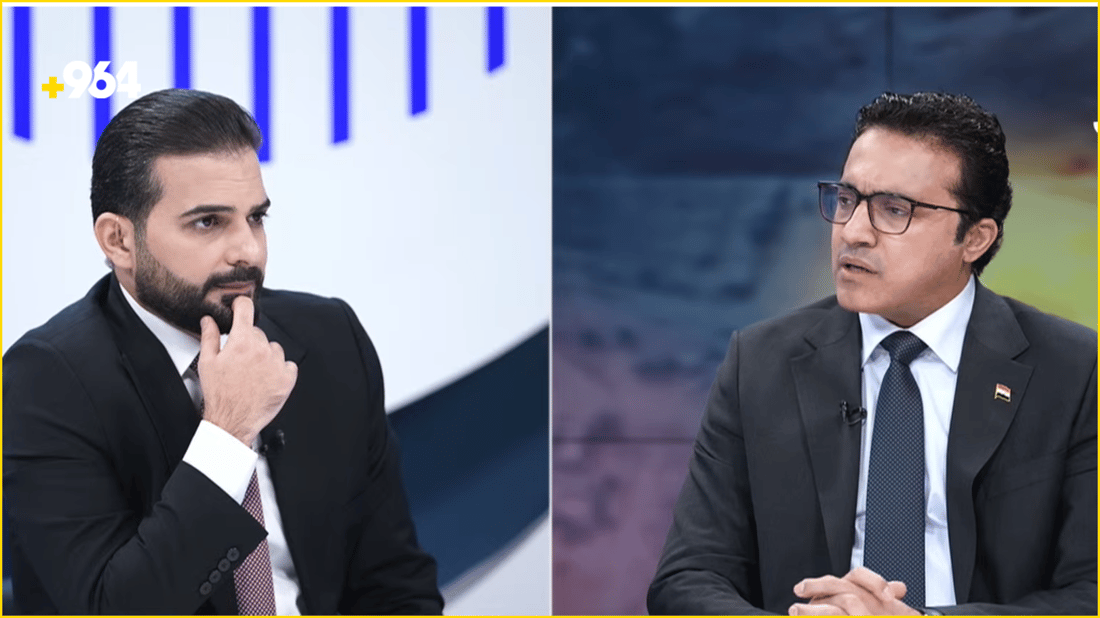
Al-Rasheed TV presenter Yasser Amer (left) interviews Iraqi government spokesperson Haider al-Aboudi (right) about alleged oil smuggling in Jurf al-Sakhar and the government's plans to restore state control over the area.
Standoff
Iraq vows it will soon retake Jurf al-Sakhar from Kataib Hezbollah
BAGHDAD — Iraq’s government on Sunday named Kataib Hezbollah as the party behind oil smuggling in Jurf al-Sakhar and said security forces would soon retake the northern Babil area, which it said the Iran-aligned faction controls.
“The party involved in the smuggling is the party that holds the ground, and that is Kataib Hezbollah,” government spokesperson Haider al-Aboudi told presenter Yasser Amer on Al-Rasheed TV on Sunday. “Jurf al-Nasr will soon return to the authority of the security forces,” he said, using the area’s official name. He did not say when or how.
The government’s statement on Saturday’s dismissals of nine officials over the smuggling had not named the faction.
Prime Minister Ali al-Zaidi has given Kataib Hezbollah until Friday to leave Jurf al-Sakhar or the government will use force, the newspaper Al-Mada reported Monday, citing leaks. 964media found no government statement announcing a deadline and could not verify the report.
Al-Mada said there was no clear information that Zaidi had political backing from the Coordination Framework, the ruling alliance of Shiite parties, to use force. A Framework official told it the faction could be moved out gradually.
Aboudi said the committee Zaidi formed to investigate an intelligence report on the smuggling had entered six sites named in the report and found tampering and other signs of wrongdoing. Three branches of the Basra-Haditha strategic pipeline run through the area the faction controls, two to Dora in Baghdad and one to Musayyib, he said.
The committee faced provocation while touring the area, Aboudi said. Zaidi then called an emergency security meeting Saturday, relieved nine security and oil officials of their duties and sent the case to the judiciary. Those relieved included Babil’s police chief, the governorate’s Popular Mobilization Forces commander, the commander of the Energy Police’s 6th Brigade and the director of the Oil Pipelines Company.
“The government is able to complete this file, and completing it is not far off,” Aboudi said. He tied the move to the plan to bring all weapons under state control. He said earlier governments had put the plan off and that it had topped Zaidi’s government program, approved by parliament, for six months.
Zaidi said Sunday that “the Iraqi judiciary is backing you 100%” as he rewarded members of the investigating committee with cash and letters of thanks, in a video his media office published. Some people had told him, “You’re wrong, you don’t have forces that can confront,” he said, and such talk had weakened the forces’ resolve.
Zaidi also met Supreme Judicial Council President Faiq Zaidan on Sunday to discuss enforcing the law, protecting national economic resources and fighting smuggling, and the importance of the judiciary’s support for those steps, his media office said.
Lt. Gen. Abdul Amir al-Shammari, director of the commander-in-chief’s office, chaired a meeting Sunday with Chief of Staff of the Army Lt. Gen. Abdul Amir Rashid Yarallah and the heads of the security agencies to follow up Zaidi’s orders. The meeting called the case an affront to state sovereignty and an attack on public money, and stressed speeding up arrest warrants and pursuing wanted people, a statement said.
The same day, Federal Police commander Lt. Gen. Mohammed Qasim al-Fahd inspected his forces in Jurf al-Sakhar.
Kataib Hezbollah on Sunday denied smuggling oil from Jurf al-Sakhar and accused Zaidi’s office of spreading “fabricated reports.” It said the committee “found no tampering with the oil pipelines” and had documented only fuel tanks and “a simple plant, of which there are hundreds like it in Iraq, that works to improve quality.”
The plant is more than 5,000 meters from the pipeline and fuels the faction’s vehicles across a military sector stretching from northern Babil to al-Qaim on the Syrian border, it said. 964media found no response from the faction to Aboudi’s remarks by Monday morning.
Talib al-Yasari, a senior figure in former Prime Minister Mohammed Shia al-Sudani’s Reconstruction and Development Coalition, warned Sunday that the two sides could clash within days unless Zaidi reaches a deal with the faction. “If he cannot resolve the matter with the Kataib this week with a reasonable solution, we are facing a confrontation after five or six days,” he told presenter Ahmed al-Tayeb on Al-Rasheed TV. “Take it from me, the Kataib will not give it up easily.”
Yasari said the faction could not hold out against the state. “Militarily, there is no comparison between Kataib Hezbollah and the government forces, because three brigades cannot face 1.4 million fighters, an army and the Federal Police,” he said. He did not say where the figures came from.
He proposed a way out. “I propose that government forces go in with Kataib Hezbollah, in the manner of Saraya al-Salam in Samarra, and that the pipelines be allowed to be run transparently,” he said. Saraya al-Salam, the armed wing of Shiite cleric Muqtada al-Sadr, handed security in Samarra to state forces under the weapons plan. Kataib Hezbollah had asked about that option, Yasari said.
Hassan Mandil, who was Babil governor for the Hikma Movement from 2019 to 2022, told Tayeb that the faction had once barred him from entering Jurf al-Sakhar while he was governor and later backed down. “I think the matter will be untangled and overcome, and Zaidi will not rush into a clash,” he said. “The Kataib realize the dangers of the matter and are not prepared to drag Iraq into a clash with the government.”
The government committee entered Jurf al-Sakhar on Nov. 13 under a large military escort and met faction leaders before starting its fieldwork. Sources told 964media that Kataib Hezbollah had refused to let Zaidi’s first committee in, and that under a deal with PMF Chief of Staff Abdul Aziz al-Muhammadawi, a Popular Mobilization Commission official took the chair and investigators visited only sites agreed in advance.
The inquiry followed a Federal Intelligence and Investigations Agency report that began circulating Nov. 9. It alleges that oil is drawn from a pipeline in Jurf al-Sakhar through an unauthorized opening and carried away in tanker trucks. Parliament Speaker Haibat al-Halbousi ordered a separate inquiry by lawmakers, which questioned Oil Minister Basim al-Abadi on Sunday and was due to host the interior and defense ministers on Monday.
The PMF is the state-sanctioned umbrella of mostly Shiite armed groups formed in 2014 to fight the Islamic State group. Kataib Hezbollah has brigades in the PMF, and the United States designated it a terrorist organization in 2009. The faction has refused to hand over its weapons under the government’s plan, which calls for a six-month handover ending June 30, 2027.
Jurf al-Sakhar was officially renamed Jurf al-Nasr in 2014 after Iraqi forces and allied armed groups recaptured it from Isis. It has been closed since then, and many of its displaced residents still cannot return.