
Pipeline chief checked at most 300 meters at Jurf al-Sakhar, firm says
BAGHDAD — Iraq’s state-owned Oil Pipelines Company said Sunday that its chief’s on-camera remark that the pipes in Jurf al-Sakhar had no problem covered only the 200 to 300 meters he had inspected.
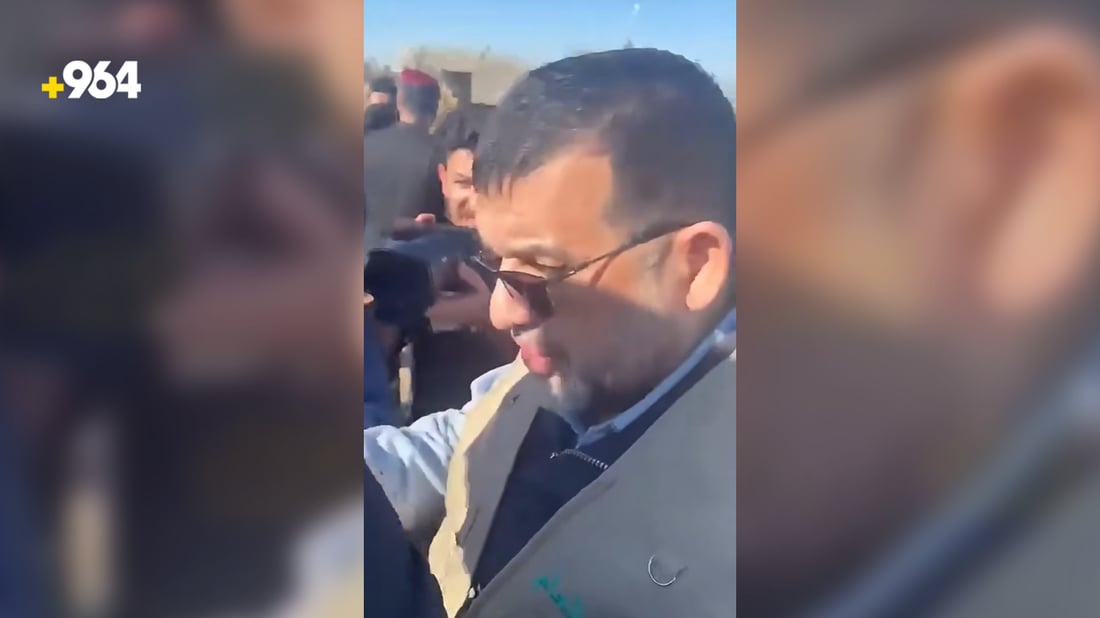
Director General Ali Abdul Karim al-Mousawi made the remark as he entered the area with the government committee investigating oil smuggling there. It did not apply to the whole pipe, which runs for about 5,100 meters, the company said in a statement sent to 964media. The company said the clip circulating online had been filmed without its knowledge or coordination.
“The published video included an excerpt of the director general’s remarks and did not show the whole of what he said or its full context,” the company said. That led viewers to read one phrase apart from its technical meaning and give it a sense he did not intend, it said.
The remark was not a full technical assessment or a final judgment on the whole route of the pipe, the company said. Mousawi made it during a field inspection of one section, within the coordinates approved for the committee’s work. Final findings rest with the committee, which is drawn from several bodies including the company, once it finishes its work and submits its recommendations, the company said.
The statement came a day after Prime Minister Ali al-Zaidi relieved nine security and oil officials fo their duties, among them the director of the Oil Ministry’s Oil Pipelines Company. He also ordered everyone accused of smuggling oil in Jurf al-Sakhar referred to the courts. The committee had confirmed information in a Federal Intelligence and Investigations Agency report on oil smuggling and the existence of oil refineries in the area, according to a statement from his military spokesperson, Sabah al-Numan. That statement named none of the nine. Sunday’s company statement did not mention the dismissal and still referred to Mousawi as director general.
The committee entered Jurf al-Sakhar under a deal that limited it to sites agreed in advance, sources told 964media. Kataib Hezbollah, the Iran-aligned faction widely regarded as controlling the area, had refused to let Zaidi’s first committee in. Zaidi then let a Popular Mobilization Commission security official lead the inquiry, the sources said. One source said investigators saw small installations that looked like oil facilities but could not establish for themselves what they were used for.
Other agencies have also moved against smuggling. Members of parliament’s Oil and Gas Committee said they would follow up on the committees’ findings. The Energy Police have formed a force reporting directly to their director general to fight oil smuggling and theft in the south and protect the desert pipeline network. The Kirkuk Operations Command has tightened checks at its checkpoints, and the Federal Commission of Integrity has formed a team to investigate suspected smuggling from fields between Kirkuk and the Kurdistan Region.
Parliament Speaker Haibat al-Halbousi on Wednesday ordered a separate committee of lawmakers to look into the intelligence report. On Sunday, a parliamentary committee formed under an order dated that day hosted Oil Minister Basim al-Abadi and senior ministry staff for a briefing on oil smuggling in Jurf al-Sakhar, Kirkuk and the Kurdistan Region, the state-run Iraqi News Agency reported.
Jurf al-Sakhar, in northern Babil, was officially renamed Jurf al-Nasr in 2014 after Iraqi forces and allied armed groups recaptured it from Isis. It has been closed since then, and many of its displaced residents still cannot return.