
Jurf al-Sakhar
Oil smuggling fight must reach ‘big heads,’ Iraqi lawmaker says
BAGHDAD — Fighting oil smuggling must reach the people who protect the networks, Iraqi lawmakers said in remarks published Sunday, a day after Prime Minister Ali al-Zaidi relieved nine officials of their duties over smuggling in Jurf al-Sakhar.
“Fighting smuggling is not complete with the arrest of small smugglers, but with reaching the big heads and the parties that provide protection and cover for these networks,” Qaisar al-Jurani, a member of parliament’s Oil and Gas Committee, told the state-run newspaper Al-Sabah.
The committee will follow up on the results and hold negligent officials to account, Jurani said. “There are no red lines in protecting public money, and no immunity for anyone involved, whatever their position or influence,” he said.
Mohammed al-Ziyadi, another committee member, told the newspaper that the smuggling reports from Jurf al-Sakhar were a thorny issue that needed a serious and thorough investigation to establish what is happening there and who is responsible.
Zaidi sacked the nine security and oil officials on Saturday after an emergency security meeting reviewed his committee’s findings, and ordered everyone accused of smuggling referred to the courts. They include Babil’s police chief, the Popular Mobilization Forces commander in Babil, the commander of the Energy Police’s 6th Brigade and the director of the Oil Ministry’s Oil Pipelines Company.
The committee confirmed information in a Federal Intelligence and Investigations Agency report on oil smuggling and the existence of oil refineries, and found cases of manipulation, Sabah al-Numan, spokesperson for the commander-in-chief of the armed forces, said in a statement. The government has not named the suspects, said how much oil was taken or said how many people face prosecution.
Numan told state-run Al-Iraqiya TV on Saturday that the prosecutions would deter the misuse of public funds. “The judiciary supports the government’s measures to hold oil smugglers accountable,” he said.
Zaidi warned that security commanders could be held to account for failing to protect public assets, Numan said. Security and intelligence commanders across Iraq have been told to tighten oversight of oil infrastructure, and committee members will be rewarded for their work, he said.
Other agencies have also moved against smuggling. The Kirkuk Operations Command said its commander chaired a meeting of the governorate’s committee against fuel smuggling on Saturday and ordered checkpoints to step up their efforts and watch suspicious sites along the roads.
On Friday, Lt. Gen. Hamid al-Husseini, director general of the Energy Police, told the state-run Iraqi News Agency that a new force reporting directly to him was patrolling the southern desert to protect pipelines. It had foiled three attempts to fit illegal valves at the Subba oil field in Dhi Qar, he said.
The Federal Commission of Integrity said Wednesday that it had formed a team to investigate suspected smuggling from fields between Kirkuk and the Kurdistan Region.
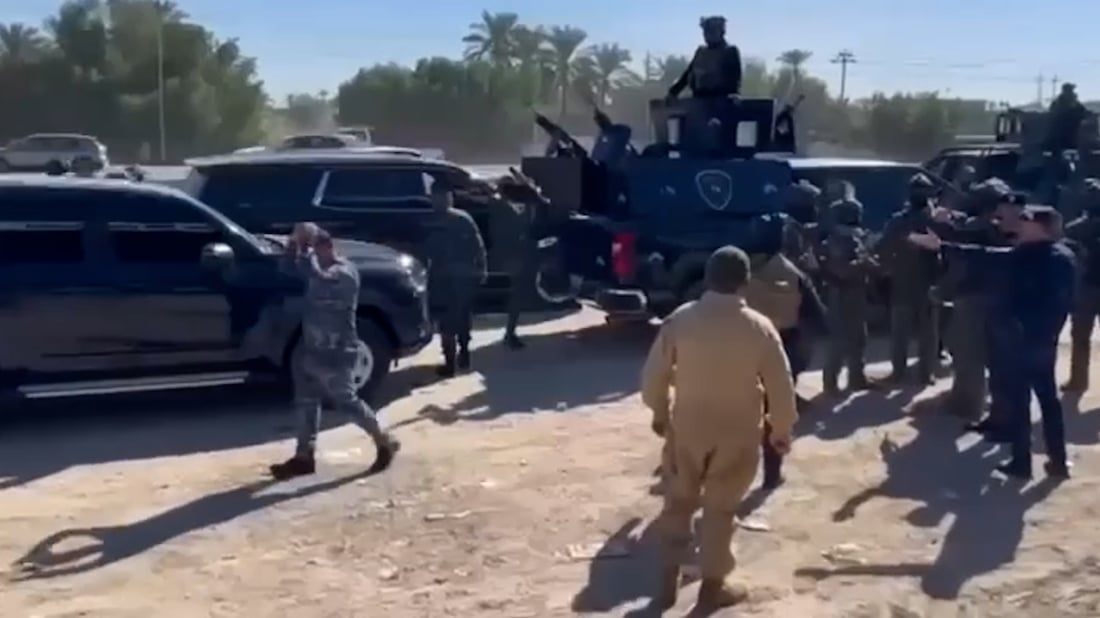
In Jurf al-Sakhar itself, Kataib Hezbollah has massed armored vehicles at the area’s main entrance, Ayad al-Janabi, spokesperson for the tribes of Jurf al-Sakhar, said in an interview with Al-Rasheed TV on Saturday. He said he had passed the Anwar checkpoint, the main southern entrance, several times that day and seen armored military vehicles there. Kataib Hezbollah, an Iran-aligned faction, is widely regarded as controlling the area.
“We do not want to see a military escalation between the security forces,” Janabi said. “Today there is a very large buildup inside Jurf al-Sakhar.”
964media could not independently verify the deployment.
Janabi also questioned how far the investigators got. He said the committee entered Jurf al-Sakhar on Friday from the Musayyib side in the south and stayed in the area where some families still live.
Using a map during his interview with presenter Ahmed al-Tayeb, Janabi said leaked photos showed investigators in the Bahbahani area. They did not go beyond Ruwayiya, where the zone that residents are barred from returning to begins, he said.
The restricted core lies in the center and north, in areas such as Farisiya and northern Baj, whose residents have never returned, Janabi said. Federal Police are deployed on the area’s edges, while Kataib Hezbollah controls all of Jurf al-Sakhar, he said.
Even former Prime Minister Haider al-Abadi did not go beyond Ruwayiya when he raised the Iraqi flag after the 2014 recapture, Janabi said. Families from the Janabi tribe, Bayt Harran and Al Masoud still live near the southern entrance because they were not displaced that year, he said.
Janabi disputed Babil Governor Ali Turki’s account of the site named in the intelligence report. Turki said Tuesday that the site was an old fuel station called al-Madina al-Munawwara, used to fuel Federal Police and PMF vehicles. Janabi said it was the Zamil station, at the southern edge of Jurf al-Sakhar and outside the no-return zone.
He named three possible smuggling routes: through Amiriyat al-Fallujah, through Musayyib and, he believed, through Yusufiya toward Baghdad. He gave no evidence that oil had moved along them.
Under a deal, the committee could go only to sites agreed in advance. Kataib Hezbollah refused to let Zaidi’s first committee in, sources told 964media. After talks with PMF Chief of Staff Abdul Aziz al-Muhammadawi, a security official from the Popular Mobilization Commission, the state body that runs the PMF, took the chair of an enlarged committee, the sources said.
Investigators reviewed tanker movements and fuel records, the sources said. They saw small installations that looked like oil facilities but could not establish for themselves what they were used for, and could not visit every site the report named.
The committee met armed faction leaders inside Jurf al-Sakhar on Friday before starting its inspections. The same day, Lt. Gen. Saad Maan, head of the Public Relations and Government Communication Authority at the Office of the Commander-in-Chief of the Armed Forces, told INA that no political parties or armed factions sat on the committee.
The PMF is the state-sanctioned umbrella of mostly Shiite armed groups formed in 2014 to fight the Islamic State group. Kataib Hezbollah has brigades in the PMF, and the United States designated it a terrorist organization in 2009. The State Department designated Muhammadawi in 2021 and described him as a former secretary-general of the faction.
The intelligence report began circulating Monday. It alleges that oil is drawn through an unauthorized opening in a pipeline in Jurf al-Sakhar and carried away in tanker trucks. The pipeline carries crude from Basra to Baghdad’s Dora refinery and the Musayyib thermal power station.
Turki said Thursday that he had resigned over the case. Parliament Speaker Haibat al-Halbousi on Wednesday ordered a separate committee of lawmakers to examine the report, along with intelligence on oil smuggled from the Kirkuk fields and the Kurdistan Region through Iran to Afghanistan. It has not announced findings.
Jurf al-Sakhar, in northern Babil, was officially renamed Jurf al-Nasr in 2014 after Iraqi forces and allied armed groups recaptured it from Isis. It has been closed since then, and many of its displaced residents still cannot return.