
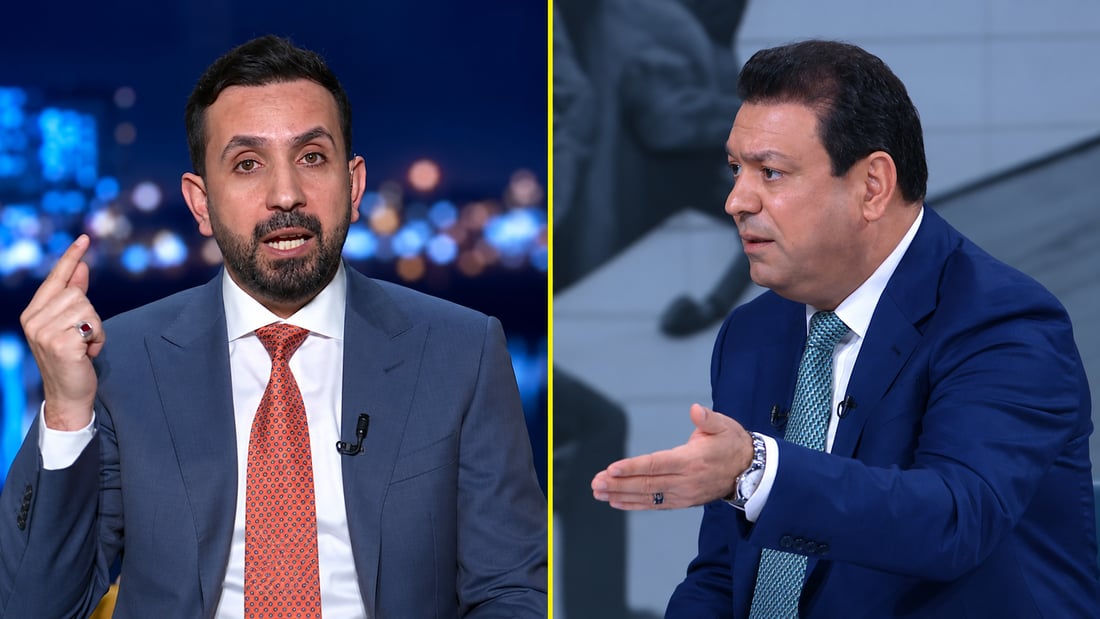
Hussam al-Hasani, spokesperson for Ammar al-Hakim's Hikma Movement, part of the ruling Shiite Coordination Framework, in an interview with journalist Adnan al-Taie on UTV
Media Monitor
Hikma denies ‘secret clause’ in factions’ deal, warns of sanctions
BAGHDAD — A Hikma Movement spokesperson denied that the armed factions’ de-escalation agreement with the government contains a “secret clause” voiding it if war between the United States and Iran flares again.
Iraq would enter “a tunnel of sanctions” if the agreement were broken, Hussam al-Hasani, spokesperson for Ammar al-Hakim’s Hikma Movement, part of the ruling Shiite Coordination Framework, said in an interview with journalist Adnan al-Taie on UTV.
“The agreement did not stipulate that it would be considered void if the war between Iran and America resumed. There is no such thing… for certain,” Hasani said.
The agreement was signed “by Iraqis, with Iraqi will” and took account of Iraq’s circumstances, he said. Some faction leaders signed it themselves while others authorized someone to sign on their behalf, he said. He did not say when it was signed.
Hasani called it “respected and binding on all parties,” first among them the government and the factions. “If we do not abide by this agreement, we will take Iraq into a tunnel of sanctions that we can do without, because we face commitments,” he said. He cited international commitments, meaning the full withdrawal of the international coalition, and regional ones, meaning a partial withdrawal of Turkish forces that he said would become total by the end of the year.
The U.S.-led coalition ended its mission in Iraq on Sept. 30. Iraq and Turkey <a href=”https://en.964media.com/52970/”>agreed in September that Turkish forces would gradually hand over</a> the Bashiqa-Zilkan base in Nineveh, but published no completion date, and the deal does not cover Turkey’s other positions in northern Iraq. Prime Minister Ali al-Zaidi said on Oct. 5 that Turkish forces had withdrawn from some positions.
Hasani said Iraq now deals with Trump alone. “Who is America to us as a political class? Do we deal with the State Department, the Treasury or the Federal Reserve? Today we deal only with the decision-maker in the White House, President Trump,” he said.
Iraq’s oil revenue, which funds most of the state budget, is held in the Central Bank of Iraq’s account at the Federal Reserve Bank of New York.
Trump makes decisions apart from American institutions, which Hasani called an internal problem for the United States, and U.S. special envoy Tom Barrack is now the clear diplomatic channel with Iraq, he said. That is why the prime minister’s dealings with Barrack produce statements about partnership, cooperation and mutual trust, he said.
“If Zaidi wants to extend the weapons deadline, Tom Barrack goes and takes the approval and the decision from President Trump, and the matter goes through,” Hasani said.
Zaidi <a href=”https://en.964media.com/53969/”>persuaded Washington to push the deadline back</a> from Sept. 30, 2026, to June 30, 2027, after the United States threatened economic measures, presidential spokesperson Khalid al-Yaqoubi said on Oct. 19. The government’s roadmap sets <a href=”https://en.964media.com/52890/”>a 90-day halt to attacks from Sept. 30</a>, followed by a six-month handover of weapons.
Hasani said he shared concerns over whether the government and the factions would honor the agreement. “Time will reveal how far the parties are committed to the terms of the agreement, away from statements,” he said.
“At first, we never imagined that one day the factions would hand over their weapons, but they handed them over and responded,” he said. “We ask no more than what they signed and committed themselves to.”
Harakat al-Nujaba <a href=”https://en.964media.com/54061/”>restated on Oct. 21 that it would not surrender its weapons</a>, and the four factions of the Islamic Resistance in Iraq said on Sept. 30 that they were not bound by any government timetable. Zaidi said on Oct. 5 that five factions had agreed to hand over their weapons and three had done so, without naming them.
The U.S.-Israeli war with Iran began Feb. 28 and has continued at varying intensity despite a ceasefire announced in April. President Donald Trump told Fox News on Sunday that he had “a decision to make: Do I finish it off, which would be very easy to do, or do I make a deal?”