
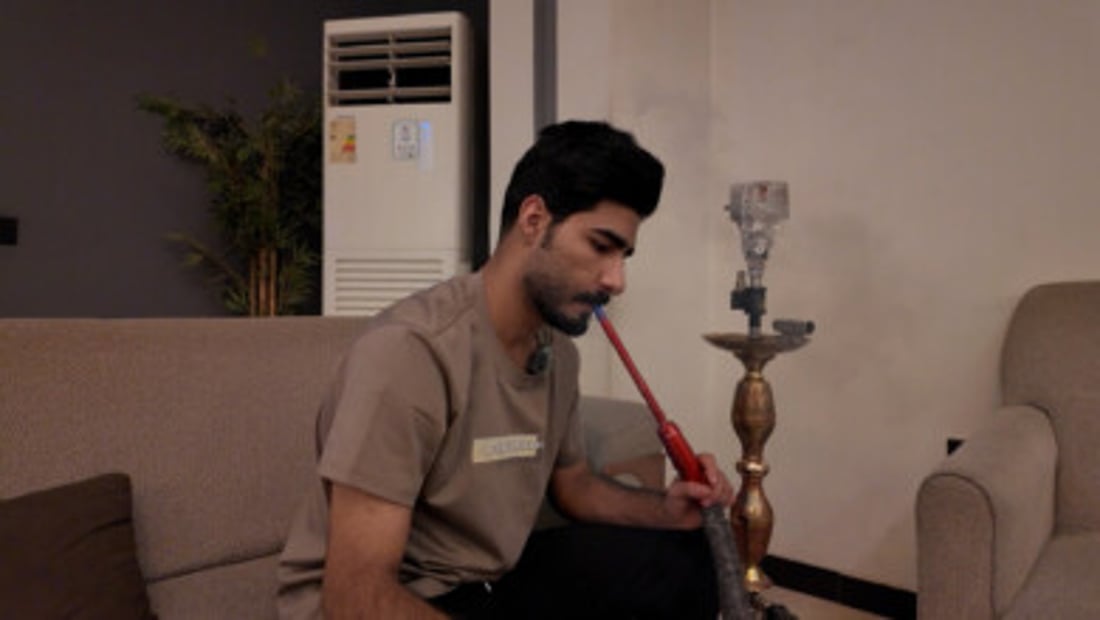
Najaf shisha smokers check the charcoal as Hormuz crisis lifts prices
NAJAF — Some shisha smokers in Najaf now ask where a cafe’s charcoal comes from before they order, after disruption to shipping through the Strait of Hormuz sent up the price of the Indonesian brands they prefer.
Shisha, flavored tobacco smoked through a water pipe, is heated with burning charcoal. If the charcoal is Indonesian, these customers sit down. If it is Iranian or Chinese, which they say gives off more fumes and spoils the flavor, some leave to look for another cafe.
The price of imported Indonesian charcoal has climbed since the U.S.-Israeli war with Iran disrupted shipping through the strait, and some shipments now come in through Jordan, cafe owners and a supplier said. Some brands cafes used have disappeared from the market, and wholesalers are rationing others.
Some cafes have switched to cheaper Iranian and Chinese charcoal, which owners say burns faster and gives off more fumes. They say they cannot raise the price of a shisha above 5,000 dinars (about $3) for fear of losing customers, even though it is no longer profitable at that price.
Muammal Maan, a supervisor at al-Nubalaa Cafe on al-Zuhur Street in Najaf, told 964media that cafes had relied on Burj Baghdad, an Indonesian-made charcoal popular with local cafes, which cost 30,000 to 35,000 dinars (about $18 to $21) a carton. It rose to about 50,000 dinars (about $30) and then became unavailable, he said.
The alternatives are no better, Maan said. Coco charcoal now costs nearly 50,000 dinars a carton and is hard to find, and Panda charcoal has reached 75,000 dinars (about $44). Depending on the brand and quality, a carton now costs 40,000 to 75,000 dinars, he said.
Cheaper charcoal burns quickly and gives off more fumes, which customers notice as they smoke, Maan said, and some now ask which charcoal a cafe uses before they order.
Supply is a problem as well as price, he said. A cafe could once buy 50 cartons at a time, but wholesalers now limit how much each buyer can take because of shortages.
At 5,000 dinars, a shisha no longer turns a profit, Maan said, but charging more is hard because customers are used to the price.
Hussein al-Aboudi, owner of al-Aboudi Shisha Supplies, told 964media that shipments rerouted through Jordan after the disruption in Hormuz had pushed some varieties from 25,000 dinars (about $15) to about 57,000 dinars (about $34) a carton.
Indonesian charcoal is still the most sought-after because of its quality, Aboudi said, but the difficulty of importing it has pushed the market toward Iranian and Chinese charcoal. Some smokers have turned to Iranian charcoal because it is relatively cheap, though its price has also risen, he said.
Some of the alternatives on the market give off more fumes and do not give shisha the same flavor, Aboudi said. Cafe owners find it hard to pass the full increase on to customers because shisha prices have stayed at the same level for years, he said.
Amir Fares, a cafe customer, told 964media that he now asks what charcoal a cafe uses before ordering, because its quality matters to him as much as the rest of the shisha.
Fares prefers Indonesian charcoal and said good-quality charcoal does not give him the headaches some other types do. He looks for cafes that use charcoal that suits him and sometimes leaves when he finds out a cafe uses another kind.
Shipping through the Strait of Hormuz has been disrupted since U.S. and Israeli strikes on Iran began on Feb. 28. Iraq-bound transit containers through Jordan’s port of Aqaba rose to 37,182 in the first seven months of 2026 from 3,599 in the same period of 2025, according to the Jordan Shipping Association.
Iraq’s Trade Ministry has switched some food imports to alternative routes, including through Turkey, because of the disruption, Lama al-Mousawi, director general of the state-owned General Company for Foodstuff Trading, said on Oct. 18. The new routes had sharply raised freight, insurance and fuel costs, and deliveries could take up to 90 days, she said.