
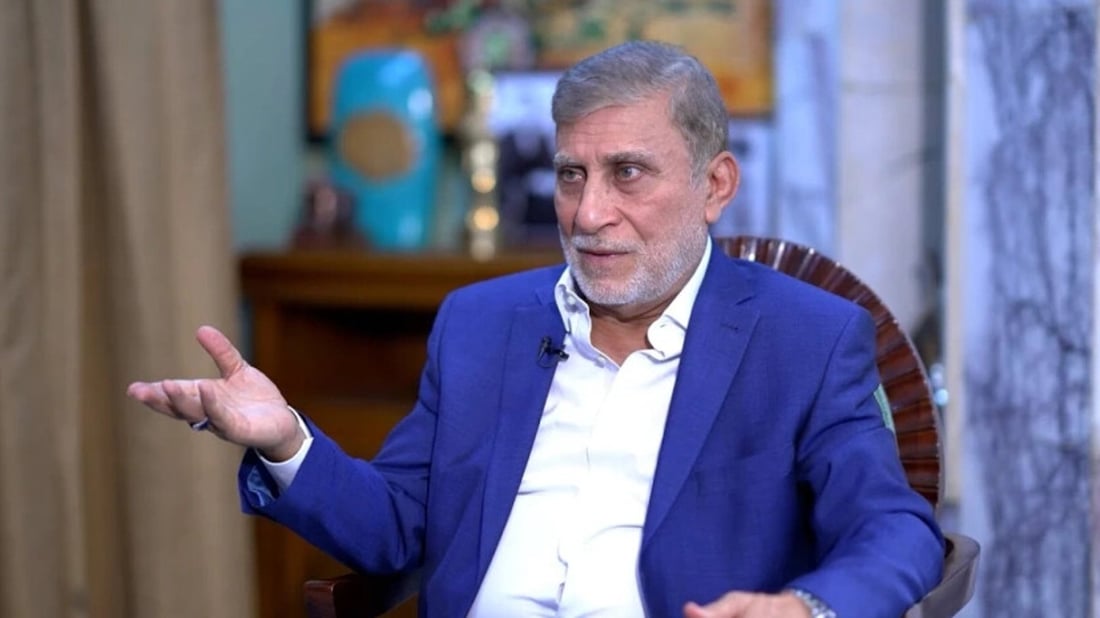
Iraqi politician Izzat al-Shabandar
Shiite alliance in ‘paralysis’ over Jurf al-Sakhar, former Iraqi MP says
BAGHDAD — Former lawmaker Izzat al-Shabandar on Monday faulted the “paralysis” of Iraq’s ruling Shiite alliance as the government moved against Kataib Hezbollah in Jurf al-Sakhar, saying neither side had found a solution that would spare Iraq the fallout.
“The issue is not the government’s inability to confront the factions or its ability to drag the people into that confrontation, but the failure of both sides to reach a solution that would spare Iraq the evils of what may follow,” Shabandar wrote in a post on X.
The post blamed the “paralysis of the Shiite Framework,” meaning the Coordination Framework, the ruling alliance of Shiite parties that backs Prime Minister Ali al-Zaidi. The alliance had failed in its duty to protect its own political camp and to play the role it was formed for, he wrote.
Shabandar also took on the government’s case over oil smuggling. “If the issue is oil theft, oil is plundered with or without weapons. If it is something else, there is plenty of time between now and June 2027,” he wrote, referring to the government’s deadline for bringing the factions’ weapons under state control.
“The state and its constitution are the constant, and everything else is temporary and transient and will end for the same reasons it came into being,” he wrote.
Government spokesperson Haider al-Aboudi told the state-run Iraqi News Agency on Monday that Zaidi had ordered the armed forces into Jurf al-Sakhar, an area of northern Babil, and had given the armed faction there a short deadline to leave. He did not say how long the faction had.
On Sunday, Aboudi named Kataib Hezbollah as the party behind oil smuggling in Jurf al-Sakhar. “The party involved in the smuggling is the party that holds the ground, and that is Kataib Hezbollah,” he told presenter Yasser Amer on Al-Rasheed TV. Kataib Hezbollah has denied smuggling oil from the area and accused Zaidi’s office of spreading “fabricated reports.”
Zaidi on Saturday relieved nine security and oil officials, among them Babil’s police chief, the Popular Mobilization Forces commander in Babil and the director of the Oil Ministry’s Oil Pipelines Company. He ordered everyone accused of smuggling referred to the courts. The government has not named the officials or the accused.
In September, Shabandar told Dijlah TV the Framework was formed as a reaction rather than a project, had no binding voting mechanism and had “no agenda” beyond sharing power.
The alliance has put off its leadership meetings since Oct. 19 over disputes including the factions’ weapons, a source in the Framework told 964media last week. At that meeting, its last on record, the Framework reaffirmed the June 30, 2027, deadline and authorized Zaidi’s government to take whatever measures were needed to meet it.
The Framework took power after lawmakers loyal to Shiite cleric Muqtada al-Sadr resigned from parliament in 2022. It backed Mohammed Shia al-Sudani’s government from that October and now backs Zaidi, who replaced Sudani as prime minister in May.
Zaidi’s timetable for the factions sets a 90-day halt to attacks from Sept. 30, followed by a six-month handover of their weapons to the state. Kataib Hezbollah and Harakat al-Nujaba have refused to give up their weapons. Other factions have begun returning weapons kept in one another’s depots ahead of a handover, sources told 964media.
The PMF is the state-sanctioned umbrella of mostly Shiite armed groups formed in 2014 to fight the Islamic State group. Kataib Hezbollah, an Iran-aligned faction, has brigades in the PMF, and the United States designated it a terrorist organization in 2009.
Jurf al-Sakhar was officially renamed Jurf al-Nasr in 2014 after Iraqi forces and allied armed groups recaptured it from Isis. It has been closed since then, and many of its displaced residents still cannot return.