
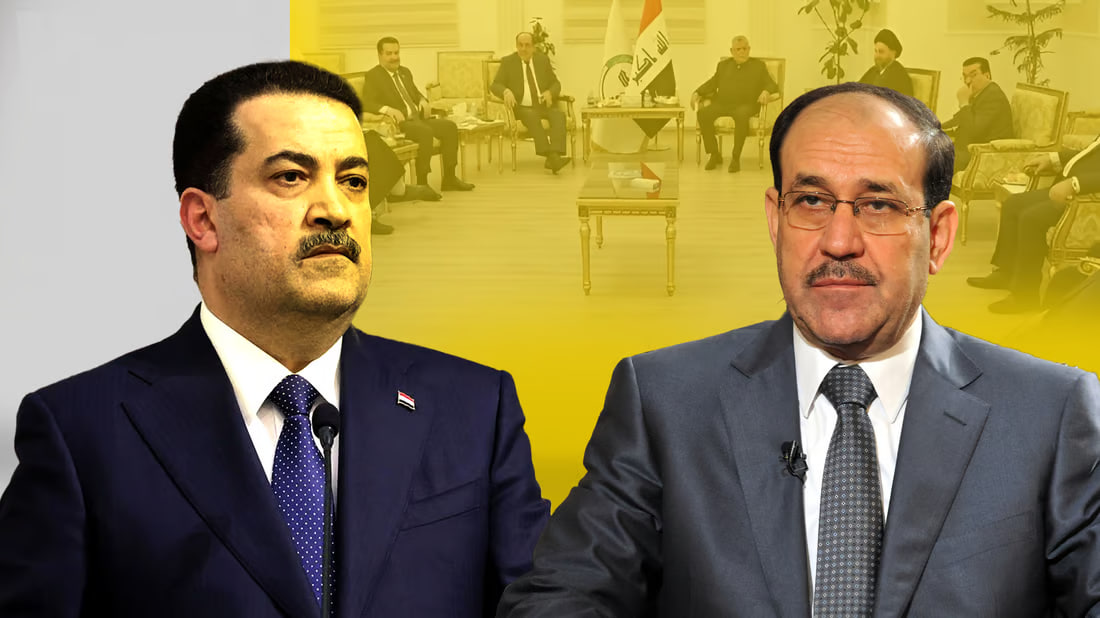
Mohammed Shia al-Sudani (left) and Nouri al-Maliki appear in a composite image against the backdrop of a meeting of Shia Coordination Framework leaders in Baghdad
Media monitor
Maliki bloc blames Sudani’s no-tender projects for Iraq’s cash crunch
BAGHDAD — A spokesperson for Nouri al-Maliki’s State of Law Coalition on Monday blamed former Prime Minister Mohammed Shia al-Sudani’s government for Iraq’s financial crisis, saying it awarded costly projects through exemptions instead of public tenders.
Aqeel al-Fatlawi told Al-Rasheed TV that comparable projects, such as bridges of the same specifications and length, had cost no more than a fifth as much under Maliki as under Sudani. “The bridge that cost 10 billion dinars was completed for 50 billion,” he said, without naming the bridge. The two sums are about $6.6 million and $33 million at the official rate.
“During Mr. Maliki’s tenure, contracts were awarded through public tenders and in the open. Under Mr. Sudani, exemptions were granted for high-cost projects, which brought the country to this situation,” Fatlawi said in the interview with presenter Ahmed al-Tayeb.
The exemptions are granted by the cabinet. They waive Iraq’s government contracting rules so that work can be awarded without a public tender.
Fatlawi gave no project records to support the comparison. He said Maliki had handed all his government’s financial tables and details to his successor, Haider al-Abadi, in 2014, while the exemptions and the money spent under Sudani were “surrounded by doubts.”
The remarks came a day after a senior figure in Sudani’s coalition said that mediation by Ammar al-Hakim, leader of the Hikma Movement, had ended the latest row between the two former prime ministers’ camps. Mohammed al-Khalidi, of the Reconstruction and Development Coalition, told the same channel on Sunday that Hakim’s intervention had calmed the situation.
Fatlawi defended State of Law lawmaker Yousif al-Kilabi, whose remarks about Sudani set off that row. He said every lawmaker had a duty to raise the causes of the budget crisis. “What happened during this period is not an attempt to target or undermine a political figure or a particular bloc,” he said.
Fatlawi said the public debate began after citizens saw the prime minister announce that the budget was “dead,” and lawmakers had to explain why it had stalled. Iraq has had no 2026 budget since the 2023-2025 budget law expired. Spending therefore runs on the one-twelfth rule, which caps monthly spending at one-twelfth of the previous year’s actual current spending.
“The financial situation in Iraq is exhausted and strained, and it has greatly affected citizens because of the previous government’s financial policy,” Fatlawi said.
He said State of Law had raised the issue more than any other bloc, and had criticized how projects were carried out even when its relations with Sudani were good. “We want to understand where our money went. Contractors are demanding that the state pay their dues, and the financial situation is deteriorating,” he said.
Kilabi had called for Sudani to be held accountable for Iraq’s debt, saying Sudani’s government left the country 208 trillion dinars (about $160 billion at the time) in debt. Parliament referred him to its conduct committee on Oct. 27 over the remarks, on a complaint from Bahaa al-Araji, head of Sudani’s parliamentary bloc. Prime Minister Ali al-Zaidi, who succeeded Sudani in May, told lawmakers on Oct. 8 that his government had inherited public debt of more than 208 trillion dinars.
The row escalated after Khalid Walid al-Marsoumi, a member of Sudani’s coalition, called on X late Saturday for Maliki to be tried over the fall of governorates to the Islamic State group in 2014. “Put Maliki on trial, and do not forget the blood of your sons in the days of the fall of the governorates and the bitter strife,” Khalid Walid wrote.
Khalidi said Sunday that the post had been made on instructions, without saying who gave them.
Hisham al-Rikabi, who heads Maliki’s media office, rejected the call in a reply on X. “Enough hypocrisy and point-scoring over the blood of Iraqis,” he wrote. He added that those who spoke of the fall of the governorates should stop exploiting Iraqis’ tragedies in their political rivalries.
State of Law, Sudani’s coalition and Hakim’s Hikma all belong to the Coordination Framework, the dominant Shiite alliance in parliament. Maliki served as prime minister from 2006 to 2014. In June 2014, Isis captured Mosul, Iraq’s second-largest city, and went on to seize large areas of northern and western Iraq.