
Najaf court orders council energy chief’s arrest as tribal emir held
NAJAF — A Najaf court has ordered the arrest of a provincial council member and his brother over oil smuggling through a pipeline on their family’s land, and security forces have since arrested a tribal emir from the family. On Monday, military intelligence seized the excavator that dug a trench around the plot, 964media’s correspondent in Najaf said.
The court on Saturday ordered the arrest of Mohammed Ali al-Hasnawi, a member of the Najaf Provincial Council who chairs its energy committee, and his brother, after an investigating judge inspected the site and preliminary findings showed oil had been smuggled through the pipeline. Investigators found that the two had earlier dug a trench all the way around the plot, keeping people out and hiding what went on inside, the judge said, according to a Supreme Judicial Council statement. The judiciary did not name the two men. 964media confirmed the council member’s identity.
The court also ordered five officers and three other members of the Energy Police, the Interior Ministry force that guards oil and power sites, held pending investigation, after their statements pointed to the brothers’ involvement. Local reports of other illegal activity at the site, including drug smuggling, are still being investigated, the judge said.
Security forces on Saturday arrested Hussein Ali al-Hasnawi, the emir of the Bani Hassan tribes and a member of the family, on a warrant on an oil smuggling charge, and he was “handed over to the official authority that requested him,” a security source told the state-run Iraqi News Agency, which gave his name as Hussein al-Abbasi. The land belongs to the family but is not registered in the emir’s name, 964media has learned. The judiciary has not said who the second warrant names.
Teams from the Najaf branch of the Defense Ministry’s General Directorate of Intelligence and Security found the excavator after “a careful and continuous intelligence follow-up that ran from the first hours of the night until early morning,” and caught it “red-handed” with its driver, the ministry said in a statement. The driver and the machine were handed to the authorities for legal action. The statement did not name the driver or link the excavator to the plot.
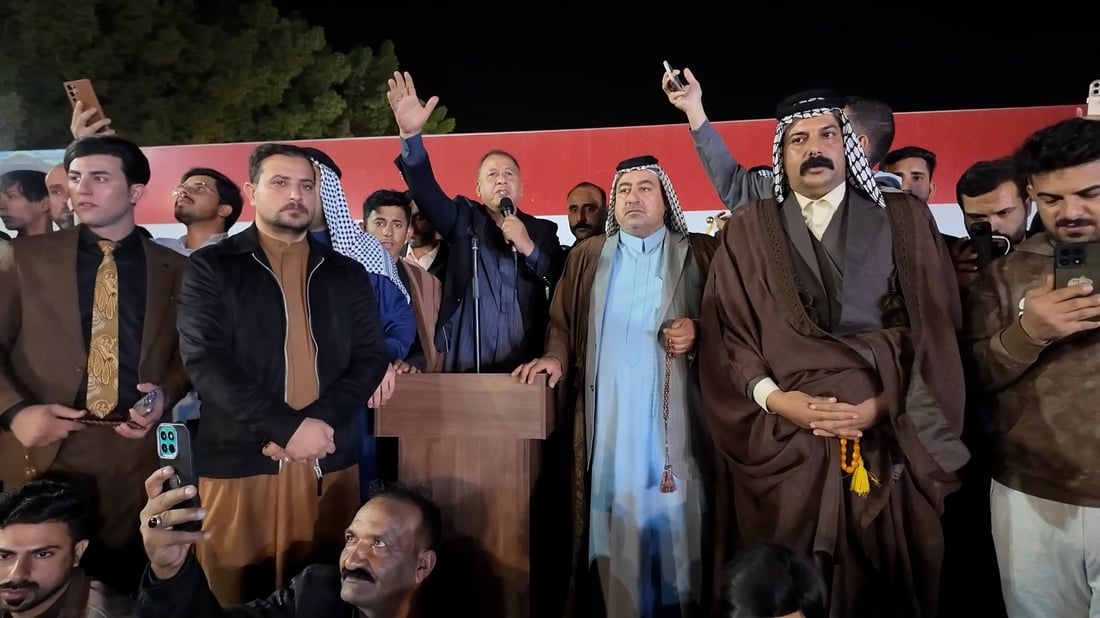
Tribal leaders in the Haydariya subdistrict of Najaf, meeting at the guesthouse of lawmaker Abdul Hadi al-Hasnawi, said the emir was held over digging on his land rather than over the pipeline. They said the emir, the MP and his brother, the council member, were innocent of the charges.
Mohammed Nayef al-Hasnawi, a tribal sheikh, told 964media that work on the trench had lasted no more than 15 days, while the pipe was about seven years old. “Emir Hussein Abu Zaid was not detained because of the pipeline case but because of the trench work,” he said, using the emir’s kunya.
The emir had only run an excavator on his land to protect it from encroachers, the sheikh said. “There is no land, contract or deed registered in his name,” he said.
Qasim Jawad, a spokesperson for the Bani Hassan tribes, told 964media the tribes would leave the matter to the courts. “Our trust in the Iraqi judiciary, which will have its say, is absolute,” he said.
The MP, of the Reconstruction and Development Coalition, on Saturday denied reports that linked his name to the case. His office said social media pages and accounts had tried to drag his name into a smuggling case on a farm in Haydariya. “I categorically deny any link to this matter, near or far,” he said in the statement. He said he had told his lawyers to sue the pages behind what he called “rumors” for defamation and slander.
Government spokesperson Haider al-Aboudi said Saturday that anyone named in the oil smuggling investigations would face the courts. “In practice, every name that appears in these investigations will be subject to legal accountability,” he told the state broadcaster Al-Iraqiya.
Interior Minister Yasser al-Maliki told parliament on Wednesday that the ministry’s campaign against oil smuggling had begun in the central and Middle Euphrates governorates, “starting with ourselves and our community,” and would reach every area without exception, because the ministry “does not look with one eye.”
The crackdown began in Jurf al-Sakhar, in northern Babil, where Prime Minister Ali al-Zaidi on Nov. 14 relieved nine security and oil officials and ordered the accused referred to the courts. A parliamentary inquiry has since widened to Kirkuk, Basra and Nineveh.