
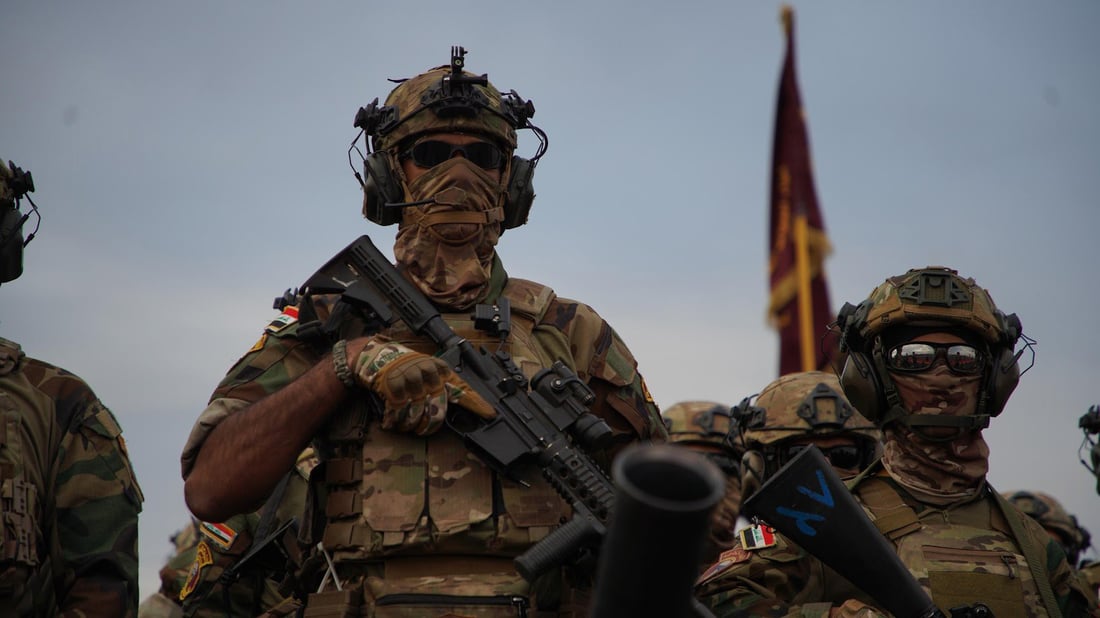
Iraqi security forces in military gear during a formation.
Joint command activates
Iraq puts forces on alert as Jurf al-Sakhar command set to start Friday
BAGHDAD — Iraq’s armed forces went on “Alert C” on Thursday, hours before a new joint command is due to take control of Jurf al-Sakhar in northern Babil, where the government wants the Iran-aligned faction Kataib Hezbollah out.
“The armed forces’ units, in all their formations, have now entered a state of Alert C,” Lt. Gen. Saad Maan, head of the Public Relations and Government Communication Authority at the Office of the Commander-in-Chief of the Armed Forces, told the state-run Iraqi News Agency. He did not say what the alert involves or how long it will last. Maan’s authority, formerly the Security Media Cell, speaks for Iraq’s security forces.
The order also recalls personnel on leave, from Thursday until further notice, a security source told 964media.
A day earlier, Defense Ministry spokesperson Maj. Gen. Yahya Rasool said in an interview that army units were fully ready. “As of now there is no security alert, and all the forces are waiting for zero hour, the hour of taking control of Jurf al-Sakhar,” he said. He added that he hoped the move would go smoothly, without a clash.
Under an executive order from Prime Minister Ali al-Zaidi, a controlling headquarters for Jurf al-Sakhar opens at 6 a.m. Friday and takes command and control of all security units under it, said Sabah al-Numan, spokesperson for the commander-in-chief of the armed forces. It answers in every respect to the Federal Police Command and covers the area’s administrative boundaries.
Lt. Gen. Ahmed Hatem Hamid will command it, with Maj. Gen. Hussein Ali Nassif as deputy for defense affairs and Uday Abdul Aimma Musahab as deputy for Popular Mobilization Forces affairs. It takes in an army brigade, a Federal Police brigade, two PMF brigades and an Energy Police regiment to guard the oil pipelines that cross the area.
The headquarters will coordinate with the Babil Police Command and the Baghdad, Anbar and Karbala operations commands, Numan said. Officials have not said whether Kataib Hezbollah has agreed to leave or what would happen if its fighters stay.
Kataib Hezbollah answered Zaidi’s plan on Wednesday with a video of first-person-view drones that ends in a hosa, a traditional Iraqi chant: “You’ll only hear their buzz beside you, faster than Solomon’s jinn.”
On Thursday, the faction said its secretary-general, Ahmed al-Hamidawi, had met Iran’s Quds Force commander, Esmail Qaani, as well as Badr Organization leader Hadi al-Amiri and Falih al-Fayyadh, chairman of the Popular Mobilization Commission, to consult on “the crisis.” Hamidawi described the results as good, the statement said, without giving details or saying whether the faction would leave.
Saud al-Saadi, a lawmaker from the Kataib Hezbollah-linked Huqooq bloc, refused to say whether the faction would withdraw by 8 p.m. Friday when asked in a UTV debate late Wednesday. He denied that the faction smuggled oil.
Documents obtained by 964media on Wednesday show Zaidi approved a plan dividing Jurf al-Sakhar among the army’s 38th Brigade, the Federal Police’s 17th Brigade and the PMF’s 72nd and 79th brigades. He set aside Fayyadh’s proposal to give the whole area to PMF units.
The army takes the area from the Ya Hussein berm to the Fadhiliya intersection and the boundary of the Anbar Operations Command. The Federal Police take central Jurf al-Sakhar, from the Euphrates to the Musayyib-Fadhiliya road, and the PMF brigades take the sector from that road to the boundary of the Karbala Operations Command.
The plan calls for reopening the Musayyib-Bahbahani-Fadhiliya-Amiriyat al-Fallujah road and keeps a Counter-Terrorism Service regiment at Garrison Camp as a reserve. Numan told state television on Wednesday that the roads toward Amiriyat al-Fallujah would open once the new units had deployed, paving the way for displaced residents to return.
Rasool said displaced residents who are not wanted by the courts or security agencies would be allowed back, while those who are wanted would face legal action and be barred.
Also on Wednesday, Zaidi’s new higher committee for security sector reform referred the government’s investigations into violations on the pipeline to the judiciary for legal action, his media office said. The committee also handed the pipeline to the Energy Police and decided that the force holding the area would be replaced.
At a news conference inside Jurf al-Sakhar on Tuesday, senior faction figure Abu Talib al-Saeedi accused the investigators of falsifying their findings and said there would be no fighting with security forces. He told AFP the same day that the faction would not leave “even over our bodies.”
Also on Tuesday, Maj. Gen. Ali al-Hamdani, the PMF’s commander of Middle Euphrates operations, said Kataib Hezbollah was ready to let the Energy Police guard the pipelines and to dig along them to show they were intact. A judicial committee inspected the suspected smuggling sites the same day. Its findings have not been made public.
Leaders of the Coordination Framework, the ruling alliance of Shiite parties, turned down Zaidi’s push for combat troops at a meeting Monday, a source in the alliance told 964media. They favored replacing the force in the area with other PMF units to avoid a confrontation, the source said.
Earlier Monday, government spokesperson Haider al-Aboudi said Zaidi had ordered the armed forces into Jurf al-Sakhar and given the faction a short deadline to leave. He did not say when it expires.
The standoff began after a report by the Federal Intelligence and Investigations Agency, an Interior Ministry body, began circulating Nov. 9. It alleges that crude was drawn from pipelines in Jurf al-Sakhar and carried away in tanker trucks. On Saturday, Zaidi relieved nine security and oil officials of their duties after his investigating committee found tampering with the pipelines and two refineries in the area, Aboudi said.
Kataib Hezbollah denies smuggling oil and has accused Zaidi’s office of spreading “fabricated reports.” The faction has brigades in the PMF, the state-sanctioned umbrella of mostly Shiite armed groups formed in 2014 to fight the Islamic State group.
Jurf al-Sakhar, officially renamed Jurf al-Nasr in 2014, was recaptured from Isis that year by Iraqi forces and allied armed groups. It has been closed since, and many of its displaced residents still cannot return.