
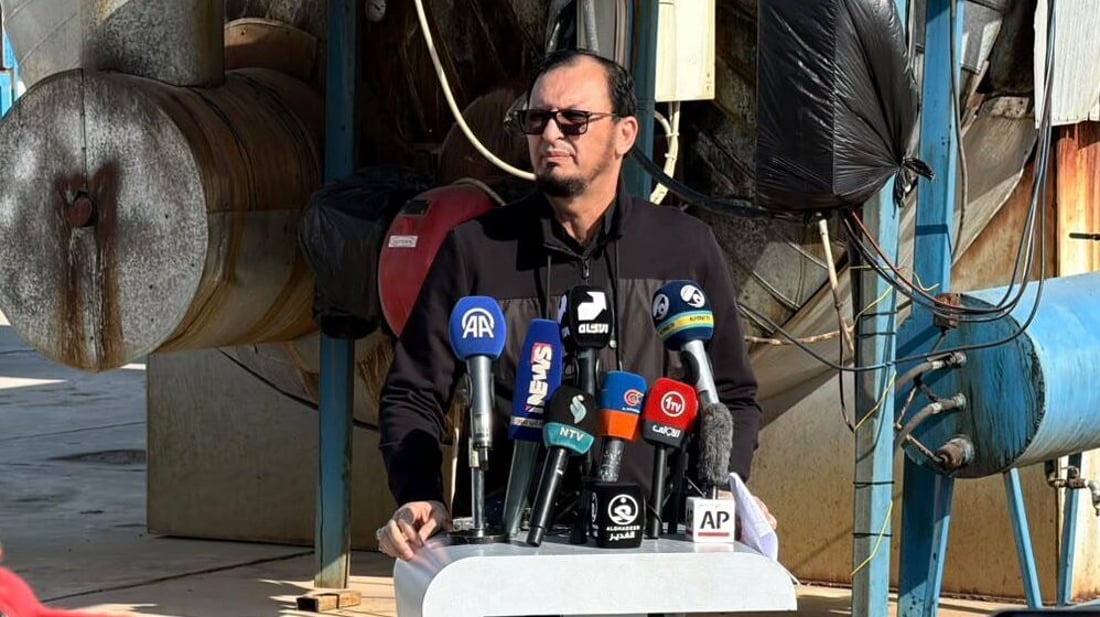
Senoior Kataib Hezbollah figure Abu Talib al-Saeedi speaks at a news conference beside a disputed oil-processing facility in Jurf al-Sakhar, Babil governorate, Nov. 17, 2026.
Confrontation fears mount
Kataib Hezbollah refuses to quit Jurf al-Sakhar ‘even over our bodies’
BABIL — Kataib Hezbollah will not leave Jurf al-Sakhar despite a government deadline, a senior faction figure told AFP on Tuesday, though he said there would be no fighting with the troops Prime Minister Ali al-Zaidi has ordered in.
“I can state with certainty, and say it categorically, that the dream they are dreaming, that the Kataib withdraw from Jurf al-Sakhar, will not come true, even over our bodies, our blood, our legacy, our wounded and our martyrs,” Abu Talib al-Saeedi told the French news agency during a media tour the Iran-aligned faction organized in the area.
The refusal came a day after the government said Zaidi had ordered the armed forces into Jurf al-Sakhar and given the faction a short deadline to leave. No date for the deadline has been announced. Abdul Amir Taiban, an adviser to Zaidi, told Dijlah TV on Monday that there would be no retreat from the decision to take control of the area.
Saeedi also held a news conference inside the closed area in northern Babil, where he accused Zaidi’s investigators of falsifying their oil smuggling findings and warned against a clash with security forces. “There will be no strife,” he said.
He said it would be averted by the wisdom of the faction’s secretary-general, Ahmed al-Hamidawi, known as Abu Hussein, whom he called “the living martyr,” and by the intervention of “the wise” in politics and public opinion.
Saeedi said the dispute was political, not technical. “Iraq is now on the threshold of a crisis, and a big crisis, and there are those who want this crisis to grow,” he said.
He said the blood of men who had fought side by side was being put at risk by “the political decision and the adventure of the current head of government.” For 12 years, since Grand Ayatollah Ali al-Sistani’s 2014 call to arms against the Islamic State group, the faction’s fighters and the security forces had held the same front line, he said. They fought beside the army, the Federal Police and the Counter-Terrorism Service to retake Jurf al-Sakhar, he said.
The deadline has exposed a rift within Kataib Hezbollah, a source told 964media on Monday. Popular Mobilization Forces Chief of Staff Abdul Aziz al-Muhammadawi favors a deal that would let federal forces take over parts of the area, while Hamidawi opposes further security concessions, the source said. The U.S. State Department has described Muhammadawi as a former Kataib Hezbollah secretary-general.
Hamidawi’s wing has proposed putting off any handover until June 30, 2027, the government’s deadline for bringing all weapons under state control, according to the source. Saeedi’s remarks to AFP set no such date. The faction has not publicly commented on the proposal.
At the news conference, Saeedi stood in front of what he said was the site the government links to oil smuggling. “This is a plant, in fact a primitive plant,” he said.
The plant is about 5 kilometers from the three pipelines that are alleged to have been tapped, Saeedi said, and he asked how it could be tied to the theft. “Where is this pipeline?” he said.
He said the plant runs only during fuel shortages, turning fuel oil that the faction buys “with our own money” into diesel for generators and vehicles. That fuel serves a sector stretching hundreds of kilometers from Musayyib in Babil to al-Qaim on the Syrian border, he said. The material inside showed the plant had been idle “for many months,” he added.
The government gives a different account. Government spokesperson Haider al-Aboudi told the state-run Iraqi News Agency on Monday that the investigating committee found clear tampering with the pipelines at six sites, as well as attempts to bury the traces. It also found two refineries, a tanker and storage tanks, which he said pointed to a supply of crude oil to run them. Three branches of the strategic Basra-Haditha pipeline cross the area the faction controls, two to Dora in Baghdad and one to Musayyib, Aboudi said in a televised interview Sunday.
“We did not restrict the committee,” Saeedi said. He rejected Aboudi’s statement that investigators had faced provocation inside the area.
The faction’s fighters had prepared lunch for the committee, he said. “We had no grudge against them. We did not know they intended, unfortunately, to falsify the facts.”
Saeedi told the journalists at the news conference that they would be taken to every site the committee had visited.
Accounts of the committee’s access differ. Sources told 964media that Kataib Hezbollah refused to let Zaidi’s first committee in. Under a deal with Muhammadawi, an official of the Popular Mobilization Commission, the state body that runs the PMF, took the chair, and investigators visited only sites agreed in advance, the sources said. Babil Provincial Council Chairman Asaad al-Muslamawi told the state-run Al-Iraqiya TV on Friday that the committee had met no objection or obstruction but had more sites to visit.
Kataib Hezbollah denied smuggling oil in a statement Sunday and accused Zaidi’s office of spreading “fabricated reports.” It said the plant improves fuel quality for its military vehicles. A day earlier, Zaidi relieved nine security and oil officials of their duties over the committee’s findings and ordered everyone accused referred to the courts. Those relieved included Babil’s police chief, the governorate’s PMF commander and the director of the Oil Pipelines Company.
Also on Tuesday, a judicial committee investigating the smuggling went to Jurf al-Sakhar with the government’s committee to inspect the sites, an official source told the state-run Iraqi News Agency. It announced no findings Tuesday.
The PMF is the state-sanctioned umbrella of mostly Shiite armed groups formed in 2014 to fight Isis. Kataib Hezbollah has brigades in the PMF, and the United States designated it a terrorist organization in 2009.
Jurf al-Sakhar was officially renamed Jurf al-Nasr in 2014 after Iraqi forces and allied armed groups recaptured it from Isis. It has been closed since then, and many of its displaced residents still cannot return.