
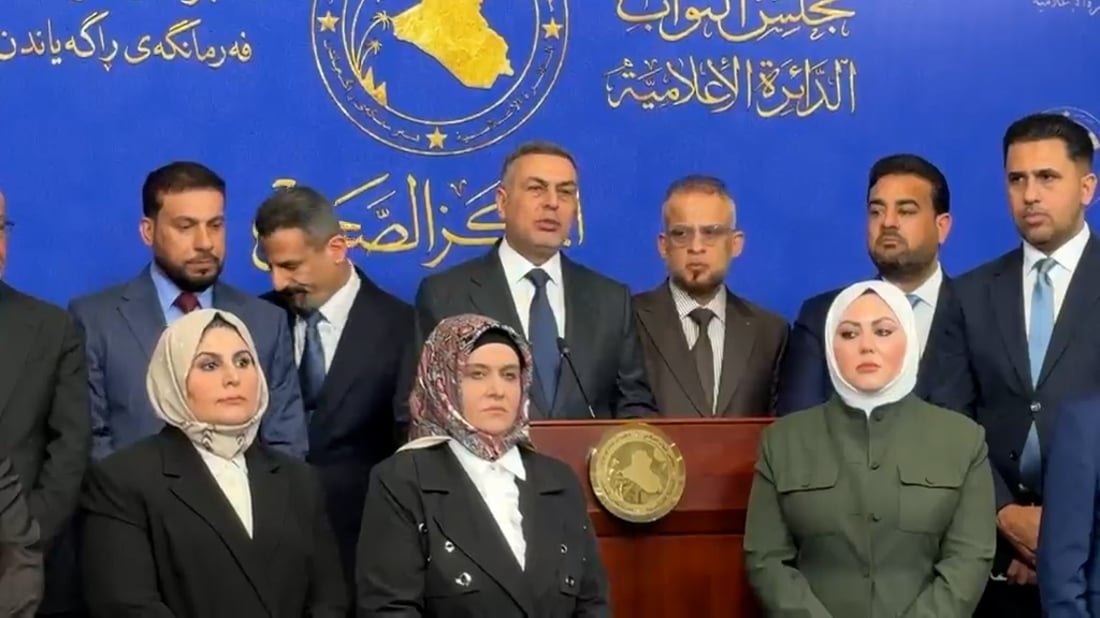
Basra Governor Asaad al-Eidani addresses a news conference alongside lawmakers at Iraq’s parliament in Baghdad, Nov. 18, 2026.
Provincial allocations disputed
Basra governor accuses Iraq’s finance minister of halting project funding
BAGHDAD — Basra Governor Asaad al-Eidani on Wednesday accused Finance Minister Falih al-Sari of stopping funds for governorate projects that the Finance Ministry itself had approved. He said the governorates would take the dispute to parliament if Sari did not reverse the decision.
Eidani spoke at a news conference with parliament’s Finance Committee at the parliament building in Baghdad. He said the governorates were asking only for the law to be applied. If the minister did not back down, he said, they would turn to parliament as “the house of the people.”
“We are surprised that the finance minister wants to stop the funding. In fact, he has stopped all funding for projects the Finance Ministry approved, projects that touch citizens’ needs and their lives, and now he stands as a stumbling block, in a clearly arbitrary way,” Eidani said.
He did not say how much money the halt covered or when the ministry stopped paying.
Eidani reminded Sari, a former lawmaker, of his years in parliament. He said Sari had sat on the Finance Committee in every term since 2014, chaired it for a time and had read out budget provisions giving the governorates half of their border-crossing revenue and their petrodollar funds. Petrodollar funds are the per-barrel share of oil revenue that federal law sets aside for oil-producing governorates.
“If we go back to the old videos, we will find that the finance minister was a member of the Finance Committee and read out that 50% of border-crossing revenue and petrodollar funds go back to the governorates,” he said.
Eidani warned against halting payments from the regional development program, which funds local projects in the governorates, and from the petrodollar funds while paying only salaries.
“If any emergency happens in the governorates, God forbid, the blame will be thrown on the local authorities as a government, and on parliament to deal with the problem,” he said.
“The minister has no right to interpret the law. The governorates’ rights were approved by the Federal Board of Supreme Audit, the coordination commission and the governorates law,” Eidani said. He asked how one person could stop all of it when the Finance Ministry had approved the projects itself.
The commission he named is the Supreme Commission for Coordination Among Governorates, which the prime minister chairs and which brings federal ministers together with the governorates. The governorates law is Law No. 21 of 2008, which governs the governorates that are not part of a region.
Asked why the governorates’ dues had not been paid, Eidani said the minister “interprets the law as he sees fit.”
“I am an executive. It is neither my right nor my duty to interpret the law. The legislature is the one that interprets the law, and amending the Financial Management Law is parliament’s right. It is not the finance minister’s right to interpret it as he pleases,” he said.
The Finance Ministry had not publicly responded to Eidani’s remarks as of Wednesday.
Eidani was among the officials the Finance Committee hosted on Nov. 12 to discuss Basra’s petrodollar dues and its share of revenue from the border crossings in the governorate, the committee said in a statement. A deputy finance minister, the planning minister, the head of the Federal Board of Supreme Audit and representatives of Basra’s protest movement also attended. The committee called for a clear road map for funding strategic projects, particularly in northern Basra’s districts and in Shatt al-Arab and Zubair.
In a voice message to Basra residents on Nov. 4, during a sit-in by residents demanding services outside the West Qurna 1 oil field, Eidani said Basra had not been paid its border-crossing dues for about a year and a half and that petrodollar payments had stopped in September 2024. The next day, Basra’s lawmakers demanded the governorate’s petrodollar funds and called for a sovereign fund under parliament’s oversight to rebuild it.
On Aug. 24, the cabinet set 2.5 trillion dinars (about $1.9 billion at the time) for regional development projects in the governorates outside the Kurdistan Region and 2 trillion dinars (about $1.5 billion) in petrodollar funds under the 2023 budget law, the prime minister’s media office said.
Iraq has had no 2026 budget. Spending has run on the one-twelfth rule since the three-year budget law covering 2023 to 2025 expired. Under that rule, monthly spending is capped at one-twelfth of the previous year’s actual current spending while there is no budget law. The draft 2027 budget had still not reached parliament on Tuesday, two days after its Nov. 15 target.
The government has not published the draft. On Nov. 4, Ahmed al-Fatlawi, the general coordinator for governorate affairs at the coordination commission, told iNews that Prime Minister Ali al-Zaidi had agreed to raise the draft’s regional development money from 3.5 trillion dinars to 4.5 trillion (about $3 billion at the official rate). With 1.5 trillion dinars (about $990 million) in petrodollar funds, that would give the governorates 6 trillion dinars (about $3.9 billion), he said.