
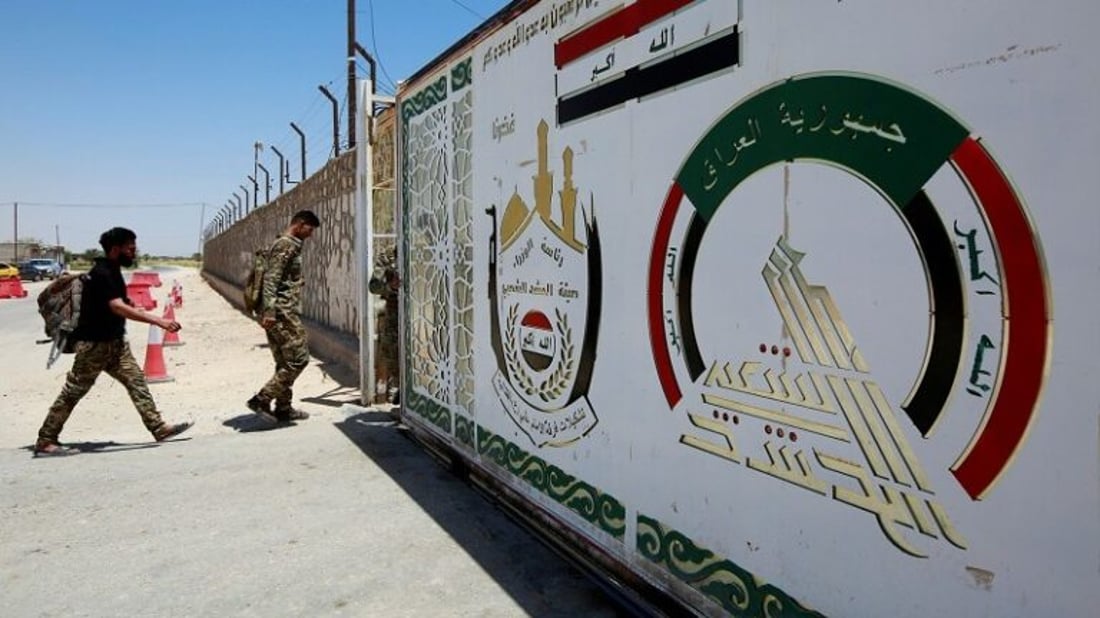
PMF denies dismissal of commander behind Jurf al-Sakhar pipeline offer
BAGHDAD — The Popular Mobilization Commission on Wednesday denied that Maj. Gen. Ali al-Hamdani had been removed as commander of Middle Euphrates operations for the Popular Mobilization Forces, a day after he made an offer on Kataib Hezbollah’s behalf in the Jurf al-Sakhar standoff.
Some social media pages had circulated reports that a decision had been issued to dismiss Hamdani, said the commission, the state body that runs the PMF. “We affirm that the report is completely untrue,” it said in a statement.
The commission urged media outlets and pages to check their facts, rely on official sources and stop spreading rumors, especially under the current circumstances. It did not say who had started the reports.
At a news conference in Jurf al-Sakhar on Tuesday, Hamdani said Kataib Hezbollah was ready to let the Energy Police guard the oil pipelines that cross the area, from where they enter it to where they leave. The faction would also dig along both sides of the pipelines to show they are intact, he said. The Energy Police is the Interior Ministry force that guards oil and power sites.
The government accuses the Iran-aligned faction, which is widely regarded as controlling the northern Babil area, of smuggling oil from those pipelines. Prime Minister Ali al-Zaidi has ordered the armed forces into Jurf al-Sakhar and given the faction a short deadline to leave, the government said Monday. It has not said when the deadline expires.
On Saturday, Zaidi relieved nine security and oil officials over the findings of his oil smuggling inquiry. The posts listed included the PMF commander in Babil but not the Middle Euphrates operations command. The government’s statement did not name any of the nine.
Government spokesperson Haider al-Aboudi named Kataib Hezbollah as the party behind the smuggling on Sunday. He said three branches of the strategic Basra-Haditha pipeline run through the area the faction controls.
Kataib Hezbollah denies smuggling oil from Jurf al-Sakhar. It has said Zaidi’s investigators found no tampering with the pipelines and documented only fuel tanks and a plant that supplies fuel to its military vehicles.
Leaders of the Coordination Framework, Iraq’s ruling alliance of Shiite parties, turned down Zaidi’s insistence on combat forces at a meeting Monday evening, a source in the alliance told 964media. They proposed instead that other PMF units replace the force that holds Jurf al-Sakhar.
Also on Wednesday, senior commanders, among them the commission’s director of operations, agreed to study proposals to redeploy forces and redraw sectors of responsibility in northern Babil and Jurf al-Sakhar, the commander-in-chief’s office said. Gen. Abdul Amir al-Shammari, the office’s director, chaired the meeting on Zaidi’s orders.
The PMF is the state-sanctioned umbrella of mostly Shiite armed groups formed in 2014 to fight the Islamic State group, and Kataib Hezbollah has brigades in it. Jurf al-Sakhar was officially renamed Jurf al-Nasr in 2014 after Iraqi forces and allied armed groups recaptured it from Isis. It has been closed since then, and many of its displaced residents still cannot return.