
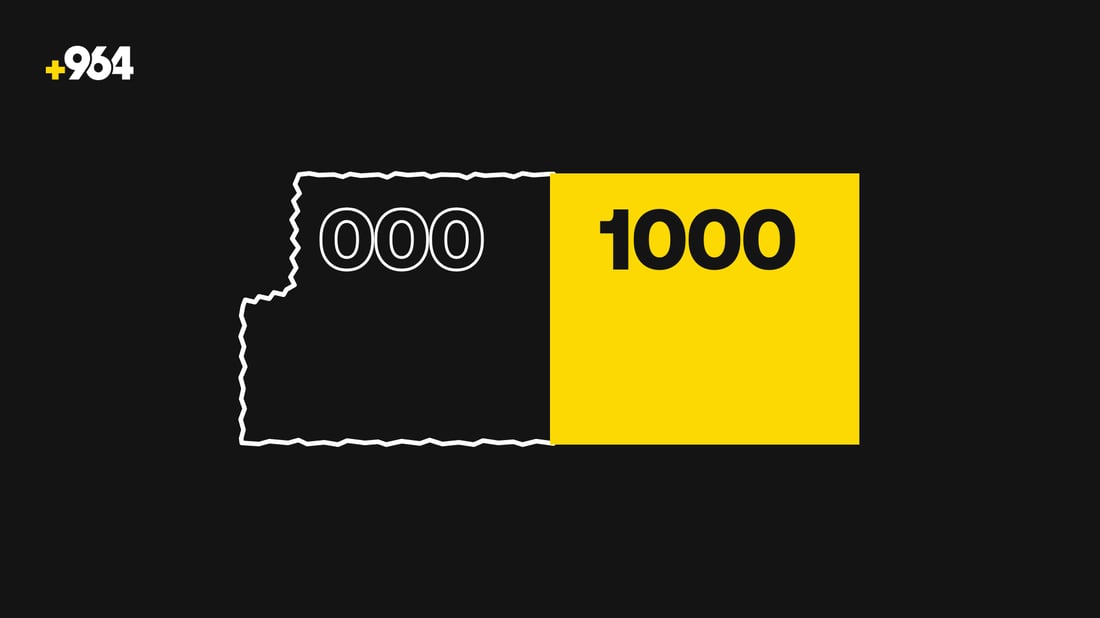
Iraq’s Central Bank says removing zeros requires new law, favors currency redesign
BAGHDAD — The Central Bank of Iraq prefers to redesign the dinar’s banknotes for now rather than remove zeros from the currency, a step that would need a law passed by parliament and new notes, its spokesperson said Wednesday.
Mahmoud Dagher, an adviser to the Central Bank governor and the bank’s spokesperson, said in an interview with Al-Nahrain TV that removing zeros would go far beyond issuing replacement notes, because it would bring many legal and financial changes with it.
“Let’s give an example: A share price on the stock exchange is now 1 dinar, so what would its value be if we wanted to remove zeros?” Dagher said. “We need a law that reorganizes that, and there are many things resulting from it, such as stakes and other matters.”
Passing such a law would not be difficult in itself, he said, but under present conditions the bank sees changing only the notes’ design as the better option.
Countries that have dropped zeros did it by law. Turkey’s parliament passed a law in January 2004 under which 1 new lira replaced 1 million old lira from Jan. 1, 2005. Iran’s parliament voted 144 to 108 on Oct. 5, 2025, to take four zeros off the rial, with old and new notes to circulate side by side for up to three years.
A redesign means new banknotes with modern designs and advanced security features, with the same purchasing power and the same denominations as the notes they replace.
Iraq has replaced every note in circulation before. Between Oct. 15, 2003, and Jan. 15, 2004, the Coalition Provisional Authority exchanged the old dinar for new notes at 250 bank branches and collected more than 10,000 metric tons of old notes, it said.
Removing zeros would also mean printing a new note for every one in circulation, Dagher said, and Iraq’s notes are printed by what he called one of the world’s four best currency printers. “The issue isn’t just a matter of picking up the phone and telling them, ‘Send us 10 tons of wheat,'” he said.
His remarks match ideas already under discussion between the bank and parliament’s Finance Committee. A committee member told 964media in September that lawmakers and monetary officials had largely set aside removing zeros for now. They favored a new banknote series, possibly with new denominations, to replace worn and counterfeit notes and draw cash kept at home back into the banking system.
Under ideas the committee reviewed, ordinary sums would be exchanged simply. Larger amounts could require opening a bank account, depositing the money and passing know-your-customer and source-of-funds checks instead of receiving cash. A threshold of 100 million to 150 million dinars (about $66,000 to $99,000 at the official rate) was discussed, with no figure agreed.
About 102 trillion dinars (about $77 billion at the time), nearly 92% of the currency issued, was held outside banks at the end of June, according to Central Bank data. When India scrapped its 500- and 1,000-rupee notes in November 2016, 99.3% of their value came back to the central bank, the Reserve Bank of India reported in 2018.
The bank has also moved note replacement online. On Oct. 18, it launched an online service for replacing damaged banknotes through the government’s Ur e-services platform.
In a 2024 interview with Iraq 24 TV, before he took up his Central Bank posts, Dagher said removing zeros would not change purchasing power or inflation. “The idea of removing zeros has been in the mind of the Central Bank of Iraq for a long time. It is currently under study, and we will not be the first country to take this step,” he said then.
Wednesday’s remarks follow months of speculation about redenomination that has unsettled the currency market.
The Central Bank denied on Aug. 26 that it had printed new banknotes with zeros removed, warning that unverified reports about monetary policy could harm people’s financial interests. In September, economist Amr Hisham told the state-run newspaper Al-Sabah that officials’ talk of removing zeros had pushed Iraqis to buy dollars as a hedge. Baghdad exchange shops were then selling $100 for about 160,250 dinars, against an official rate of 132,000.
On Oct. 1, a government source told the state-run Iraqi News Agency that no plan or timetable to remove zeros had been approved and that the proposal was still at an early stage of study.
Six days later, on Oct. 7, the Central Bank devalued the dinar, raising the official rate from 1,320 to 1,520 dinars per dollar and citing economic and financial pressures. On Oct. 29, Central Bank Governor Nizar Nasser Hussein told a parliamentary committee visiting the bank that no new currency was being printed.
On Monday, Baghdad exchange shops were selling $100 for 171,400 dinars, about 13% above the official rate of 152,000, according to 964media’s daily rate check.