
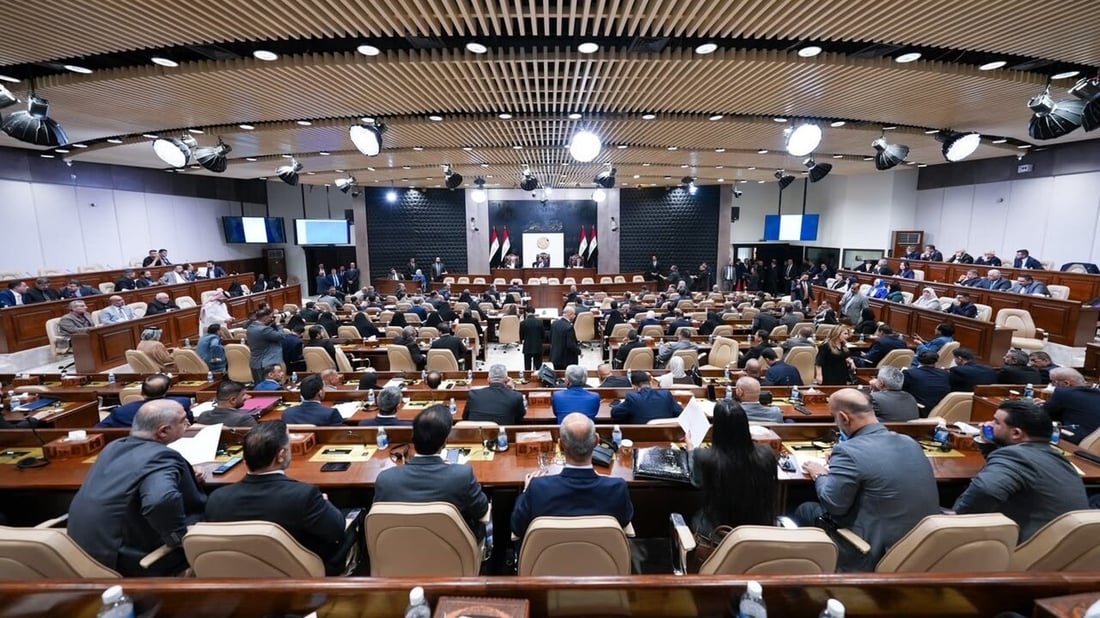
Iraqi lawmakers attend a parliamentary session in Baghdad.
2027 budget to reach parliament November 15, a month past legal deadline
BAGHDAD — Iraq’s draft 2027 budget has been delayed and will reach parliament on Nov. 15, a month after its legal deadline, the chair of parliament’s Finance Committee, Uday Awad, said Monday.
“Sending the draft budget law to parliament has been postponed to Nov. 15,” Awad told the state-run Iraqi News Agency. He gave no reason for the delay. Under the Financial Management Law, the draft was due in parliament by Oct. 15.
Awad said his committee backs the government’s plan to move contract employees and daily wage workers onto the permanent payroll. “The committee supports making contract employees and daily wage workers permanent, and we are working with the government to make them permanent,” he said.
Prime Minister Ali al-Zaidi on Saturday ordered all contract employees and daily wage workers made permanent and 120,000 new posts created in the 2027 budget. His office said the posts would be open to all groups and divided fairly among the governorates by population, with a dedicated application platform to ensure fairness.
The order covers more than 500,000 people, according to a Finance Ministry count, government spokesperson Haider al-Aboudi said in an interview with state-run Al-Iraqiya TV. Of the new contract posts, 50,000 will go to the security services and 70,000 to ministries and governorates, he said. Neither the government nor the ministry has given a cost.
The state already spends about 7.7 trillion dinars a month on salaries and other payments to about 10 million employees, pensioners and welfare recipients, according to the prime minister’s financial adviser, Mazhar Mohammed Salih, who gave the figure in August.
Finance Minister Falih al-Sari first announced the move in September, without saying how many people it would cover. He has since said the 2027 budget includes an allocation for contract employees and daily wage workers and uses an adjustable oil price assumption to deal with price swings.
Sari did not say what oil price the draft assumes, and no official figures have been published. Committee member Abbas Ahyal said on Oct. 7 that the draft is built on oil at $58 a barrel and an exchange rate of 1,500 dinars to the dollar. He put spending at about 217 trillion dinars (about $140 billion at the official rate) and the deficit at about 50 trillion.
Economists Nabil al-Marsoumi and Abdulrahman al-Mashhadani, citing the same draft, put the deficit at about 45 trillion dinars on exports of about 4 million barrels a day, above what Iraq exported before the war with Iran. Iraq exported about 2.6 million barrels a day in September as of Sept. 21, according to the Oil Ministry, against 3.3 million to 3.5 million before shipping through the Strait of Hormuz was disrupted.
The Ministerial Council for Economy approved the draft and sent it to the cabinet on Sept. 27. Aboudi said on Saturday that the cabinet would hold a special session on its details before sending it to parliament for debate and a vote.
Oil provides more than 90% of federal revenue. Iraq has had no budget this year, with spending governed by the one-twelfth rule since the three-year law covering 2023 to 2025 expired, and the government acknowledged a fiscal crisis in late July, when salaries went out in stages.