
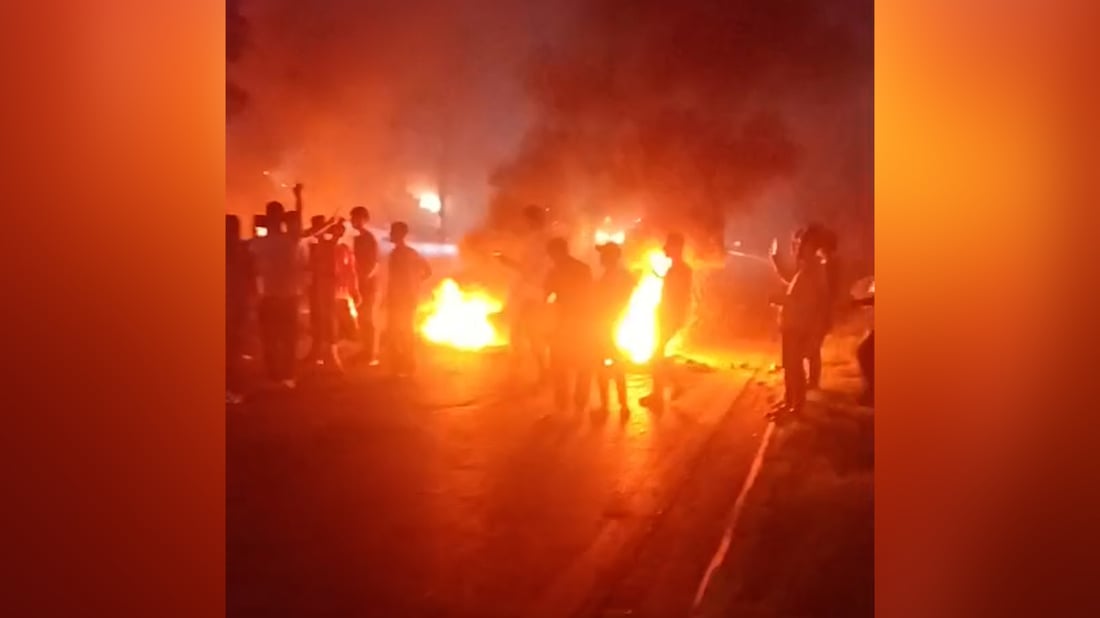
Protesters gather around burning tires on a street in Kirkuk on Monday night, Nov. 2, 2026
Security forces deployed
Kirkuk protests spread as generator owners strike over council’s fee cut
KIRKUK — Protests spread to at least five areas of Kirkuk late Monday after private generator owners went on strike against a council-ordered cut in their fees, leaving neighborhoods across the city in the dark.
The Kirkuk Provincial Council on Monday set the monthly price of one ampere of generator power at 13,000 dinars (about $7.70 at the street rate) after two nights of protests over a price increase. The rate satisfied neither side. Owners said it would not cover their costs, and protesters told 964media it should go lower still.
Army units, police and tactical forces deployed across the city as protesters burned tires, blocked main roads and confronted security personnel. Security forces chased protesters through densely populated neighborhoods, and several police and traffic police booths and other public facilities were damaged, 964media correspondents reported.
Protests were reported in the June 1st neighborhood, the Qadisiyah and Askari neighborhoods, Ihtifalat Square and Panja Ali, and protesters also blocked roads with burning tires near the University of Kirkuk. Security forces reopened Baghdad Road, but Quds Street and the Kirkuk-Dibis road were still closed late Monday as crowds gathered at the Arafa overpass.
Owners began switching off their generators around midday Monday. Kirkuk police that evening ordered them to keep to the operating hours set by the local administration, under Decision No. 65, which was issued Monday after the council’s emergency session.
“We will not allow any person or party to exploit the generator issue to disturb civil peace or stir up chaos in the street,” the police said in a statement.
First Deputy Governor Rebwar Taha on Monday evening told the generator owners’ association to restart immediately. The Electricity Ministry had agreed in a phone call to raise Kirkuk’s share of the national grid from 650 megawatts to 800 MW until the dispute is settled, according to a governorate statement.
Mohammed Mustafa, one of the generator owners who gathered outside the Kirkuk district administration building Monday, told 964media they would not switch on under the council’s decision. He said supplying one ampere really costs 24,000 dinars (about $14), and that owners receive only 20% of their fuel from the state and buy the rest themselves.
“Now we are losing money at that price, and yet it has been made 13,000 dinars,” Mustafa said, referring to the 18,000-dinar rate set on Sunday.
At its emergency session, the council also ruled that residents will not have to pay arrears left by earlier pricing decisions. Council chairman Mohammed al-Hafiz told a news conference that the council would work with the Kirkuk Operations Command and the police on legal action, including arrests, against owners who refuse to run their generators or ignore the new price. He said the council would also file a complaint against the committees that set the earlier prices.
The council moved the management of private generators to the governorate and set up a department to oversee them. It ordered generator services across Kirkuk automated before the start of 2027 and said the 13,000-dinar rate must be observed until the end of the month.
The dispute began Sunday, when the Kirkuk district administration raised the rate for October from 14,000 dinars (about $8.30) to 18,000 dinars (about $11) per ampere, an increase of nearly 29%, after meeting the generator owners’ association.
Hawri Zangana, an administrative affairs official at the district administration, said Sunday that the national grid was supplying only a few hours of power a day and that diesel on the black market had reached 280,000 dinars a barrel (about $170). He said the subsidized allocation of 20 liters per kilovolt-ampere covers only about 109 hours of generator running time a month.
Protests began Sunday evening in Wahid Huzairan and spread to the Asra wa Mafqudin neighborhood and Airport Street, where residents blocked roads with burning tires. They said the increase would add to the burden on families already struggling with rising living costs.
The protests turned into a night of clashes with security forces. Some protesters threw stones and Molotov cocktails at security personnel, and riot police used batons to disperse crowds. At least three security personnel and several protesters were injured and four protesters were detained, according to 964media correspondents. Hundreds of officers were deployed, and civil defense teams put out fires.
On Monday morning, the district administration cut the rate to 15,000 dinars (about $8.90), citing difficult economic conditions and the need to ease the financial pressure on residents. Protests went on in several neighborhoods, including Shorja, where residents blocked part of a street and demanded a rate of 10,000 dinars (about $5.90), below the original rate before the price increase that set off protests in the first place.
The unrest came a day after Interior Minister Yasser al-Maliki visited Kirkuk and warned against letting the quota system, which shares out state posts among parties, shape security in the governorate. He said security must be kept out of political rivalries.
Private generators remain an essential source of electricity for homes and businesses across Iraq because the national grid cannot supply power around the clock. Subscribers pay a monthly fee for the number of amperes they take, and local authorities generally set prices according to fuel costs, grid supply and required operating hours.
The dispute follows a nationwide shutdown announced by private generator owners in August over fuel allocations, taxes and fees. Prime Minister Ali al-Zaidi then ordered subsidized diesel for generators and required operators to provide at least 20 hours of power a day in combination with the national grid.
In Baghdad, the provincial council on Monday set November rates at 12,000 dinars (about $7.10) per ampere for premium service and 8,000 dinars (about $4.70) for regular service.
Kirkuk’s November schedule, set by the district administration, has private generators running 16 hours a day, from 6 a.m. to 9 a.m. and from noon to 1 a.m.