
Disarmament
Jurf al-Sakhar could bring Iraq’s arms deadline forward, spokesperson says
BAGHDAD — Iraq’s takeover of Jurf al-Sakhar will help it bring weapons under state control before the June 30, 2027, deadline, the commander-in-chief’s spokesperson said Sunday, without giving a new date.
Sabah al-Numan, spokesperson for the commander-in-chief of the armed forces, told the state-run Iraqi News Agency that the operation in the northern Babil area, officially renamed Jurf al-Nasr in 2014, showed that every force there, including the Popular Mobilization Forces, answers to one command under Prime Minister Ali al-Zaidi.
“Part of the current government’s resolve is restricting and regulating weapons, and what happened in Jurf al-Nasr will contribute to speeding up or bringing forward the set date for restricting and regulating weapons,” Numan said, using the area’s official name.
He did not say how much earlier the government now expects to finish or announce any change to the timetable.
Iraq set June 30, 2027, as the deadline for bringing weapons under state authority, and the Coordination Framework, the ruling alliance of Shiite parties, endorsed the date in October and authorized Zaidi’s government to take whatever measures were needed to meet it. Zaidi had persuaded Washington to push back an earlier Sept. 30, 2026, deadline, a presidential spokesperson said at the time.
“What happened in Jurf al-Sakhar gave a clear example that all the weapons there are under the command of the commander-in-chief of the armed forces and are used only according to the orders and duties assigned to them,” Numan said.
No other authority can sway that command or the loyalties of the security forces, he said. Zaidi is keen to keep security and strategic decisions in one set of hands, and the replacement of the units in the area was carried out on his orders, Numan said.
“The recent events in Jurf al-Nasr are practical proof that there is one security decision, and that the Iraqi armed forces take their orders from the commander-in-chief of the armed forces, the prime minister,” he said.
Four formations from different security bodies now report to the area’s new joint command: the army, the Federal Police, the PMF and the Energy Police, the Interior Ministry force that guards oil and power sites. The command’s leaders have been given the powers to command and control them and to issue them executive orders, Numan said.
He described the handover as orderly and smooth. The commander-in-chief’s office issued a plan to replace the units, and coordination and operational meetings with the commanders of the forces involved turned it into orders carried out on the ground, he said.
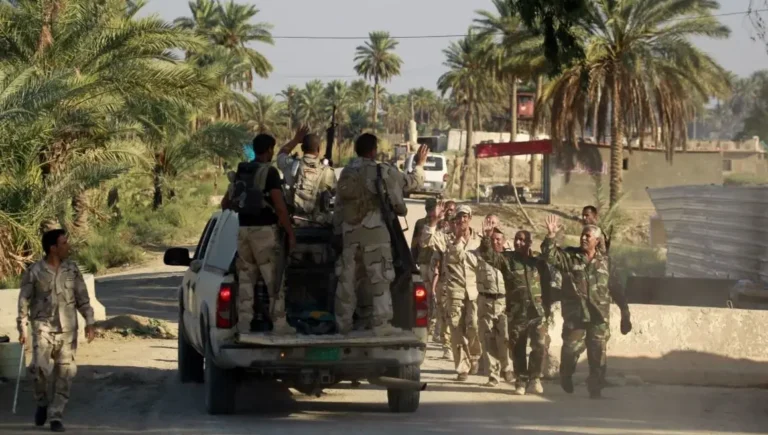
Iraqi forces began moving into Jurf al-Sakhar on Friday, when the joint command took charge under Federal Police leadership. They are replacing the PMF’s 45th, 46th and 47th brigades, which belong to Kataib Hezbollah, an Iran-aligned armed faction that has held the area since 2014. Under a plan Zaidi approved on Wednesday, the PMF’s 72nd and 79th brigades, the army’s 38th Brigade and the Federal Police’s 17th Brigade each take a sector, and an Energy Police regiment guards the oil pipelines that cross the area.
The faction has not fully left. Kataib Hezbollah fighters were still posted at the Fadhiliya side of the area on Saturday, footage obtained by 964media showed. The first battalion of the 45th Brigade had begun withdrawing, and the handover would take less than a month, Lt. Gen. Saad Maan, head of the Public Relations and Government Communication Authority at the commander-in-chief’s office, said in an interview that day. The three brigades would be given duties elsewhere, he said.
Officials have not said how many of the faction’s fighters remain in the area or what will happen to its weapons and facilities there.
On Oct. 13, Numan said most armed factions had responded positively to the 2027 deadline. Kataib Hezbollah had said on Sept. 30 that it was not bound by any timetable. Zaidi’s plan sets a 90-day halt to attacks from Sept. 30, followed by a gradual six-month handover of weapons.
On Friday, Zaidi told the forces moving in that the state’s drive to impose its authority across Iraq starts in Jurf al-Sakhar, and asked them for restraint. “Our decision is firm: no weapons outside the authority of the state,” he said.
A day earlier, Kataib Hezbollah’s secretary-general, Ahmed al-Hamidawi, known as Abu Hussein al-Hamidawi, said differences with the “head of the authority,” an apparent reference to Zaidi, would be handled through private channels, and told his fighters to return to their normal duties. His statement followed consultations with Iran’s Quds Force commander Esmail Qaani, Badr Organization leader Hadi al-Amiri and Falih al-Fayyadh, chairman of the Popular Mobilization Commission, the state body that runs the PMF.
On Saturday, the road from south of Baghdad through Jurf al-Sakhar to Karbala opened to civilian traffic, though trucks remain barred. The area’s roads had been closed to civilians since 2014. Displaced residents will be allowed back gradually once forces have assessed security and services are restored, officials have said, but no date has been set.
The standoff began after an Interior Ministry intelligence report started circulating Nov. 9. It alleged that oil was being drawn from pipelines in Jurf al-Sakhar and carried away in tanker trucks. On Nov. 14, Zaidi relieved nine security and oil officials after a government committee reported tampering with the pipelines and found two refineries in the area. Kataib Hezbollah denies smuggling oil and has accused Zaidi’s office of circulating fabricated reports.
The PMF is the state-sanctioned umbrella of mostly Shiite armed groups formed in 2014 to fight the Islamic State group. Iraqi forces and allied armed groups recaptured Jurf al-Sakhar from the Islamic State group that year. The area has been closed since, and many of its displaced residents have been unable to return.