
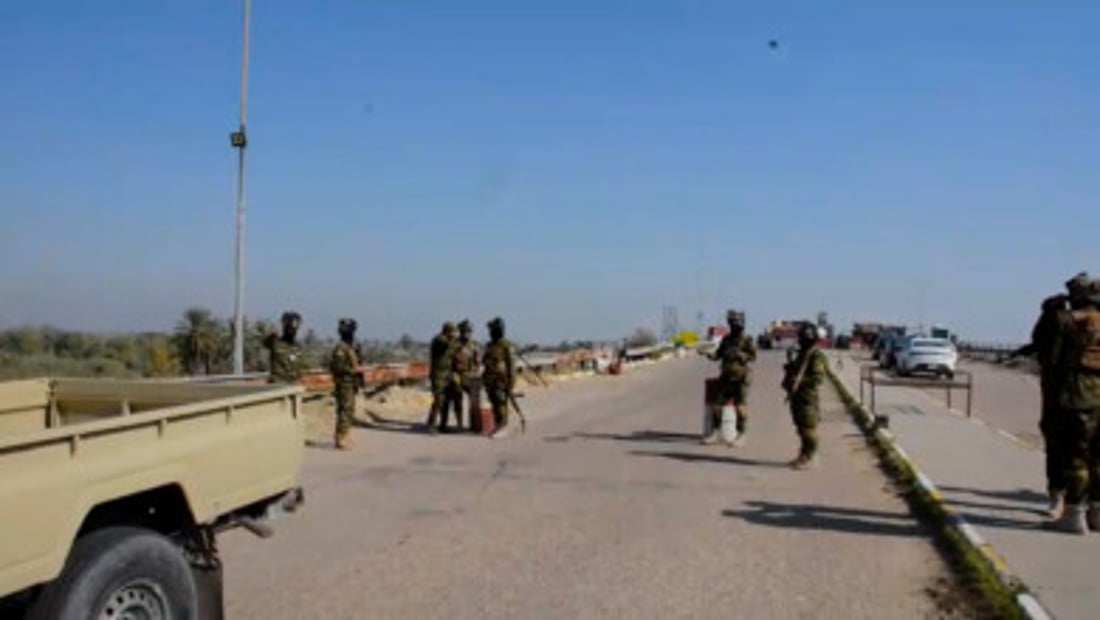
Kataib Hezbollah fighters remain in Jurf al-Sakhar as pullout begins
BABIL — Kataib Hezbollah fighters were still deployed at the entrance to Jurf al-Sakhar on Saturday, a day after Iraqi forces began moving in, as the government said the faction’s three brigades would be gone within a month.
Footage obtained by 964media showed the Iran-aligned faction’s fighters posted at the Fadhiliya side of the northern Babil area, which was officially renamed Jurf al-Nasr in 2014.
The first battalion of the Popular Mobilization Forces’ 45th Brigade, one of the three Kataib Hezbollah brigades in the area, began withdrawing on Saturday, Lt. Gen. Saad Maan said in an interview with presenter Sami Qasimi. Maan heads the Public Relations and Government Communication Authority at the commander-in-chief’s office, formerly the Security Media Cell. The PMF’s 79th and 72nd brigades will take the faction’s place, he said.
“They are three brigades, so they will be given other duties in other areas, depending on need, distribution, the replacement of units and the redeployment,” Maan said.
The handover will take less than a month, he said. “Any replacement of units needs technical and logistical arrangements, ‘furniture’ and everything related to these details, and within a month the process will be completed gradually,” Maan said. Every country sets a time limit when it rotates security forces, he added.
Sabah al-Numan, spokesperson for the commander-in-chief of the armed forces, had said before the operation began that “Kataib Hezbollah will withdraw from Jurf.” Earlier on Saturday, he told the state broadcaster Al-Iraqiya that the army’s 38th Brigade had finished taking over its sector and that much of a Federal Police brigade and part of the PMF brigade replacing the previous force had deployed. The Energy Police regiment guarding the oil pipelines had also completed its deployment, he said. Under the plan, the forces’ sectors will be extended to cover all of Jurf al-Sakhar and its surroundings, including desert areas, Numan said.
Civilian cars began crossing the Fadhiliya bridge between Baghdad and Babil on Saturday morning after about 12 years of closure, footage followed by 964media showed. Police and PMF commanders and other officials attended the reopening, which the Baghdad Karkh Police Command oversaw.
The road from Latifiya, south of Baghdad, through Jurf al-Sakhar to Karbala also opened to civilian traffic Saturday, Maan’s authority announced. The Interior Ministry said it had set up 12 security posts along the oil pipelines in the area.
Government spokesperson Haider al-Aboudi said Saturday that pursuing powerful figures, officials and politicians in the Jurf al-Sakhar oil smuggling case was “not ruled out.” Displaced residents will return gradually through the new joint command, and forces are surveying parts of the area that may be mined, he said.
Iraqi forces began deploying in Jurf al-Sakhar on Friday, when Numan announced that the new joint command had opened and that the 45th Brigade had begun handing its sector to a new PMF brigade. Prime Minister Ali al-Zaidi had ordered the forces in and the area’s closed roads opened.
On Thursday, Kataib Hezbollah Secretary-General Abu Hussein al-Hamidawi said in a statement that problems with the “head of the authority,” an apparent reference to Zaidi, would be handled through private channels. He told his fighters to return to their work “as it was before the alert.” Senior faction figure Abu Talib al-Saeedi said in a speech before the statement was read that the faction would leave Jurf al-Sakhar only “over their bodies.”
The standoff began after an Interior Ministry intelligence report began circulating Nov. 9. It alleged that oil was being drawn from holes in pipelines in Jurf al-Sakhar and carried away in tanker trucks. On Nov. 14, Zaidi relieved nine security and administrative officials and referred those accused to the courts.
Kataib Hezbollah denies tampering with the pipelines. The faction has held Jurf al-Sakhar since Iraqi forces and allied armed groups recaptured it from the Islamic State group in 2014, and the area’s residents are still displaced.