
Karbala road through Jurf al-Sakhar reopens to traffic as tribe calls for civilian return
BAGHDAD — The road from south of Baghdad through Jurf al-Sakhar to Karbala opened to civilian traffic on Saturday, a day after Iraqi forces began taking over the area from the Iran-aligned faction Kataib Hezbollah.
Lt. Gen. Saad Maan, head of the Public Relations and Government Communication Authority at the commander-in-chief’s office, told the state-run Iraqi News Agency that the road was open. The authority was formerly the Security Media Cell. The Baghdad Operations Command had said the road would open in both directions at 6 a.m. It runs from Latifiya through Qamishli, the Fadhiliya bridge, Jurf al-Sakhar and Jamaliya to Karbala.
The road is open to civilian vehicles only, and trucks remain barred, the commander-in-chief’s spokesperson had said Friday. Jurf al-Sakhar’s roads had been closed to civilians since Iraqi forces and allied armed groups recaptured the northern Babil area from the Islamic State group in 2014.
The Baghdad Karkh Police Command reopened the Fadhiliya bridge between Baghdad and Babil governorates on Friday evening after years of closure. In a statement, it said its commander, Maj. Gen. Adnan Hassan Hamad, oversaw the reopening and that a new checkpoint on the bridge would check vehicles and control who enters and leaves. The aim was to make travel between the two governorates easier, “especially toward Jurf al-Nasr,” it said, using the area’s official name since 2014.
Replacing the units inside Jurf al-Sakhar is happening in stages and will be finished “in a short time,” Maan told Alahad TV on Friday. He gave no date. The new command running the area is led by Lt. Gen. Ahmed Hatem Hamid, with support from the army and the Popular Mobilization Forces, he said.
Sabah al-Numan, spokesperson for the commander-in-chief of the armed forces, told the state-run news agency Friday that the PMF’s 45th Brigade had begun handing its sector to a new PMF brigade. “It is proceeding very smoothly according to the set plan,” he said. The 45th is one of three Kataib Hezbollah brigades in the area.
Roads to Amiriyat al-Fallujah and the rest of Anbar governorate will also reopen once the deployment is complete and the area is secured, Numan said. Forces are coordinating with the four operations commands around the area so the new deployment leaves no gaps, he said. Local authorities will then draw up plans to restore services and infrastructure so displaced residents can return, he said.
The Energy Police Command said Friday it had set up 12 security posts and a regiment headquarters to guard the oil pipelines and facilities in Jurf al-Sakhar. It also opened a road along the pipelines so forces can move and watch them more easily, it said. The force’s director general had said earlier Friday that it would post personnel every 500 meters along the 5-kilometer stretch inside the area.
In Anbar, a police force deployed Friday in the Owaisat area of Amiriyat al-Fallujah district as a reserve for the forces inside Jurf al-Sakhar, ready to respond to any emergency, the Anbar Police Command said. The interior minister ordered the deployment, and Anbar police chief Maj. Gen. Adel Hamed Rashid oversaw it, the command said.
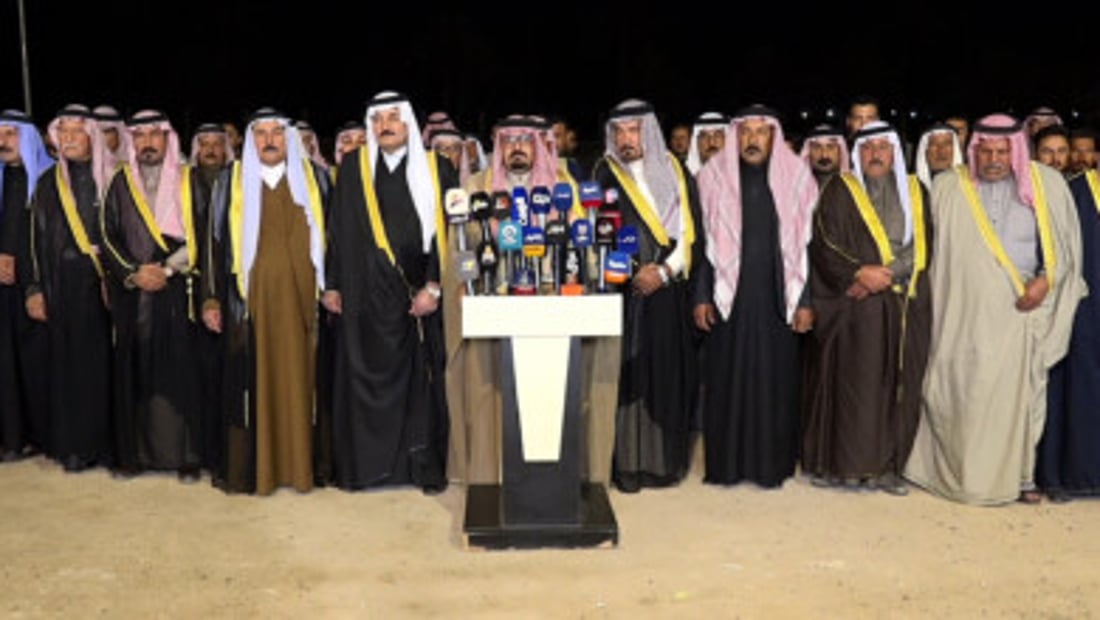
Also on Friday, the Albu Issa tribe called for displacement to end and for families to be returned to their home areas, starting with Jurf al-Sakhar, Owaisat and Albu Issa. “The return of the displaced to their original areas is a cornerstone for achieving social justice, turning the page on the past and strengthening peaceful coexistence,” tribal spokesperson Sabah Nouri al-Dahal told a news conference attended by 964media in Bzebiz, in Amiriyat al-Fallujah district. The tribe’s leaders, headed by Ziad Kamel al-Dahal, said they fully supported Prime Minister Ali al-Zaidi.
In Washington, U.S. President Donald Trump praised Zaidi when reporters at a White House news conference on Friday asked whether he could bring armed groups under state control. “He’s a good guy. I mean, he’s a strong guy. I think when he wants to do something, he’s able to do it,” Trump said.
“He is my friend,” Trump said, adding that Zaidi “was in 10th place and I endorsed him and he won in a very big upset.” Zaidi did not run in the November 2025 parliamentary election. The Coordination Framework, the alliance of Shiite parties, nominated him for prime minister in April. Trump did not say what he expected Baghdad to do about the factions’ weapons.
On Saturday, UTV presenter Ahmed Mulla Talal posted on X, formerly Twitter, a photo of himself with Zaidi taken Friday. He suggested the area be renamed Jurf al-Iraq, “away from the dispute over the name between Jurf al-Sakhar and al-Nasr.”
Zaidi ordered all closed roads in Jurf al-Sakhar opened on Thursday. On Friday, he told the forces moving in that the state’s drive to impose its authority across Iraq starts there. Kataib Hezbollah Secretary-General Abu Hussein al-Hamidawi said in a statement read out in the area Thursday that differences with the “head of the authority” would be handled through private channels. Before it was read, senior faction figure Abu Talib al-Saeedi said Kataib Hezbollah would leave only “over their bodies.”
The standoff began after an Interior Ministry intelligence report began circulating Nov. 9. It alleged that oil was being drawn from holes in pipelines in Jurf al-Sakhar and carried away in tanker trucks. Zaidi then relieved nine security and administrative officials and referred suspects to the courts. On Nov. 16, he ordered the armed forces into the area and set a deadline for the faction to leave. Kataib Hezbollah denies smuggling oil. Kataib Hezbollah has held Jurf al-Sakhar since 2014, and its residents are still displaced.