
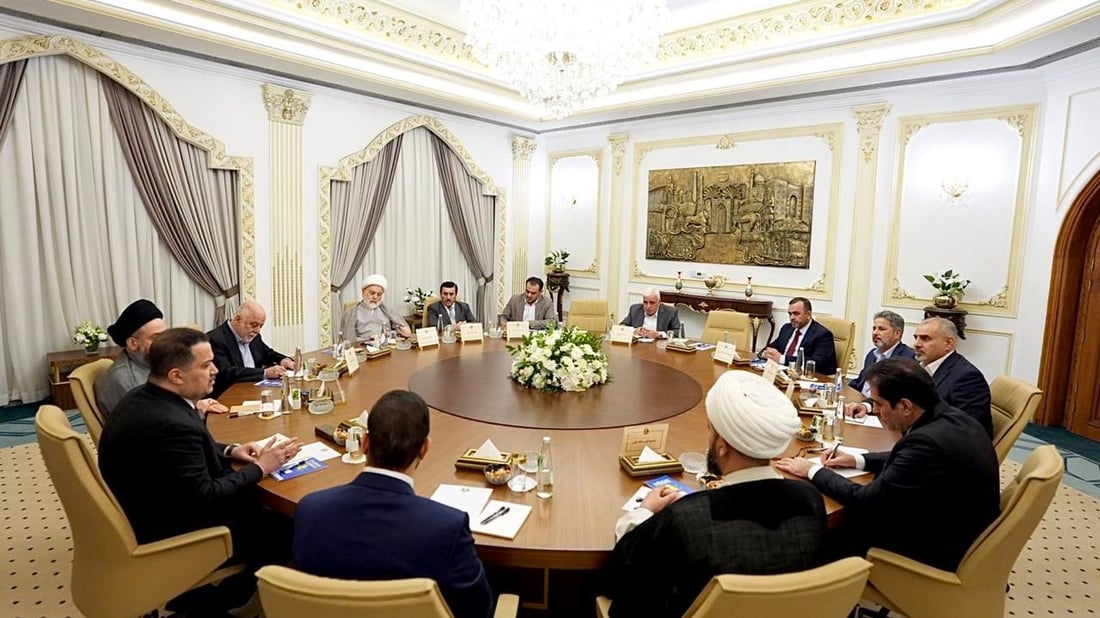
Iraq’s Coordination Framework meets in Baghdad on Oct. 19, 2026, to discuss disarmament, government priorities and regional tensions.
Framework backs June 2027 weapons deadline, ‘authorizes’ government to enforce it
BAGHDAD — The Coordination Framework on Monday reaffirmed its commitment to bringing weapons outside state control under government authority by June 30, 2027, and authorized Prime Minister Ali al-Zaidi’s government to take whatever measures are needed to meet the deadline.
The ruling Shiite alliance announced the decision after its 300th regular meeting, held at the office of former Prime Minister Mohammed Shia al-Sudani and attended by Zaidi. It did not say what the government could do to factions that miss the deadline.
Zaidi persuaded Washington to push the deadline back from Sept. 30, 2026, to June 30, 2027, after the United States threatened economic measures if the original date was missed, presidential spokesperson Khalid al-Yaqoubi said Monday. Disarmament required gradual steps and agreements rather than an immediate decision, he said. U.S. envoy Tom Barrack said after Zaidi’s September meeting with President Donald Trump in New York that the two countries had agreed that military force would be held only by the Iraqi state by the end of June.
Zaidi’s timetable sets a 90-day halt to attacks from Sept. 30, followed by a six-month handover of weapons, and includes disarming non-Iraqi armed groups in the country. In September, Reconstruction and Development bloc leader Bahaa al-Araji said most factions had accepted it but some wanted two years instead of six months. The Islamic Resistance in Iraq said on Sept. 30 that its four factions were not bound by any government or political deadline. Sabah al-Numan, spokesperson for the commander-in-chief, said on Oct. 13 that most factions had responded positively, and Asaib Ahl al-Haq leader Qais al-Khazali said on Sunday that weapons outside state control were one of the government’s two biggest challenges.
The Framework also discussed the allocation of parliamentary committee chairs, formed a leadership committee to review stalled constitutional legislation and laws needed for the government’s program, and discussed financial policy on living standards, markets, development funding, poverty and unemployment. It stressed keeping Iraq out of regional conflicts and supporting de-escalation.