
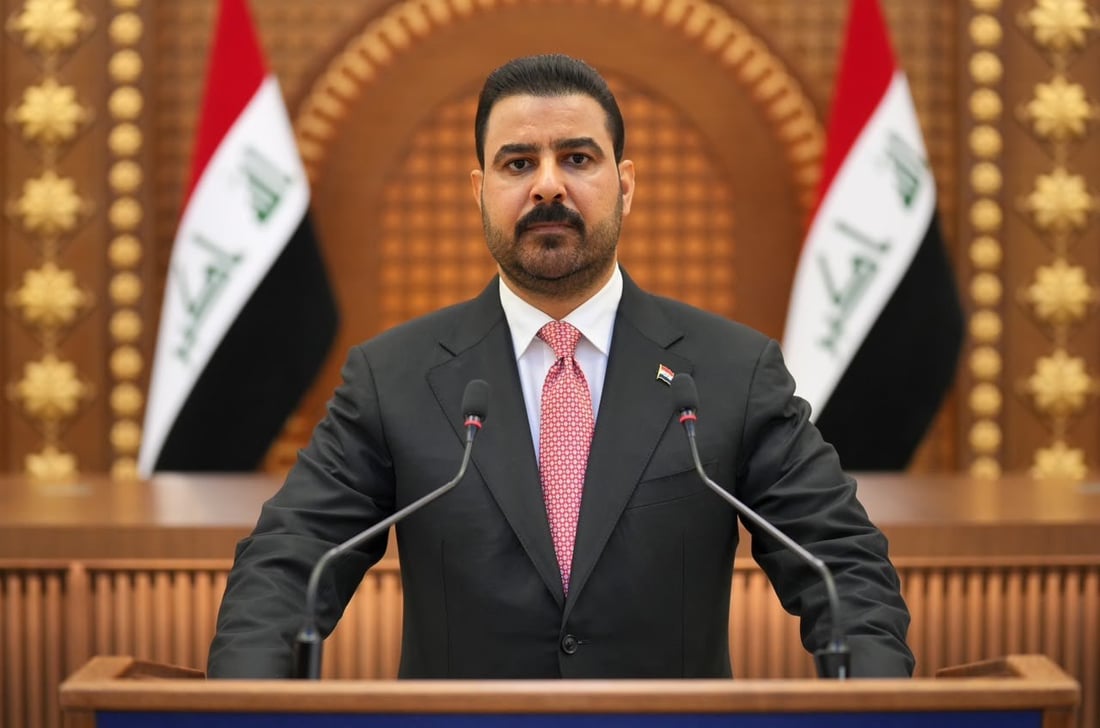
Prime Minister Ali al-Zaidi
Security roadmap begins
Zaidi pledges to disarm non-Iraqi armed groups as coalition mission ends
BAGHDAD — Prime Minister Ali al-Zaidi said Thursday his government would begin disarming non-Iraqi armed groups operating in the country and bring Iraqi factions’ weapons under state control by June 30, 2027, a day after the U.S.-led coalition formally ended its mission in Iraq.
“Oct. 1, 2026, marks the serious beginning of addressing the issue of weapons outside state control and fulfilling constitutional obligations, according to a clear roadmap and agreed timetables that do not extend beyond June 30, 2027,” Zaidi said.
He said the government would prohibit military action outside constitutional authority and uphold the principle that decisions of war and peace belong exclusively to the state.
“The government, with God’s help and in accordance with the constitution, will work to completely disarm all non-Iraqi armed groups present on Iraqi territory,” Zaidi said, describing the measure as a way to protect the country’s security, stability and borders. He did not name the groups.
Zaidi also said the government would begin purchasing a complete air-defense system to strengthen control over Iraqi airspace, without identifying a supplier, cost or delivery date. Iraq would prevent its territory and airspace from being used as a launch point or transit route for attacks on neighboring countries, he said, and would reject the use of other countries’ territory or airspace to attack Iraq.
He pledged to legislate a law governing the Popular Mobilization Forces and reaffirm their position within the official security establishment under the commander-in-chief.
The announcement builds on a timetable Zaidi set earlier: a 90-day halt to attacks beginning Sept. 30, followed by a six-month weapons handover ending June 30, 2027. Sabah al-Numan, spokesperson for the commander-in-chief, said in September that once national authorities became the sole source of security decisions, “any justification for acting outside the frameworks of the state falls away.”
The coalition mission, established in 2014 to support Iraqi forces against ISIS, formally concluded Wednesday when Zaidi declared it over at a National Sovereignty Day ceremony. The Pentagon said coalition forces had completed their withdrawal from Erbil Air Base, the last coalition base in Iraq, and that Washington would continue targeted training and intelligence support for Iraqi partners. Combined Joint Task Force-Operation Inherent Resolve remains operational from Jordan.
The Foreign Ministry said Wednesday the end of the mission marked Iraq’s “transition to a new phase in which it assumes full responsibility for its security and stability,” but “does not mean the end of cooperation with friendly countries.” Future security ties would move to bilateral frameworks covering training, capacity building and exchanges of expertise and information, the ministry said, thanking the United States and other coalition members, including personnel killed in operations against the Islamic State group.
National Security Adviser Qasim al-Araji likewise pointed to continued intelligence coordination, information sharing, training and capacity building. Coalition commander Rear Adm. Liam Hulin said Iraq should now “take the initiative” in managing its own security.
The weapons timetable remains contested. The Islamic Resistance in Iraq said Sept. 30 that its four factions were not bound by government or political deadlines and would keep their weapons until they verified the complete withdrawal of U.S., NATO and other foreign military forces. Ashab al-Kahf separately rejected handing over its arms and threatened a military response to any continued foreign military presence. Other political figures have said most factions accept the principle of state control over weapons but disagree over how quickly it should happen.
Muqtada al-Sadr, by contrast, dissolved his Promised Day Brigade on Sept. 30 and called for weapons to be placed exclusively under state control.
Khadamat Alliance spokesperson Hossam al-Rubaie said the coalition’s departure had removed a principal justification for armed groups operating outside state institutions. “Resistance is a state of societal rejection, not a profession,” Rubaie told journalist Hossam al-Haj on Dijlah TV.
“If today you want to be part of the defensive role of the security services, you must join these agencies and be under the command of the commander-in-chief of the armed forces as defined by the constitution,” he said.
Rubaie said Khadamat leader Shibl al-Zaidi, who previously fought U.S. forces, had set up a military structure out of what he described as an urgent need to defend Iraq when ISIS entered the country. The history and sacrifices of armed resistance should be preserved, Rubaie said, but not turned into “a bazaar for gains and entitlements.”
“Oct. 1 represents the beginning of a new phase in Iraq’s journey,” Zaidi said, describing it as one based on sovereignty, constitutional institutions and relations with regional and international partners built on mutual interests and respect.