
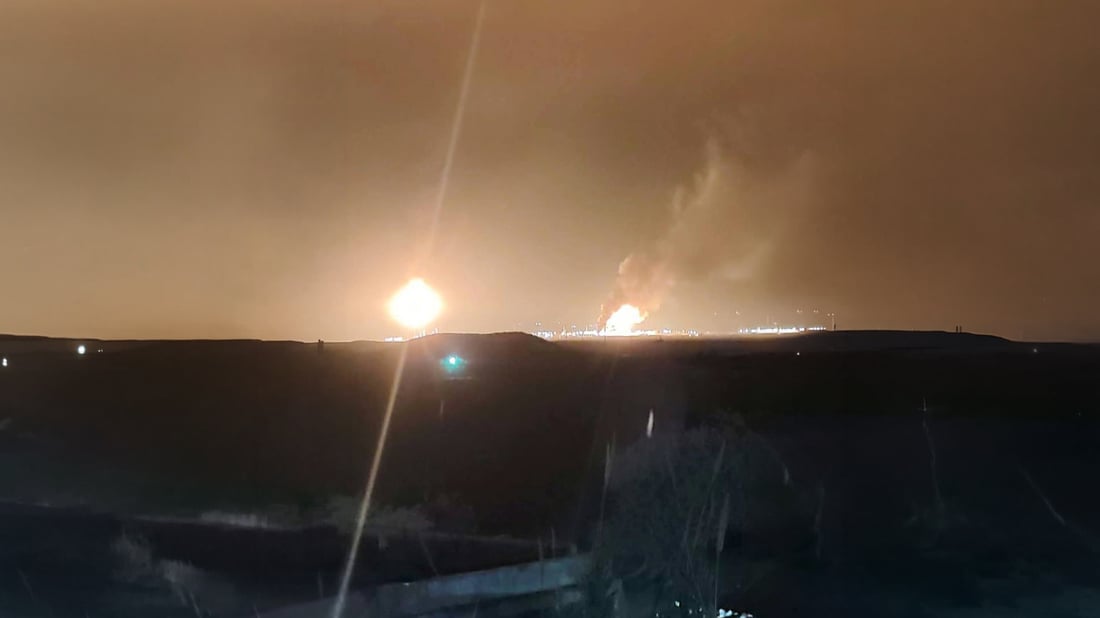
Flames and smoke rise from the Khor Mor gas field in Sulaymaniyah governorate following a suspected drone attack late Sunday, Nov. 8, 2026.
Air defense boost pledged
Iraq says it has identified Khor Mor attack’s launch site and those involved
BAGHDAD — Iraqi authorities have identified where the attack on the Kurdistan Region’s Khor Mor gas field was launched from and who was involved, Sabah al-Numan, spokesperson for the commander-in-chief of the armed forces, said Tuesday.
Numan gave no details. In remarks to the state-run Iraqi News Agency, he said the government was also working to equip its air defense forces with modern systems and radars to protect Iraq’s airspace and critical infrastructure, particularly oil facilities.
“The committee’s work was preceded by identifying the source from which this threat was launched and identifying the parties involved,” Numan said. He was referring to a high-level security committee that Prime Minister Ali al-Zaidi ordered to investigate the attack, overseen by the commander-in-chief’s office.
“The committee began its work as soon as the full information was established, and in coordination with the Kurdistan Region it will reach the perpetrators, and they will be brought to justice,” he said.
The attack late Sunday hit Khor Mor’s loading depot for liquefied petroleum gas, the household gas used for cooking and heating, which loads 1,500 metric tons a day, field sources told 964media. It also halted the gas that feeds the Region’s power stations, knocking nearly 3,000 megawatts off the grid. No group has claimed responsibility.
Dana Gas, the field’s UAE-based operator, kept production suspended Monday to assess the damage, and the power loss had eased to about 1,000 megawatts. Zaidi has ordered the federal Oil Ministry to supply the Region’s household gas until the field restarts.
Security ministries and agencies are continuously reviewing their areas of responsibility and may change deployments, particularly around critical infrastructure, Numan said. “There is an ongoing assessment of the performance of our security forces and the agencies responsible for these areas, along with continuous follow-up and coordination between the commander-in-chief’s office, the Defense Ministry and the Interior Ministry,” he said.
“The government is also continuing its efforts to equip air defense forces with modern air defense systems, modern radars and equipment to counter indirect attacks,” Numan said.
He said the systems would be meant to secure Iraq’s airspace and prevent attacks on all vital facilities, oil facilities in particular. Strengthening security at vital areas and facilities was very important, he said, “and perhaps the Kurdistan Region also has a share in this.”
Khor Mor, in the Qadir Karam subdistrict of Sulaymaniyah governorate’s Chamchamal district, has been hit by repeated rocket and drone attacks. A federal investigation into a Nov. 26, 2025, drone strike on the field found it was launched from areas east of Tuz Khurmatu, in Salah al-Din governorate, and said it was the 11th attack on Khor Mor from the same area. It said suspects had been identified and arrest warrants issued for several of them.
After that strike, Kurdistan Regional Government officials described it as part of a wider pattern of attacks on the Region’s energy infrastructure. Aziz Ahmad, deputy chief of staff to Kurdistan Region Prime Minister Masrour Barzani, blamed armed groups he described as “the usual terrorists on the federal government’s payroll.” He said electricity exports to the rest of Iraq, roughly 10% of the country’s generation, had stopped as well.
“How many attacks must happen before the US government simply allows the KRG to purchase kinetic anti-drone equipment for us to defend our skies and critical infrastructure? The Iraqi government isn’t interested,” Ahmad wrote at the time.
The Region has tried to buy its own defenses. A British anti-drone system delivered to Khor Mor in November 2025 could not be used because Britain would not accept KRG-issued end-user certificates and Baghdad refused to issue one, Ahmad has said. The Peshmerga Ministry says the Region has had no air defense since the U.S.-led coalition left on Sept. 30. Iraq says it expects air defense systems from South Korea, Turkey and the United States.