
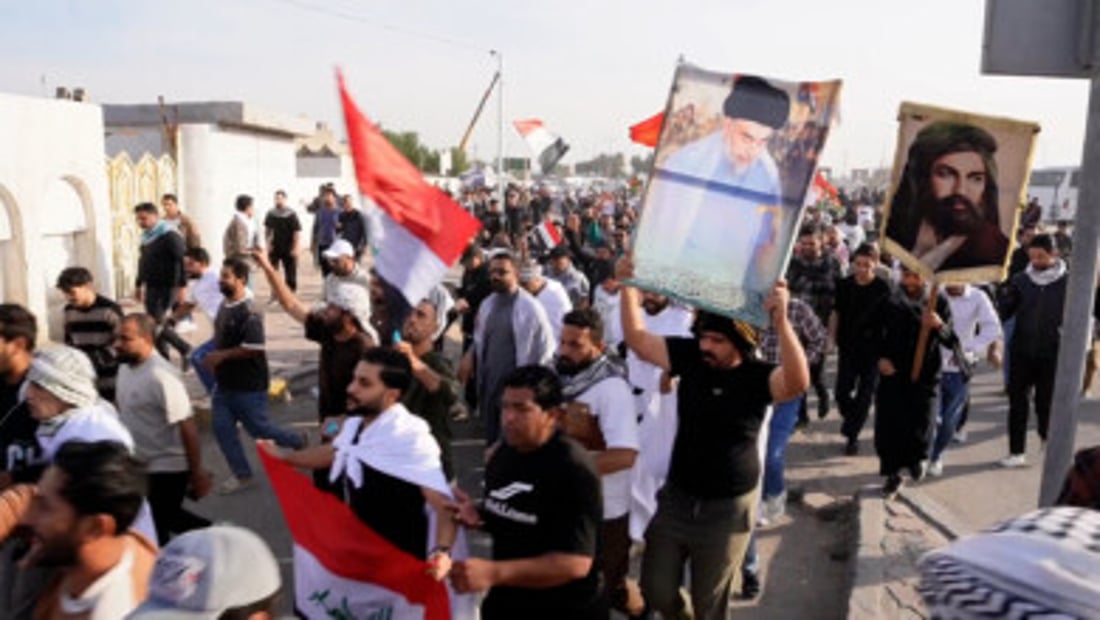
Unpaid Basra education staff wear burial shrouds and appeal to Sadr
BASRA — Contract staff and unpaid lecturers in Basra’s schools wore white burial shrouds outside the Basra Education Directorate on Sunday and appealed to Shiite cleric Muqtada al-Sadr, escalating a sit-in over months of unpaid wages.
The protesters gathered outside the directorate in Maqal with banners reading “I’m coming down to take my rights” and “No salary, no work.” They are demanding their overdue pay and a settlement for two groups of contract hires whose appointments have stalled.
Protesters in Iraq wear burial shrouds to show they are willing to risk everything for their rights.
Ali al-Muhammadi, a representative of the protesters, told 964media the sit-in had entered its seventh day. The contract staff want their back pay released and the two groups’ hiring completed, he said. One group’s case has been stalled for a year and the other’s for five months.
Muhammadi said the protesters had escalated because they had seen no clear action from the government. He urged the Finance Ministry, Education Minister Abdul Karim Abtan and Basra’s lawmakers to step in.
Another protester, Jabbar Ali, said the workers were asking for monthly salaries of 300,000 dinars (about $200 at the official rate). He said many had kept working in classrooms with no pay.
“Protesters are not targeting educational institutions; they are demanding fairness,” Jabbar Ali said. He called on Basra Governor Asaad al-Eidani and the federal authorities to act urgently.
Protester Aqeel Abdul Rahim Karim faulted Basra’s 25 members of parliament for failing to deliver a tangible response and appealed directly to Sadr, who leads the Shiite National Movement. Sadr’s movement boycotted the November 2025 parliamentary election and has stayed outside the political process.
Karima Rahim al-Zuhairi, another protester, said lecturers, teachers who work without a permanent contract, had taught in public schools for months without salaries. They have passed ministry exams and hold academic qualifications, she said. Zuhairi called on the education and finance ministries to settle their case.
Basra’s lawmakers were due to meet at the Finance Ministry in Baghdad on Sunday to press for the money to be released and the outstanding paperwork completed.
On Tuesday, contract staff kept the directorate’s building in Maqal shut for a fourth day over monthly salaries they say have gone unpaid for five to 11 months. They belong to three groups of education contract hires, known as the 10,000, the 19,000 and the Imam al-Sadiq contracts.
The protest is not the first. In September, contract staff went on hunger strike outside the directorate, and eight of them fainted in the heat, 964media correspondents reported on Sept. 14. On Nov. 2, Uday Awad, who chairs parliament’s Finance Committee, said the request for the 10,000 group’s salaries had reached the Finance Ministry and that pay would go out within two days.
Two days later, Basra lawmakers urged the Finance Ministry to settle salaries for the 19,000 posts, contract employees in Sadiq district and the 10,000-post contracts. On Nov. 16, Finance Minister Falih al-Sari said the government plans to make every remaining contract employee permanent. Two days later, Eidani accused Sari of halting funds for governorate projects his own ministry had approved.
Iraq has had no budget for 2026. The Finance Ministry said Thursday it had finished preparing the 2027 budget, but the draft has not yet reached parliament.