
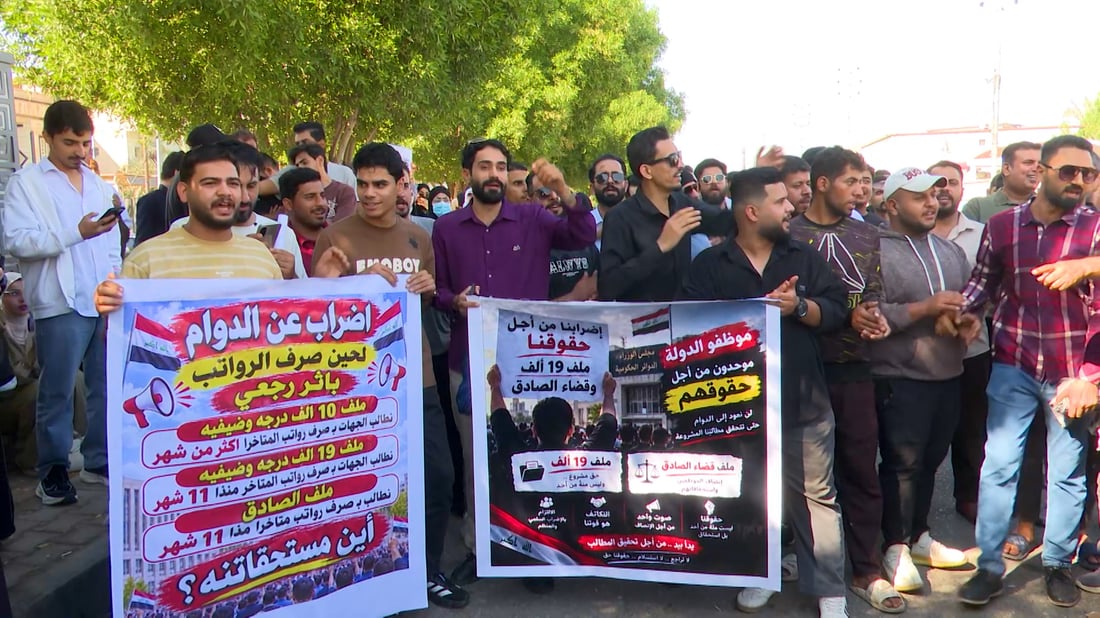
Basra contract staff unpaid for up to 11 months shut education directorate
BASRA — Contract staff kept the Basra Education Directorate’s building in Maqal shut for a fourth day on Tuesday over monthly salaries of 300,000 dinars (about $200 at the official rate) that they say have gone unpaid for five to 11 months.
The protesters belong to three groups of education contract hires, known as the 10,000, the 19,000 and the Imam al-Sadiq contracts. Some of them hold master’s degrees and, protesters said, have worked for about two and a half years under administrative orders and renewed contracts. The Basra branch of the Iraqi Teachers Union has joined the protest, and protesters threatened to block roads.
“This stand is to demand the rights of the holders of the 10,000, 19,000 and Imam al-Sadiq contracts, and we as a teachers union support them,” Safaa al-Samer, who heads the union in Basra, told 964media.
Samer said the union had called a solidarity stand with all contract staff to demand that their salaries be paid again and that money for the 19,000 and Imam al-Sadiq groups be set aside in the next budget. He warned of “the spark of protests starting from Basra and spreading.”
He called on Finance Minister Falih al-Sari “to apply the law, return rights to their owners and pay their financial dues.”
Protester Zahraa Mohammed told 964media that the 10,000 group had not been paid since July “without reasons,” and that the Imam al-Sadiq and 19,000 groups had gone 10 months without salaries.
“We are degree holders, and we came out to demand 300,000 dinars. Can any MP bear having his salary cut off for a single month?” she said.
Another protester, Ali Kadhim, gave a longer gap for the 19,000 group. “The 19,000 group has gone 11 months without salaries. They have families and living and health obligations, and we have had no response from the finance minister so far,” he told 964media.
Kadhim said the 10,000 group’s salaries had stopped five months ago, although its members had worked for about two and a half years with administrative orders and renewed contracts. “If the crisis goes on and salaries are not paid, the protesters will be pushed to escalate, as far as blocking roads,” he said.
Adel Abdul Hussein, whose son is among the protesters, told 964media he was a retiree with 35 years of service at a Basra company and had never seen anything like it in all those years.
“My son is in the 10,000 group, but I am also taking part in the protests in solidarity with the Imam al-Sadiq and 19,000 groups, because the situation has become unbearable,” he said.
Abdul Hussein urged members of the Basra Provincial Council and Basra’s 25 MPs to press the Finance Ministry and find out what had gone wrong. He faulted the Coordination Framework, the ruling alliance of Shiite parties, Basra Governor Asaad al-Eidani and the governorate’s MPs for letting the contract staff’s hardship drag on.
The protest is not the first. In September, contract staff went on hunger strike outside the directorate, and eight of them fainted in the heat, 964media correspondents reported on Sept. 14. On Nov. 2, Uday Awad, who chairs parliament’s Finance Committee, said the request for the 10,000 group’s salaries had reached the Finance Ministry and that pay would go out within two days.
Two days later, Basra lawmakers urged the Finance Ministry to settle salary payments for the 19,000 posts, contract employees in Sadiq district and the 10,000-post contracts. On Nov. 18, Eidani accused Sari of halting funds for governorate projects that his own ministry had approved.
Sari said on Nov. 16 that the government plans to move every remaining contract employee onto the permanent state payroll. Iraq has had no budget for 2026, and the draft 2027 budget has not yet reached parliament.