
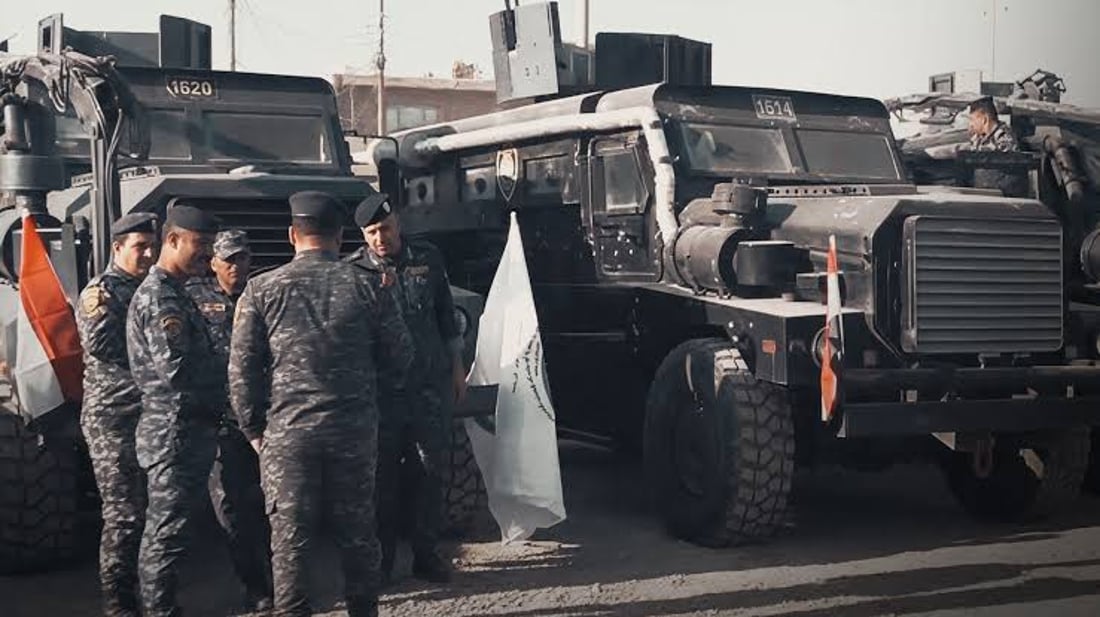
Iraqi security personnel stand beside armored vehicles during security operations in Jurf al-Nasr, Babil governorate.
Federal Police take 3 Jurf al-Sakhar checkpoints as Karbala road reopens
BAGHDAD — Federal Police have taken over three checkpoints and more than 30 kilometers of road in Jurf al-Sakhar as Kataib Hezbollah’s brigades are replaced, Iraqi security officials said Monday, and a route toward Karbala is open to civilian cars.
Lt. Gen. Saad Maan, head of the Public Relations and Government Communication Authority at the commander-in-chief’s office, told the state-run Iraqi News Agency that the handover of the northern Babil area, officially renamed Jurf al-Nasr in 2014, was going ahead in an orderly way under an approved plan. The authority was formerly the Security Media Cell. The joint command running the operation is coordinating the withdrawal and arrival of units on the approved timetable, he said.
The Federal Police now hold the Anwar checkpoint at the entrance to Jurf al-Sakhar, the Shuhada checkpoint on the road toward Fadhiliya and Mayadin and the Tahrir checkpoint near the Musayyib bridge, Maan said. Popular Mobilization Forces personnel are staying at the checkpoints as guides during the transition, while the Federal Police are responsible for securing them, he said.
The Federal Police have also set up posts and deployed units along more than 30 kilometers of the Fadhiliya road, from the bridge to the Mayadin intersection, Maan said.
The Energy Police have set up 15 security posts along a 5.2-kilometer section of oil pipeline, he said. The Energy Police Command had said on Friday that it had set up 12 posts.
Lt. Gen. Mohammed Qasim al-Fahd, the Federal Police commander, said Monday that the Fadhiliya road and the route through the Mayadin intersection toward Karbala were open to civilian vehicles, with police deployed along the whole stretch.
The road runs from the Fadhiliya bridge, which links it to the Mahmudiya and Latifiya sectors to the north, through Fadhiliya and its intersection to the Mayadin intersection, toward northern Karbala, Fahd told the state-run news agency. Reopening it will ease congestion, especially during religious pilgrimages and other occasions that draw large numbers of vehicles, he said.
The handover is on schedule and will continue until every unit covered by the plan has withdrawn, Fahd said. The forces now deployed are enough to secure the area, he said, with duties divided among the Federal Police, the army and the PMF’s 72nd and 79th brigades on the Karbala side.
The joint command is responsible for security operations, stability and the movement of traffic, Fahd said. Any future government development plans for the area will be for federal and local authorities, he said.
The new joint command took charge of Jurf al-Sakhar on Friday, when Iraqi forces began replacing the brigades of Kataib Hezbollah, the Iran-aligned faction that has held the area since 2014. The army, Federal Police, PMF and Energy Police serve under the command.
On Saturday, the road from Latifiya through Jurf al-Sakhar to Karbala reopened to civilian traffic after about 12 years of closure. The Fadhiliya bridge between Baghdad and Babil governorates had reopened Friday evening. Trucks remain barred.
Also on Saturday, Maan said the faction’s three brigades would be gone within a month, with the PMF’s 72nd and 79th brigades taking their place. Sabah al-Numan, spokesperson for the commander-in-chief of the armed forces, said the same day that the army’s 38th Brigade had finished taking over its sector.
Documents obtained by 964media on Wednesday showed that Prime Minister Ali al-Zaidi had approved a plan dividing Jurf al-Sakhar among the army’s 38th Brigade, the Federal Police’s 17th Brigade and the PMF’s 72nd and 79th brigades, with an Energy Police regiment guarding the pipelines. The standoff began after an Interior Ministry intelligence report, which began circulating Nov. 9, alleged that oil was being drawn from pipelines in the area and carried away in tanker trucks. Kataib Hezbollah denies smuggling oil.