
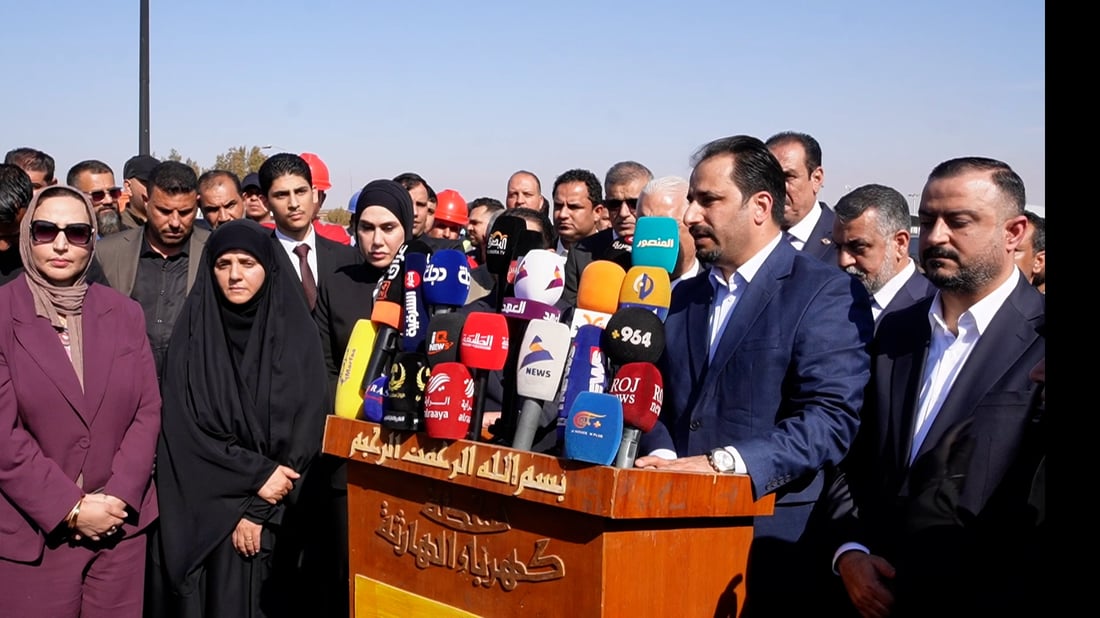
Members of Iraq’s parliamentary Electricity and Energy Committee speak to reporters during a visit to the site of the deadly gas pipeline explosion in Hartha, Basra governorate, Nov. 22, 2026.
Pipeline safety questioned
Iraqi lawmakers say homes hit by Hartha gas blast had title deeds
BASRA — Homes damaged in Saturday’s gas pipeline explosion at the Hartha power station north of Basra were legally owned and registered, lawmakers investigating the blast said Sunday. That contradicts the Interior Ministry’s first account, which said most of the victims lived in informal housing next to the station.
Members of parliament’s Electricity and Energy Committee met in Hartha district with the deputy electricity and oil ministers, civil defense officials and Basra’s deputy governor for technical affairs, Zaid al-Imara, who chaired the meeting. They looked at the state of the station and of the pipeline that feeds it, both built in the 1970s.
The lawmakers pledged to refer anyone found negligent to the judiciary, to compensate the victims’ families and the owners of damaged homes and property, and to work to move the aging pipeline. The officials will be questioned in parliament on Tuesday.
Falah Saeed, who chairs the committee, told 964media that Parliament Speaker Haibat al-Halbousi had sent the committee to the site to establish what happened.
“The station and the pipeline were built in the 1970s, while these houses and some schools and clinics were built later inside the line’s restricted zone,” Saeed said.
He said the committee had gone through the reports and observations of every authority involved, and that it would emerge later whether the blast was a technical failure or deliberate.
Lawmaker Jassim Marwar, a committee member, said the owners were employees and staff of the Electricity Ministry, and that the deeds had been issued under a previous minister.
“These houses are official, not encroachments. They are registered in the land registry, and their owners have title deeds,” Marwar told 964media.
He said the families would be compensated for their homes and property once the investigation was finished, and he asked the government to recognize the dead as martyrs, a status that entitles their families to state benefits.
Lawmaker Rajaa al-Harbi said she had met residents, and that one had offered to bring her his deed.
“The problem has existed for a long time. It did not happen today, and this is not the first incident,” Harbi told 964media.
She said there had been several earlier incidents, that lawmakers had raised them with the Oil Pipelines Company and sent it official letters, and that in 2024 she brought an official to parliament who had seen conditions in Hartha for himself. She called for decent housing for the residents and for the pipeline to be moved away from their homes.
“If the route is not changed, more disasters will happen,” she said.
The explosion happened early Saturday, when a gas pipeline feeding the Hartha thermal power station ruptured and caught fire. The flames spread to nearby homes, portable cabins and cars before civil defense teams put them out. A new video 964media obtained later on Saturday showed the blast burning for more than two minutes.
Residents of the Energy Houses neighborhood next to the station told 964media the blast struck while families were asleep. Murtadha Fadhil said it happened at about 5:45 a.m., that the pipeline had an earlier leak that was never fixed and that it was the second fire on the line. A relative of his died because the family could not get him out of the house, and fire crews arrived late, he said.
The cause has not been determined. The Oil Ministry’s legal department is checking whether there had been any encroachment on the pipeline, Qais al-Ahmed said in an interview with the Basra broadcaster al-Mirbad on Saturday. Ahmed is director general of the General Company for Electric Power Production in the Southern Region, the state power producer for the south.
Ahmed said one of the dead was a station employee who was killed at home. The 42-inch line is supplied by the Oil Ministry’s Oil Pipelines Company, and the ministry will assess the damage and plan the repairs, he said. The station is now running on fuel oil, not gas, so the power supply had not been affected, he said, though it still needs gas to start up because its igniters burn gas.
The Interior Ministry and the Security Media Cell first put the toll at four dead and 35 injured, calling the count preliminary. Health Ministry spokesperson Saif al-Badr later said 46 cases had been recorded, including two deaths, with three people in intensive care and most injuries minor to moderate. In an update Saturday, the Basra Health Directorate said 25 of the 46 had been discharged and 19 were still being treated.
On Saturday evening, residents lit candles and raised tribal banners at the gate of Hartha’s hospital, which they said had stood finished but unopened for years, leaving the injured to be taken to hospitals farther away. They threatened to boycott the next elections and reminded Governor Asaad al-Eidani how many votes he had won in the district.
“The people of Hartha came out today with burning hearts, after we buried our victims at noon, and smoke still fills the houses,” Hamid al-Maliki, who leads the Hartha protest movement, told 964media. He asked Prime Minister Ali al-Zaidi to send an audit committee to the district.
Another resident, Aqil al-Ayoubi, listed the blast among the district’s repeated tragedies, after a 2024 crash that killed six schoolchildren and the day an SUV killed nine Arbaeen pilgrims in the district in July.
Zaidi ordered an urgent investigation on Saturday to establish the cause and who was responsible, his office said. He promised compensation for the families of the dead and for the injured and said the affected families would be included in the million-plot housing scheme, known as the Watan Initiative.
Earlier that day, government spokesperson Haider al-Aboudi said Zaidi had ordered governors to count the homes built illegally on oil pipelines and in the no-build zones around them, and to include eligible occupants in the scheme.
Lawmaker Suzan al-Saad warned Saturday of “a second disaster” in Hartha. In a statement from her office, she said the state had built two schools directly over gas pipelines in the district’s Intisar neighborhood: the Jaber al-Ansari school and the Irada Ufuq al-Najah intermediate school, finished in 2018 and 2022. The line under them feeds power stations and a paper mill, and its control valves are far away in Shuaiba, which would make any leak or blast very hard to contain, she said.
The Oil Ministry had repeatedly warned Basra’s local government not to build over pipeline corridors, and the Oil Pipelines Company had filed a criminal complaint over the schools, the statement said.
Electricity Minister Ali Saadi Wahib held an emergency meeting on Saturday and ordered urgent work to repair the damage and prevent a repeat, his office said.