
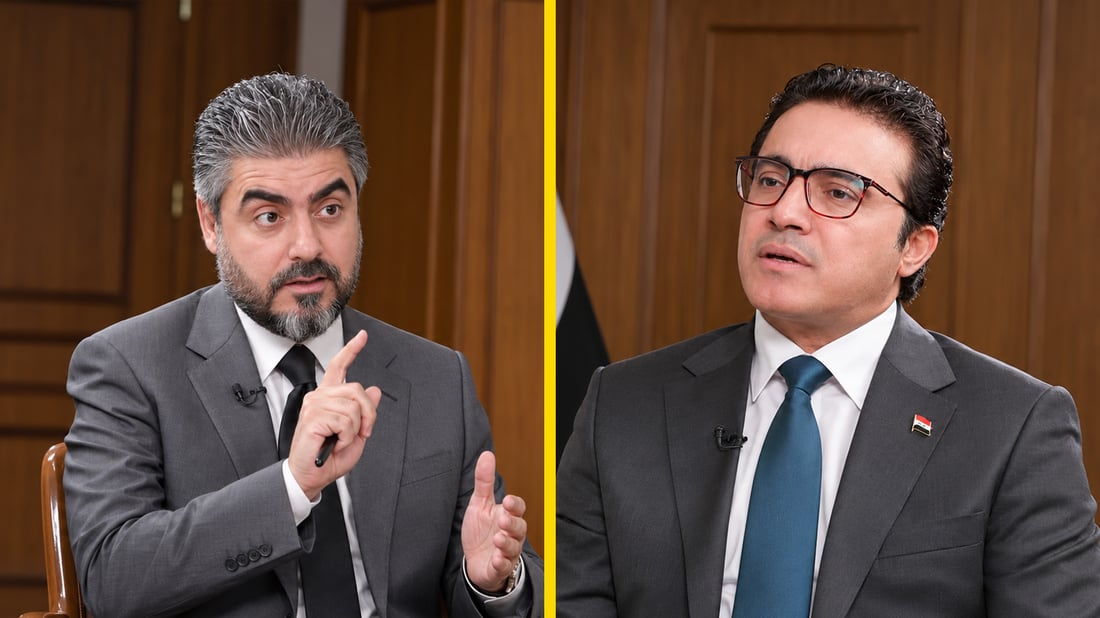
Iraqi government spokesperson Haider al-Aboudi discusses Baghdad’s border security measures and relations with Iran during an interview with Al-Hadath television.
Baghdad defends sovereignty
Iraqi government spox rejects Iranian warning over border measures
BAGHDAD — Iraqi government spokesperson Haider al-Aboudi on Saturday rejected an Iranian warning over Baghdad’s new border measures, saying the decisions were an internal Iraqi matter and that Iraq would not allow neighboring countries to interfere.
The warning came earlier Saturday from Mohammad Mokhber, an adviser to Iran’s supreme leader, Mojtaba Khamenei. In a post on X, he told Baghdad to exercise caution in managing its borders and to avoid becoming a tool of what he called “enemies of Islam” or a means of carrying out U.S. President Donald Trump’s policies.
Mokhber wrote that Iran had stood by the Iraqi people in their most difficult times. He called the shared destiny of Iran and its neighbors a fundamental principle of Iranian foreign policy.
In an interview with the Saudi-owned Al Hadath channel, Haider al-Aboudi said Iraq respected the sovereignty of its neighbors and refused to be drawn into the conflict between the United States and Iran.
“What happened on the ground was within Iraqi borders and does not provoke any neighboring country,” he said. “We respect the particular circumstances of Iraq’s neighbors, but at the same time, we do not allow interference in Iraqi affairs.”
He defended the government’s recent measures on the Kurdistan Region as a domestic matter. He also dismissed suggestions that they were connected to its actions in Jurf al-Sakhar, the northern Babil area where its campaign against oil smuggling began this month.
“All of it is Iraqi territory. When irregularities or waste are identified, it is the responsibility of the judiciary and the executive authority to address them,” the spokesperson said. He added that anyone involved in oil smuggling would be prosecuted under Iraqi law.
Haider al-Aboudi said international parties had contacted Baghdad about its dispute with the Region. Prime Minister Ali al-Zaidi had made clear to them that Iraq’s national resources were “a red line that cannot be crossed,” he said.
He said an Iraqi security delegation had to hold talks in Tehran to deal with shared security challenges, including border security and the running of border crossings.
National Security Adviser Qasim al-Aboudi met Mohsen Rezaei, secretary of Iran’s Supreme National Security Council, in Tehran on Saturday as Zaidi’s envoy, Iran’s semi-official ISNA news agency reported. They discussed counterterrorism, smuggling, border monitoring and security cooperation, the agency said.
The exchange follows orders Zaidi issued on Tuesday for federal authorities to take control of the Kurdistan Region’s border crossings, close unofficial crossings and tighten oversight of oil production and exports after an inquiry into suspected oil smuggling.
The Kurdistan Regional Government rejected the measures as unconstitutional on Wednesday. On the same day, Iraq’s Federal Supreme Court ruled that securing Iraq’s international borders and crossings, including those in the Region, is a federal power. Zaidi’s office also said no foreign power was behind the government’s decisions.
On Nov. 7, Foreign Minister Fuad Hussein said Washington had formally asked Baghdad to close all but two of Iraq’s border crossings with Iran.