
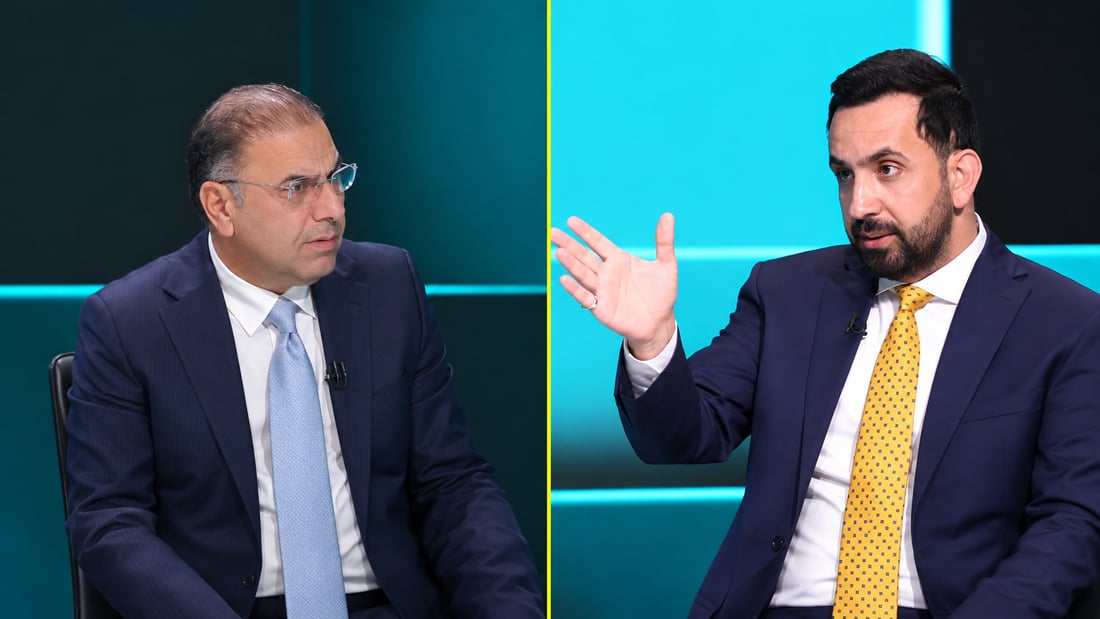
Journalist Mohammed al-Khuzaie (left) interviews Hikma Movement spokesperson Hossam al-Hassani (right) during a televised discussion on Al-Rabiaa TV.
Iraq warned of sanctions if it joins renewed US-Iran war, Hikma says
BAGHDAD — Iraq has received official warnings, mainly from the United States, that it will face sanctions if drawn into a renewed U.S.-Israeli war with Iran, a spokesperson for a party in Iraq’s ruling Shiite alliance said Monday.
“Warnings have reached Iraq officially that if any regional fallout occurs and Iraq becomes involved in it, problems and sanctions await us,” Hussam al-Hasani, spokesperson for Ammar al-Hakim’s Hikma Movement, part of the ruling Shiite Coordination Framework, told presenter Mohammed al-Khuzaie on Al-Rabiaa TV.
The warnings came from international parties, particularly the United States, Hasani said. He did not say when they arrived or who delivered them, and 964media could not independently confirm them.
Hasani warned last month, in an interview with UTV, that breaking the armed factions’ de-escalation agreement with the government would take Iraq into “a tunnel of sanctions”. In that interview he also denied that the deal holds a secret clause voiding it if the U.S.-Iran war resumes.
On Monday, Hasani said keeping Iraq out of the danger zone was the country’s greatest achievement. Military decisions belong to the commander-in-chief of the armed forces and decisions on war and peace belong to parliament, he said, and departing from that would put Iraq in serious trouble.
Prime Minister Ali al-Zaidi, the commander-in-chief, said on Oct. 23 that Iraq “will not be a party to any war” and supports de-escalation.
Hasani spoke as Qatari mediators pursued indirect talks between Washington and Tehran. “An hour ago, we heard leaks from the Doha meeting that speak of good understandings being reached, and an agreement between Washington and Tehran may be announced, perhaps today or tomorrow,” he said.
He also said sudden decisions could overturn any forecast. He recalled that what he called the 40-day war began while a U.S. delegation was traveling to Oman to negotiate with Iran.
No agreement had been announced by Tuesday. Iranian negotiators left Doha on Sunday, and a draft proposal is circulating, an official briefed on the talks told Reuters. Iranian Foreign Ministry spokesperson Esmail Baghaei said the talks rest on a seven-step plan Tehran drew up in September to reopen the Strait of Hormuz and end the U.S. naval blockade of Iranian ports. No final agreement can begin while the blockade stays in place, he said.
President Donald Trump wrote on Truth Social on Monday that “Iran wants a settlement, as soon as possible.” U.S. officials told CBS News overnight that American forces had carried out limited defensive strikes on Iranian targets near the strait after Iran’s Islamic Revolutionary Guard Corps fired on a U.S. aircraft. Trump had said in October that the United States would not attack Iran before Tuesday’s U.S. midterm elections.
The war began with U.S. and Israeli strikes on Iran on Feb. 28 and has continued at varying intensity despite a ceasefire announced in April.
Hasani also said Iraq cannot defend its own skies. “Iraq needs radar infrastructure that can monitor Iraq’s airspace, and we have a complete absence of air defense infrastructure,” he said.
Spotting a threat would not be enough, he said. “If we detect any object in the air, even if it were an alien, we cannot shoot it down.”
Zaidi’s government bears part of the blame, Hasani said, but the problem has been building since 2003.
Senior Kurdistan Democratic Party official Hoshyar Zebari said last month that Iraqi forces track about 200 military flights a day but cannot stop them.
Sabah al-Numan, spokesperson for the commander-in-chief, said in September that Iraq expected air defense systems from South Korea, Turkey and the United States but gave no delivery dates. On Oct. 26, he told the state-run newspaper Al-Sabah that long-range surveillance radars and anti-missile and anti-drone systems were on the way, again without naming suppliers or dates.