
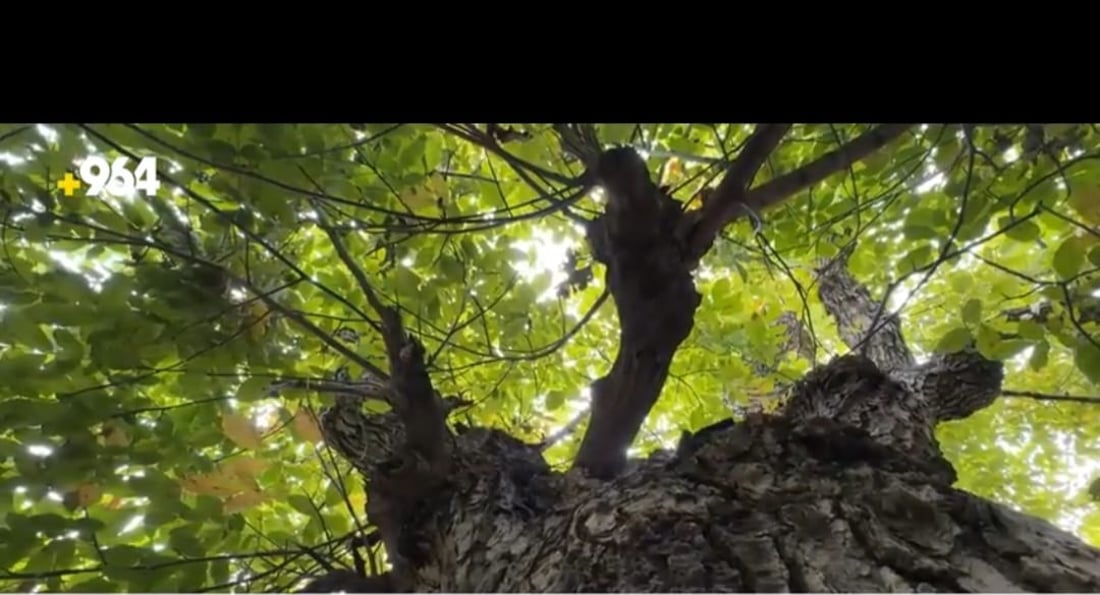
(Photo: 964media)
‘Let the walnut tree remain’: 60 Erbil families share a tree they won’t sell
ERBIL — Nearly 60 households in Rubare, a village in Erbil governorate’s Khalifan district, jointly own a walnut tree that residents say is more than 200 years old and still divide its harvest each year.
Known locally as the “40-share walnut tree,” the tree has passed down through the village’s families by inheritance. Residents say its walnuts are divided among everyone entitled to a share without disputes over the harvest, despite the number of owners.
Each year the harvest draws relatives and families back to the tree to collect and divide its walnuts.
The tree stands in the Gali Bile area of the Alana Valley. Khalifan district is part of the Soran Autonomous Administration, a status above a district but below a governorate that the Kurdistan Regional Government created in 2021.
The land the tree grows on belongs to someone else, but the families have kept their inherited ownership of the tree and the custom of sharing its produce.
Omar Karim, a resident of the area, told 964media the tree has belonged to several families for as long as he can remember. He said its name reflects the number of shares its ownership has traditionally been divided into.
“Everyone has their own share in this walnut tree, and each person is only concerned with their own portion,” Karim said.
Villagers regard the tree as an inheritance from their ancestors, and Karim said the families intend to keep it however much fruit it bears. “Let the walnut tree remain, whether it produces walnuts or not,” he said.
Karim said the families will look after the tree as long as it stands. “We have no intention of cutting it down or selling it,” he added.
Saeed Najat, a young resident of the village, said the yearly harvest brings relatives together and helps keep family and social ties alive.
The gathering gives families a chance to meet and carry on a practice inherited from earlier generations, he said.
Another resident, Kafiya Anwar, recalled the harvests of earlier years. “We used to harvest the walnuts together. The adults would shake the tree, and the walnuts would fall to the ground, while the children gathered them,” she said.
She said the walnuts were then divided among the families according to their shares. “We have never had problems dividing the harvest,” Anwar said.
Residents said the arrangement has held as generations passed and the number of families sharing the tree grew. They said other trees in the area are also jointly owned by groups of families, with their harvests divided among the owners in the same way and without disputes.
Walnuts are widely grown in the Kurdistan Region’s mountains. In the Soran administration’s Balakayati area, home to more than 100,000 walnut trees, a fungal disease halved the harvest in 2024, farmers and agriculture officials said at the time. In Halabja’s Zalm village, families still harvest walnuts by hand, relying on methods handed down through generations.