
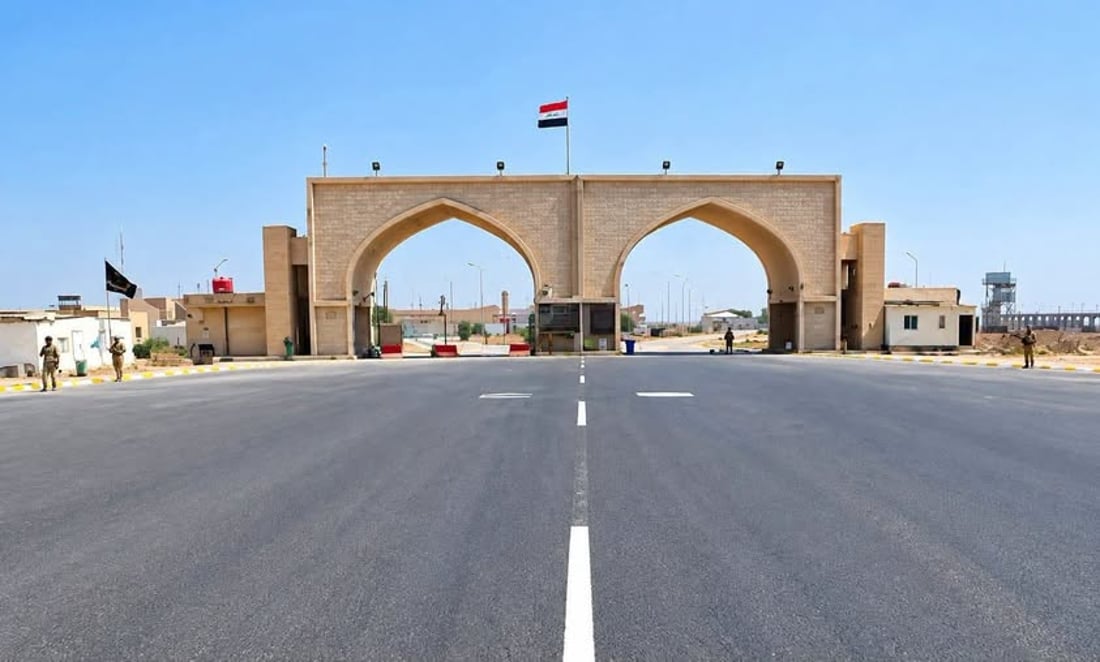
The al-Sheib border crossing between Iraq and Iran in Maysan governorate.
Border controversy
Court issues arrest warrant for Maysan council head as members object
MAYSAN — A Baghdad court on Monday issued an arrest warrant for Maysan Provincial Council Chairman Mustafa Idair al-Muhammadawi on a complaint from Prime Minister Ali al-Zaidi, after he threatened civil disobedience unless the al-Sheib border crossing with Iran reopens.
Two members of the provincial council, Hussein Ali al-Muryani and Ali Jasib al-Zaidawi, challenged Zaidi’s order to investigate Muhammadawi in separate statements the same day, saying an elected council does not answer to the prime minister.
The Third Karkh Investigation Court issued the warrant over Muhammadawi’s threat to declare civil disobedience and block roads, according to the court’s decision, which 964media has seen.
Copies of the decision published online cite the second clause of Article 224 of Iraq’s Penal Code. It covers the use of violence, threats or other unlawful means to force the prime minister, a minister or a lawmaker to act or refrain from acting within their legal powers. The penalty is more than five and up to 15 years in prison.
It was not clear whether Muhammadawi had been detained, and 964media found no public response from him to the warrant on Monday.
“The independence of provincial councils is a constitutional red line, not a favor granted by anyone,” Muryani said.
Elected institutions draw their legitimacy from voters and are not subject to orders or administrative control outside the framework of the constitution and the law, he said.
“The provincial council chairman is not an employee subordinate to the prime minister, and the provincial council is not a department of the federal government,” Muryani said.
He cited Article 122 of the constitution, which says a governorate council “shall not be subject to the control or supervision of any ministry or any institution not linked to a ministry.”
“No one is above the law, including provincial council chairmen, but legal accountability does not mean exceeding jurisdiction or granting any authority powers not established by the Constitution or the law,” he said. Any alleged violation should be handled by the proper authorities through established legal procedures, not by imposing authority on elected institutions, he added.
Zaidawi said Muhammadawi’s demand to reopen the crossing answered residents’ appeals and their concerns about rising prices and the economic cost of the closure. Elected representatives have a duty to speak for them, he said: “Defending their demands and conveying their suffering to the relevant authorities is at the heart of public responsibility.”
“The voices and interests of Maysan’s people must be at the forefront of priorities, and their demands must be addressed through dialogue and serious solutions, not through measures that increase their economic and living difficulties,” he said.
Zaidawi also said the constitution and the 2008 law on governorates make provincial councils answerable to parliament alone.
Lawmaker Mohammed Jassim al-Khafaji of the Ishraqat Kanoon bloc objected to the investigation on Monday, saying the prime minister has no authority to investigate an elected oversight body. He said he had formally asked Speaker Haibat al-Halbousi to invite Muhammadawi to parliament to discuss the case.
The Badr parliamentary bloc on Monday urged the federal government to reopen al-Sheib, warning that the continued closure could raise public tension and deepen distrust between Maysan and Baghdad as residents and traders count their losses. Maysan’s governor, Habib Zaher al-Fartousi, is a Badr member.
Zaidi ordered the investigation on Monday over remarks Muhammadawi made on Sunday, which the prime minister’s media office said included a threat to cut Maysan’s transport links with the rest of Iraq and “inappropriate language.” The office did not say which words it meant.
Muhammadawi joined dozens of truck drivers at a protest at the crossing on Sunday and gave Baghdad until Thursday, Oct. 29, warning that residents would declare civil disobedience and block the roads linking Maysan to other governorates if the crossing stayed shut.
Muhammadawi, an Asaib Ahl al-Haq leader, was elected council chairman in February 2024. Asaib, an Iran-aligned armed faction, is part of Zaidi’s government through its political wing, Sadiqoun.
Al-Sheib closed to goods and travelers at 6 a.m. on Wednesday, Oct. 21, on Zaidi’s instructions. Truck drivers protested the next day, calling the crossing a lifeline for Maysan’s economy and asking why other crossings with Iran remained open.
The government has given differing reasons for the closure. Government spokesperson Haider al-Aboudi said the crossing needed technical and logistical upgrades, while government adviser Abdul Amir Taiban said the aim was to stop drugs and counterfeit currency entering Iraq and denied that the move came under U.S. pressure or was meant to blockade Iran.
Iran’s embassy in Baghdad on Saturday rejected Taiban’s smuggling claims as false and urged Iraqi authorities to respond to remarks it said could harm relations. Tehran has also said it got no advance notice of the closure, which Aboudi called “inaccurate.”