
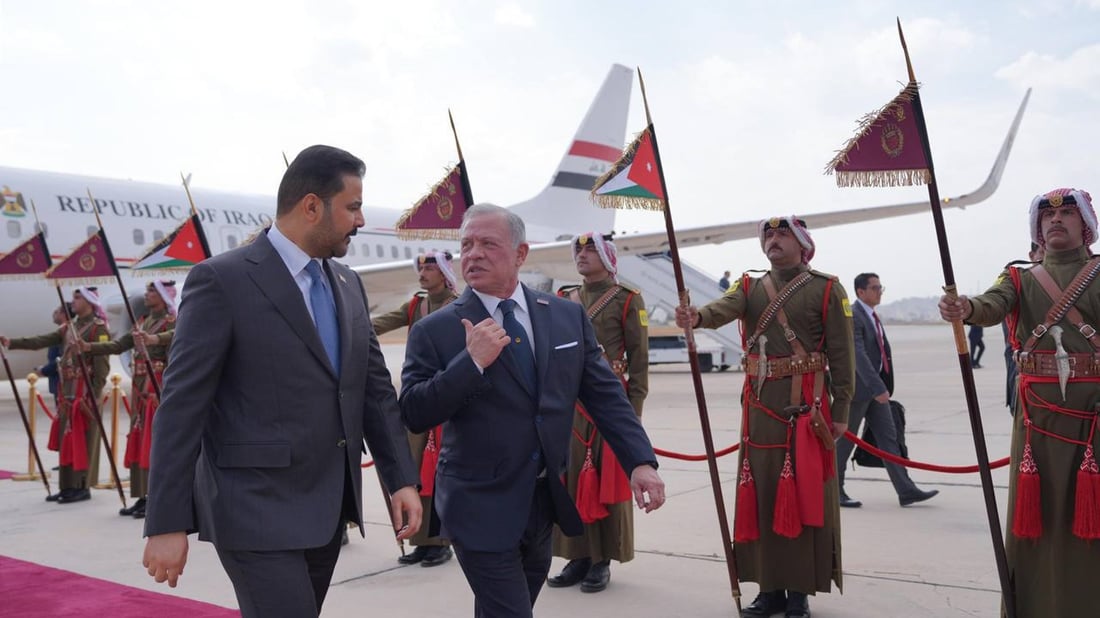
(Photo: the Iraqi prime minister’s media office)
'Strategic partner'
Iraq’s PM Zaidi calls for free zone to boost trade in visit to Jordan
BAGHDAD — Iraq and Jordan on Monday signed nine memorandums of understanding and cooperation programs, from higher education to consumer protection, as Prime Minister Ali al-Zaidi called for a joint free zone during talks in Amman.
Zaidi and Jordanian Prime Minister Jafar Hassan oversaw the signing, Zaidi’s media office said in a statement received by 964media. The six memorandums cover higher education and scientific research from 2026 to 2031, competition and preventing monopolies, environmental protection, documents and archives, cooperation between the two countries’ diplomatic training institutes and consumer protection.
The two sides also signed a mechanism for supporting small and medium-sized businesses, an amended executive program for cultural cooperation and an executive program for educational cooperation, both running from 2026 to 2028. The statement did not say who signed for each side or what each document commits the two countries to.
Zaidi and Hassan earlier chaired expanded talks between the two countries’ delegations on energy, the economy and investment, according to the office. A free zone, a designated area with customs and tax exemptions, would expand cooperation and ties between the two countries to their mutual benefit, Zaidi said, according to the statement. It did not say where the zone would be or when it might be set up.
Zaidi called Jordan a “strategic partner” for Iraq and said Baghdad looked forward to more cooperation and joint coordination to deal with all challenges and to keep strengthening bilateral relations. He said the visit was meant to increase cooperation, particularly on economic, trade, industrial and security matters.
Hassan said the visit reflected the depth of the fraternal ties between Iraq and Jordan and pledged his country’s support for Iraq’s government and people, according to the statement. He said Jordan was keen to keep up cooperation and coordination to achieve integration between the two countries in all fields.
The two delegations also discussed developments in the region, the statement said. They said the Palestinian cause was central, called for justice for the Palestinian people and the restoration of their full rights, and backed diplomatic efforts and dialogue to end crises and conflicts in the region and beyond.
Zaidi later met Palestinian President Mahmoud Abbas in Amman, where he reaffirmed what his office called Iraq’s principled and firm position on the Palestinian cause. The two discussed bilateral relations and developments in the Palestinian territories, and Zaidi called for closer regional and international coordination to end the suffering of the Palestinian people by restoring all their rights on their historical land, the office said. Abbas praised Iraq’s efforts to support the Palestinian cause and protect Palestinians’ rights, according to the statement.
Zaidi also met a group of Iraqi businesspeople and investors from several sectors in Amman. He told them Iraq had come a long way toward attracting more Arab and foreign investment by simplifying procedures, solving investors’ problems and protecting their rights under the investment law, according to his office. He said the government had granted the private sector privileges, including customs exemptions, to help carry out development projects and create jobs for young people.
Early next year, Zaidi said, the foundation stone will be laid for the Development Road corridor, which is to include industrial cities, and Grand Faw Port will open at full capacity for commercial shipping. The Development Road project is Iraq’s planned road and rail corridor from Grand Faw Port in Basra to the Turkish border. The Transport Ministry said in July that preliminary designs were complete, with the first phase targeted for 2031 and financing still being worked out.
Earlier on Monday, King Abdullah II welcomed Zaidi at Marka airport in Amman with an honor guard and both countries’ national anthems. The two then held talks on expanding economic, trade and investment ties and on containing crises and tensions in the region, Zaidi’s office said.
Zaidi told the king that Iraq is now a meeting point for all and bases its relations with brotherly and friendly countries on balance and shared interests, the office said. The king said Jordan was keen to strengthen cooperation with Iraq in all fields, especially politics, the economy and development, according to the statement. He praised Iraq’s pivotal role in securing and stabilizing the region.
The talks with the king also covered cooperation under agreements and memorandums of understanding the two countries have already signed. Government spokesperson Haider al-Aboudi had said before Zaidi left Baghdad that the new memorandums would open the way for joint economic and development programs.
Aboudi said on Thursday that Zaidi was planning visits to Lebanon and Jordan, without giving dates. Jordanian Foreign Minister Ayman Safadi delivered the king’s invitation when he met Zaidi in Washington in July, and the two discussed speeding up the Basra-Aqaba oil pipeline and completing an electricity link, Zaidi’s media office said at the time. Zaidi and the king last met in New York during the UN General Assembly in September and discussed energy and investment, according to the prime minister’s office.
The pipeline, first agreed in a 2012 framework deal and never built, would carry Basra crude about 1,700 kilometers to Jordan’s port of Aqaba, bypassing the Strait of Hormuz, where shipping has been disrupted by the U.S.-Israeli war with Iran. King Abdullah and Iraqi President Nizar Amedi stressed the need to build it in a phone call on Oct. 19. None of the statements on Monday’s talks mentioned the pipeline, and none of the nine documents signed covers energy.
Iraq’s crude deliveries to Jordan, 10,000 to 15,000 barrels a day at a discount under the previous arrangement, have been suspended since the start of the year, which the Oil Ministry attributes to a shortage of Kirkuk light crude. Jordan was supplying Iraq with 300 megawatts of electricity through a cross-border link in August, the Electricity Ministry said.
This article has been updated to include details on the meeting with Abbas and more on the MOUs.