
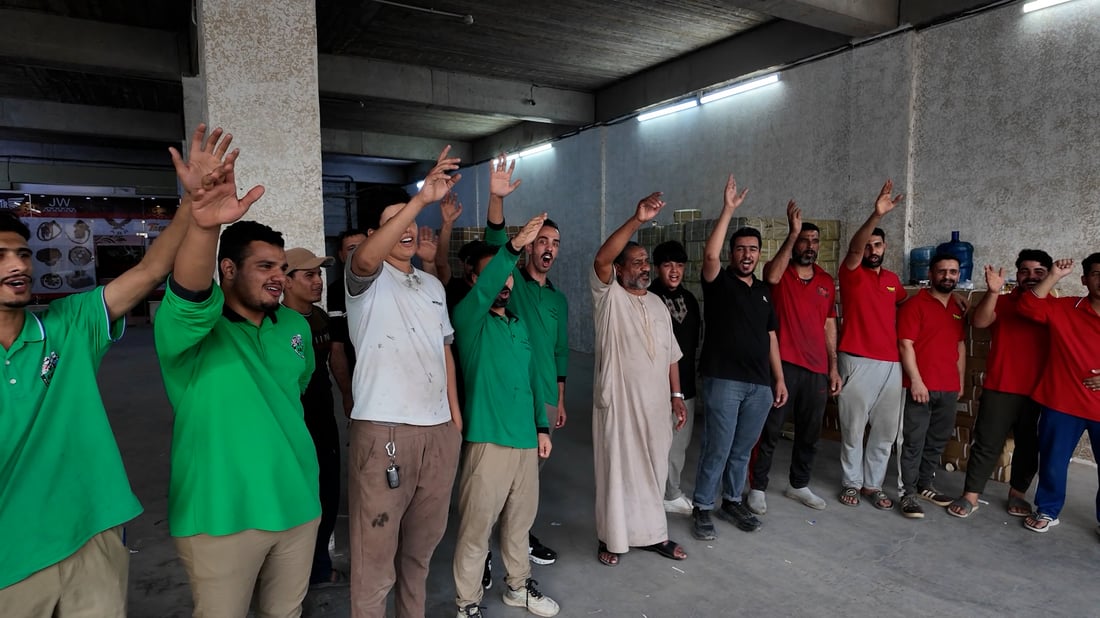
Motorcycle traders and workers in Najaf protest restrictions on importing motorcycle parts and accessories, warning of financial losses and job cuts. Photo: 964media.
Jobs at risk
Najaf motorcycle dealers say parts import ban strands paid-for shipments
NAJAF — Motorcycle dealers in Najaf said Monday that a ban on importing motorcycle spare parts, enforced at Iraq’s border crossings since May, has stranded shipments they had already paid for and put dozens of jobs at risk.
Traders told 964media the ban took them by surprise and disrupted their contracts with Chinese manufacturers, leaving them unable to bring in goods they had already bought and prepared for shipment.
Ali Jassim, a motorcycle dealer in Najaf, called the decision a government mistake and said traders had not been told about it before their shipments arrived.
“I have annual contracts in China, and our goods take a long time to prepare. When they arrived, they were barred from entering without us being informed of the decision beforehand,” Jassim told 964media.
He said he had transferred about 800 million dinars (about $530,000 at the official rate) to China and that the manufacturers were now pressing him to collect the merchandise.
“The Chinese manufacturer is asking me to take the goods, but where am I supposed to take them?” he said.
Jassim said his business employs 22 workers and 12 university graduates whose jobs are now at risk. He also questioned why imported parts were restricted when dealers already pay registration fees to obtain official approvals.
Abbas al-Hasnawi, another trader, said businesses had transferred hundreds of thousands of dollars to suppliers before learning that the ban would keep their shipments out of Iraq.
“We were surprised by this decision in May, even though we already had goods prepared and stored in suppliers’ warehouses,” Hasnawi told 964media.
He said the measure had caused substantial financial losses and was being strictly enforced at border crossings across the country.
The ban has also hit staff who turned to private businesses while they wait for government jobs. Hazim Jawad, a 2025 medical graduate who works for a motorcycle company, said the uncertainty over a public-sector post had pushed him into the private sector.
“My future regarding government appointment remains uncertain, and I currently work in the private sector,” Jawad told 964media.
He said successive government decisions and the rising dollar were piling pressure on businesses and could force employers to cut staff. The official exchange rate rose to 1,520 dinars per dollar from 1,320 on Oct. 7.
The traders called on the government to reconsider the ban and settle the status of shipments already bought from suppliers abroad. 964media found no published government decision setting out a ban on motorcycle parts in May, and no authority has said whether shipments contracted before it took effect will be allowed in.
Border authorities already treat the parts as banned goods. The Border Ports Authority said on Sept. 16 that it had found motorcycle frames, which are banned from import, in a truck declared as carrying car spare parts at the Zurbatiyah crossing in Wasit governorate. It referred the case to an investigative judge in Badra.
On Sept. 19, the authority reported seizing two 40-foot containers of undeclared motorcycle spare parts at the North Umm Qasr port in Basra, saying the parts were banned from import.
On May 23, 2023, Basim al-Awadi, then the government’s spokesperson, announced that the cabinet had banned motorcycle imports, barred motorcycles from highways, stopped new motorcycle production lines and gave owners three months to register their bikes. The decision halted imports of motorcycles of 40 cc and above from July 1 that year, except for the needs of security and traffic agencies, and permanently banned imports of smaller motorcycles and of tuk-tuks that fail safety standards.
In July, the Industry Ministry said a technical team led by its undersecretary for planning, Ahmed Abdul Jabbar al-Karim, was reviewing the ban on importing motorcycles and their spare parts, with the aim of replacing unregulated imports with a regulated system.
Fayyad al-Dulaimi, head of the Planning Ministry’s Central Organization for Standardization and Quality Control, told the state-run Iraqi News Agency on July 8 that an amended cabinet decision bans motorcycle imports for five years. He said the organization was drafting rules for importing motorcycles and spare parts. Neither body has announced an outcome.
Najaf is home to Khan al-Mukhadhar, the governorate’s biggest motorcycle market, which draws buyers from across Iraq. Dealers there said in November 2025 that China dominated the country’s motorcycle supply, including the models favored by delivery workers, and that registration problems were weighing on sales.
The General Traffic Directorate said in April that about 400,000 motorcycles had been registered nationwide and warned that bikes without registration or customs papers could be seized. It has given owners of legally imported motorcycles 90 working days, from Oct. 18 to Feb. 22, 2027, to register them and get plates or face a fine of 100,000 dinars (about $66).