
Park planned
Iraqi and Italian archaeologists find Hammurabi-era remains in Baghdad
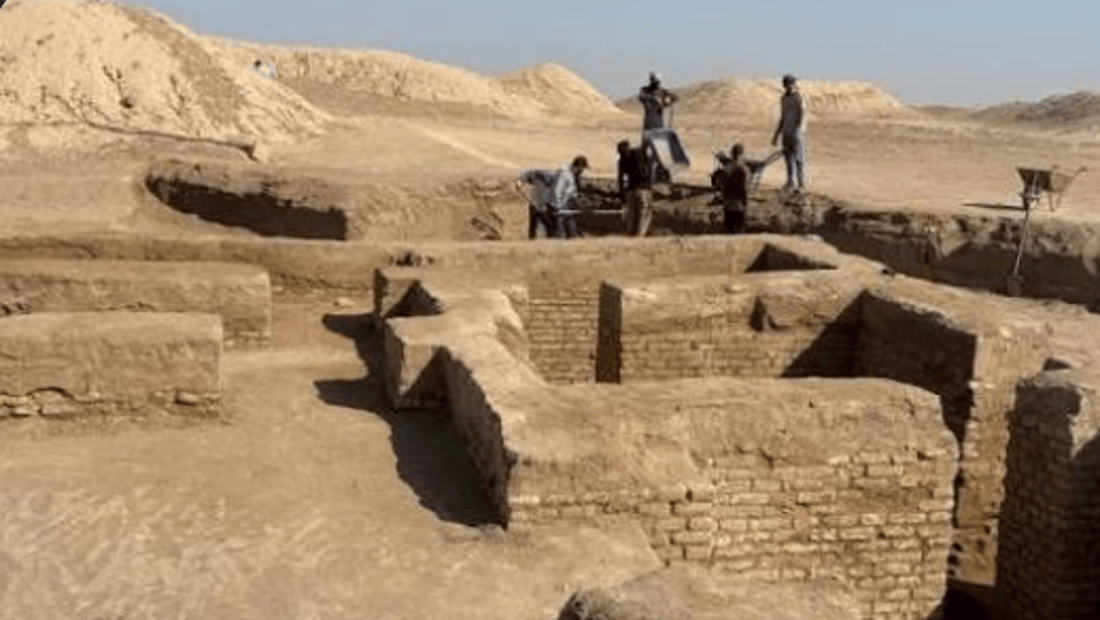
BAGHDAD — Iraqi and Italian archaeologists have found architectural remains from the reign of the Babylonian king Hammurabi at Baghdad’s Tell Muhammad, the state antiquities board said Monday as it unveiled plans for an archaeological park there.
Ali Obaid Shalgham, head of the State Board of Antiquities and Heritage, announced the finds at a presentation of a protective roof planned for the park. He said they were made with a mission from Italy’s University of Catania led by archaeologist Nicola Laneri. Hammurabi ruled Babylon from about 1792 to 1750 B.C.
Shalgham said the board would also move newly found artifacts to the Iraq Museum in Baghdad “to display them to visitors.” He did not say how many pieces had been found or what they were.
Shalgham said Tourism and Antiquities Minister Ali al-Dakhili had told the board to bring in foreign missions to work alongside its staff. The aim, he said, was to combine Iraqi and international expertise to uncover “the treasures, architectural details and secrets of civilization” that such sites hold.
He said the board planned to highlight the historical value of Baghdad and other governorates, whose heritage stretches back thousands of years. “The plans are ongoing, and there is determination and tireless effort by the minister to work with all international bodies to revive tourism in Baghdad and the governorates,” Shalgham said.
Italian Ambassador Niccolò Fontana, who attended the presentation, called the project important for protecting the site and pointed to the cooperation between Iraqi and Italian archaeologists there. He said it was his third visit and that he had seen something new each time, and he hoped the site would be ready for tourists soon.
Tell Muhammad, on Baghdad’s southeastern edge, was mainly a settlement of the Old Babylonian period. Mace heads found there in the mid-19th century carry an inscription reading “palace of Hammurabi.” Iraqi archaeologists excavated the site from 1978 to 1985, and in 2022 Laneri’s team reported finding a city wall about 6 meters thick and a monumental gate, which Laneri linked to Hammurabi’s reign.
The site lies a short distance from Tell Harmal, the nearly 4,000-year-old city of Shaduppum in the New Baghdad district. Excavations there in the 1940s uncovered clay tablets on mathematics, geometry and administration, including geometric principles that researchers later dated to centuries before the Greek mathematician Pythagoras. Residents and heritage advocates called for better upkeep of Tell Harmal in July, when Italian archaeologists resumed fieldwork there.
In April 2025, Shalgham said more than 50 foreign missions were working across Iraq to excavate and restore sites and prepare them for tourism.