
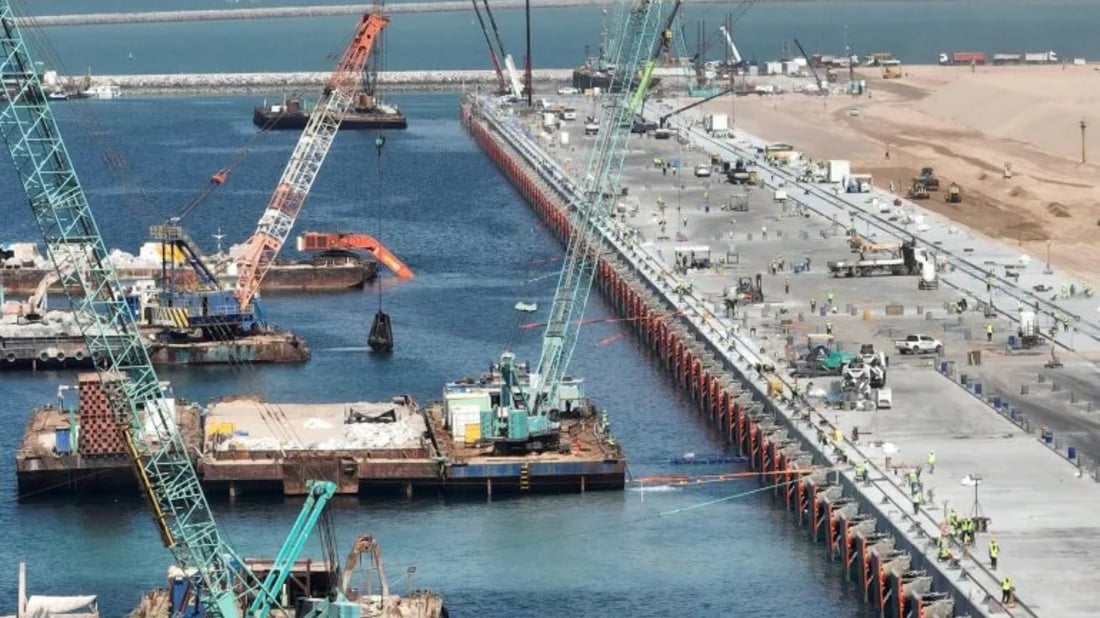
Construction work underway at Iraq’s Grand Faw Port in Basra governorate
Railway Expansion Planned
Iraq negotiating oil-backed fund with Turkey to finance Development Road
BAGHDAD — Iraq is negotiating an agreement with Turkey to set up an oil-backed fund to finance the Development Road, a railway official said Saturday, as Baghdad looks for ways to pay for the multibillion-dollar trade corridor linking the Gulf to Europe.
Fadhil Abbas, director of the projects department at the General Company for Iraqi Railways, told the state news agency that the proposed agreement would create a fund to pay for construction by Turkish companies in exchange for oil.
The project is in the design preparation stage, Abbas said. Its main aim is to move goods from the Grand Faw Port in Basra to Turkey and on to European markets, and in the opposite direction, while modernizing Iraq’s rail network, connecting governorates and expanding passenger and freight services.
Abbas said an upgrade of Iraq’s existing rail lines, which he described as the first phase of the Development Road, would be financed separately through a World Bank loan. The upgrade covers the lines from Baghdad to Basra and Umm Qasr in the south and from Baghdad to Mosul in the north, with the network also to be linked to the Grand Faw Port and the Turkish border at Fishkhabur.
The Development Road is a $17 billion initiative to connect Iraq’s southern ports with Turkey and Europe through a network of railways and highways. The project has attracted interest from Turkey, Qatar and the United Arab Emirates, with Iraq seeking international investment to fund construction.
Ankara has pushed for an oil-for-financing arrangement. In July, Turkish Transport Minister Abdulkadir Uraloglu told Al Jazeera that Iraq could use its natural resources to finance the project and that Baghdad had shown greater willingness to adopt the formula. During a visit to Ankara later that month, Iraqi Prime Minister Ali Faleh al-Zaidi said Iraq was ready to supply Turkey with around 1 million barrels of crude oil a day.
Also in July, the Transport Ministry announced the completion of preliminary railway and highway designs, saying work had moved on to detailed plans for bridges, stations and other infrastructure. Zaidi directed officials to develop a comprehensive financing mechanism and an economic model to attract Iraqi and foreign investors.
The ministry has said the project’s first phase is targeted for completion in 2031, followed by a second phase in 2038 and full capacity by 2050. In September, Iraqi and Turkish officials advanced talks on activating the Fishkhabur-Ovakoy border crossing as part of the corridor.
Abbas also said the railway company is working to restore service on the Baghdad-Akashat line after rehabilitating most of the track and repairing bridges destroyed by ISIS. The remaining work involves the Wadi Fatm bridge, a small structure whose reconstruction contract is going through the award process, he said.
In May, railway officials said rehabilitation of the western rail network had passed the halfway mark, with the 180-kilometer section between Baghdad and Hit already operational. Work on the Hit-al-Baghdadi section was reported to be 85% to 90% complete, with the Wadi Fatm bridge identified as the remaining obstacle.
Separately, Abbas said responsibility for the Baghdad Metro had been transferred from the railway company to the Baghdad Municipality, which has offered the project to investors. He said the railway company has no plans for further tram or metro projects.