
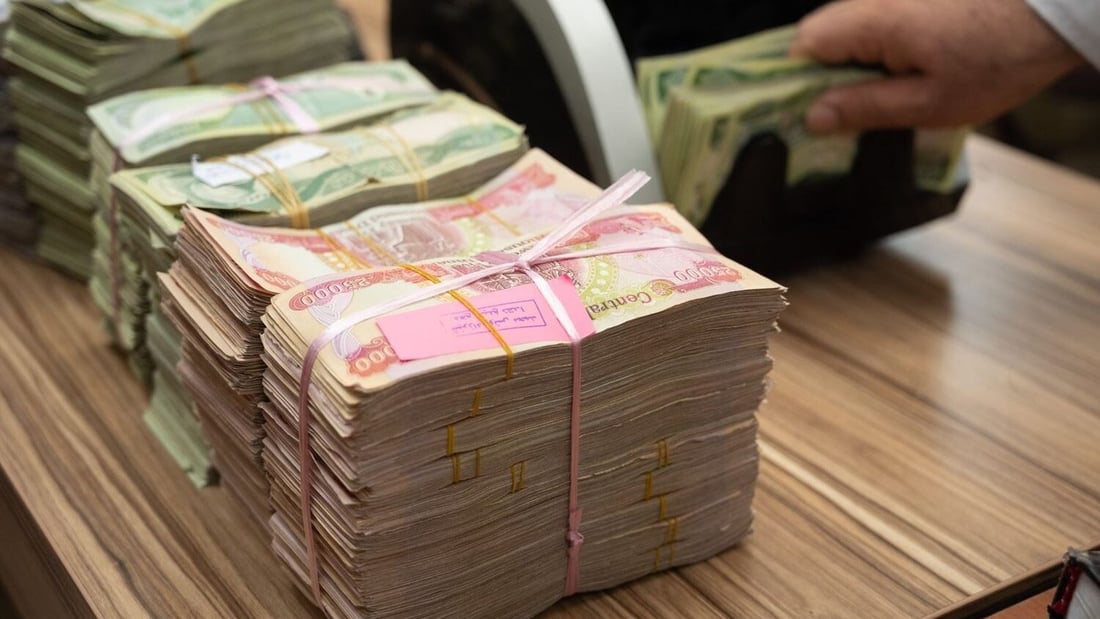
Stacks of Iraqi dinar banknotes are counted at a money exchange office in Baghdad.
Media monitor
PM ‘went around in circles’ to justify devaluation, economist says
BAGHDAD — Economist Ziad al-Hashimi said Friday that Prime Minister Ali al-Zaidi had sidestepped the causes of Iraq’s financial crisis in defending the devaluation of the dinar, accusing the government of taking the easiest option at citizens’ expense rather than tackling waste, corruption and an overstaffed public sector.
“The Iraqi prime minister went around in circles in his speech yesterday to justify the devaluation of the dinar against the dollar, taking responsibility for a controversial decision that no single individual, regardless of their position, can bear,” Hashimi wrote on social media.
Zaidi told the parliament speaker and committee chairs on Thursday that devaluation was necessary to keep paying salaries without more borrowing, after the government had weighed three alternatives: compulsory savings deducted from salaries, paying public employees every 45 days, and taking on more debt.
“He did not address, even remotely, the serious drain on public finances caused by waste, excessive staffing and corruption, which forced his government to confront those three difficult options,” Hashimi said. Zaidi’s silence on those causes “confirms once again that we are facing a politically constrained government that cannot identify the real causes of the financial imbalance or work to address them,” he wrote. “Iraqi society should prepare to remain the only party forced to bear the consequences of government failures and the large scale of financial depletion from its own pockets.”
Hashimi said on Thursday that the draft 2027 budget was a “welfare budget” that expanded spending while wealthier Gulf states cut back. The draft, not yet published, shows spending of about 217 trillion dinars, the largest in Iraq’s history, according to economists Nabil al-Marsoumi and Abdulrahman al-Mashhadani, with oil revenue of about 140 trillion and a deficit of about 45 trillion, built on exports of around 4 million barrels a day. Domestic debt rose by 15.6 trillion dinars in the first half of this year to about 106 trillion, most of it owed to the Central Bank, according to the bank’s figures.
Since Wednesday, the Central Bank buys dollars from the Finance Ministry at 1,500 dinars, sells to banks at 1,510 and sets the public price at 1,520, up from 1,300, 1,310 and 1,320. The parallel market passed 1,700 dinars per dollar in Baghdad on Wednesday and closed Thursday at 1,660 to 1,680.
Revenues covered only 76% of salaries and welfare in the first seven months of the year, leaving a gap of 29 trillion dinars, Marsoumi said on Sunday. Oil provides more than 90% of federal revenue, and exports have recovered to about 2.6 million barrels a day after collapsing when shipping through the Strait of Hormuz was disrupted in March, against 3.3 to 3.5 million before.