
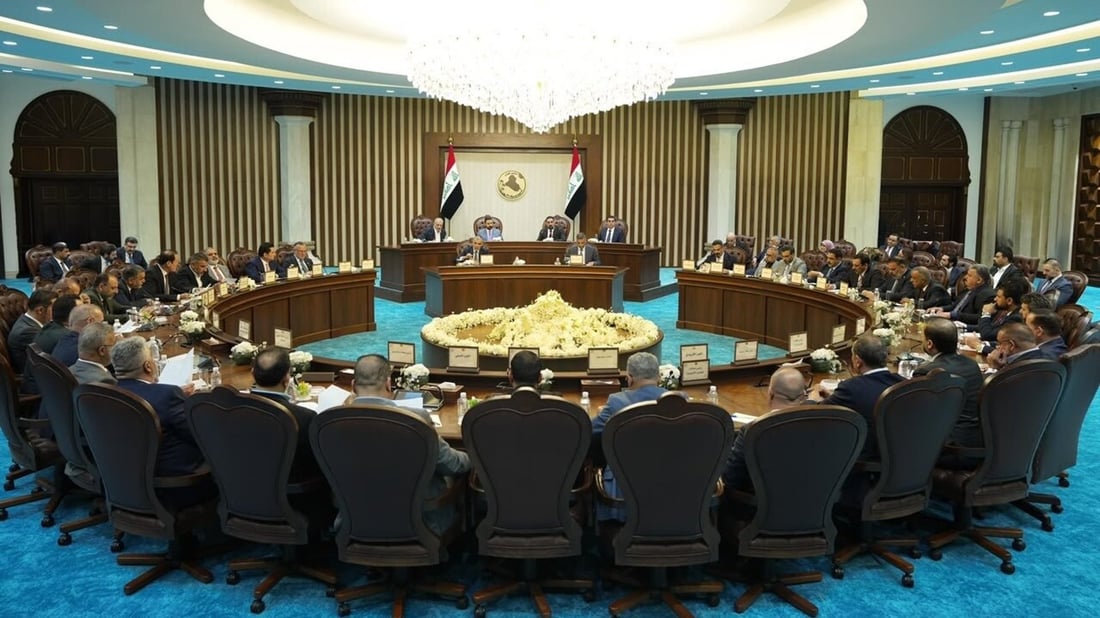
(Photo: The prime minister's media office)
Dinar devaluation chosen over 45-day pay cycle and more borrowing, PM tells lawmakers
BAGHDAD — Prime Minister Ali al-Zaidi told lawmakers on Thursday that devaluing the dinar was necessary to keep paying salaries without more borrowing, after the government had weighed three alternatives: compulsory savings deducted from salaries, paying public employees every 45 days, and taking on more debt.
Zaidi met Parliament Speaker Haibat al-Halbousi and committee chairs at the Council of Representatives, with the finance minister and the Central Bank governor present, his media office said.
“We began our duties with public debt exceeding 208 trillion dinars, while the government was required to provide 10 trillion dinars each month. Despite the crisis, we secured salary payments,” said Zaidi, who took office in May, succeeding Mohammed Shia al-Sudani. Domestic debt alone rose by 15.6 trillion dinars in the first half of the year to about 106 trillion, most of it owed to the Central Bank, according to the bank’s figures.
He blamed the regional war and the disruption of oil exports, describing it as an economic blockade. “I assumed responsibility at a time when our economy was under blockade due to the disruption of oil exports and the closure of the Strait of Hormuz,” he said.
“In the coming days, substantial amounts of foreign currency will arrive, and we will put them into circulation,” he said, without saying how much. Most of Iraq’s oil revenue is deposited in a government account at the Federal Reserve Bank of New York under arrangements set up after the 2003 invasion, and the Central Bank requests dollar transfers or cash shipments from it to meet domestic demand.
Zaidi accused currency speculators of profiting from the gap between exchange rates. “We are engaged in an intense battle against corruption, and the economy must be managed with an economic mindset,” he said.
Since Wednesday, the Central Bank buys dollars from the Finance Ministry at 1,500 dinars, sells to banks at 1,510 and sets the public price at 1,520, up from 1,300, 1,310 and 1,320. The parallel market passed 1,700 dinars per dollar in Baghdad on Wednesday and closed Thursday at 1,660 to 1,680.
Proposals had gone as high as 1,900 dinars before the Central Bank insisted on 1,500, the bank’s media director, Haider Ghazi, said on Wednesday, adding that government requests to fund salaries had been depleting its reserves. Finance Committee member Youssef al-Kilabi said the same day that Zaidi had rejected the 45-day pay proposal, and Hikma’s Ali al-Jourani said the Central Bank governor had raised the possibility of salary cuts. Blocs in the Coordination Framework said on Thursday that “the exchange rate is a monetary tool, not a fund to cover budget gaps.”
Revenues covered only 76% of salaries and welfare in the first seven months of the year, leaving a gap of 29 trillion dinars, economist Nabil al-Marsoumi said on Sunday. Oil provides more than 90% of federal revenue, and exports have recovered to about 2.6 million barrels a day after collapsing when shipping through the Strait of Hormuz was disrupted in March, against 3.3 to 3.5 million before.