
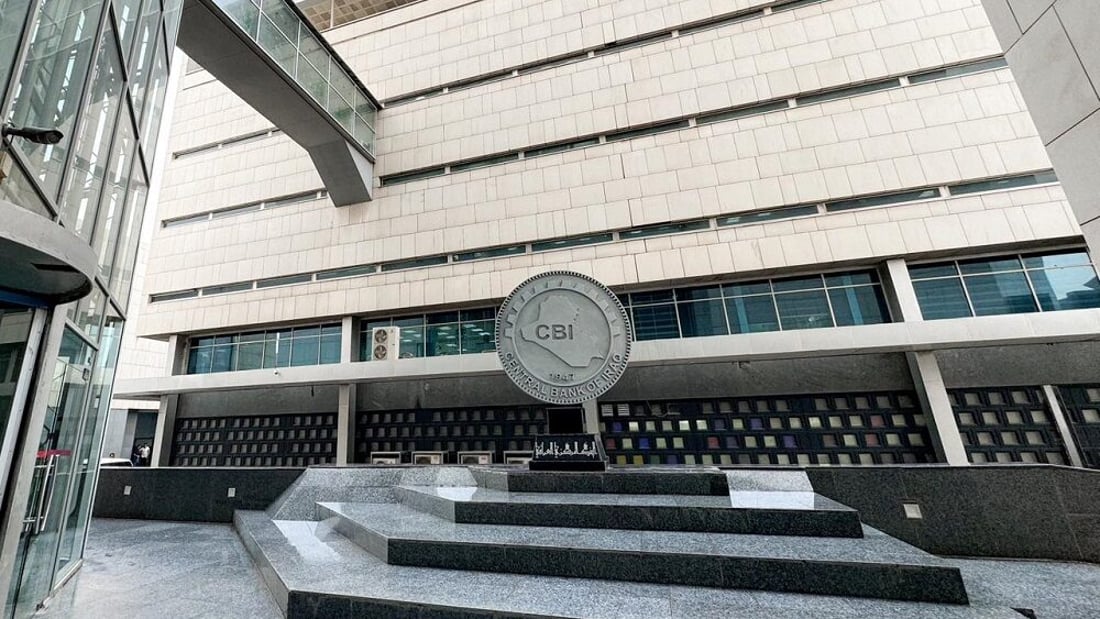
The Central Bank of Iraq (CBI) headquarters in Baghdad
Media monitor
Iraq’s Central Bank says proposals reached 1,900 dinars before it held the rate at 1,500
BAGHDAD — Proposals to devalue the dinar went as far as 1,900 to the dollar before the Central Bank insisted on 1,500, a bank official said, adding that repeated government requests for money to pay salaries had been draining its reserves.
“Keeping the exchange rate at its previous level would have meant heading directly toward the abyss,” Haider Ghazi, the bank’s media director, told Dijlah TV. “Figures as high as 1,900 dinars were proposed, along with other rates above 1,500, but the Central Bank insisted on setting it at 1,500 dinars.” He did not say who proposed the higher rates.
The government had turned to the bank more than once to cover salaries for what he put at more than 9 million people on the state payroll, through the discounting of treasury transfers, in effect lending against government debt. “With more than 9 million employees who cannot afford to wait even a few days for their salaries because of their financial obligations, the government turned to the Central Bank more than once,” he said. “Iraq consumed portions of its reserves through the discounting of transfers involving substantial amounts to cover salaries, until we found ourselves facing a crisis and depletion of our balances.”
The bank said on Wednesday, the day the new rate took effect, that its reserves were adequate “to meet all monetary requirements.” Finance Committee member Ikhlas al-Dulaimi said on Tuesday that salaries were secured and reserves could cover any gap.
“The country’s economic situation is not at the required level in terms of the government’s finances and budget,” Ghazi said. “The dollars the Central Bank provides to purchase goods from abroad come from oil, and everyone knows the difficult circumstances the region and the world are experiencing.” The bank and the government agreed the change after discussions, he said. “Although the Central Bank holds the legal authority to make the decision, we accepted responsibility despite being the party most affected by the repercussions.”
He urged the private sector to make things rather than import them, pointing to the bank’s industrial, agricultural and housing lending initiatives. “When will we learn to manufacture and produce?” he said. “It is unreasonable that we cannot manufacture even the simplest products, and instead import them from abroad.”
Under the new rates, in force since Wednesday, the bank buys dollars from the Finance Ministry at 1,500 dinars, sells to banks at 1,510 and sets the public price at 1,520, up from 1,300, 1,310 and 1,320. The parallel market passed 170,000 dinars per $100 on Wednesday, having already been above the new official rate at 160,500 the day before.
Revenues covered only 76% of salaries and welfare in the first seven months of the year, leaving a gap of 29 trillion dinars, economist Nabil al-Marsoumi said on Sunday. Oil provides more than 90% of federal revenue, and exports have recovered to about 2.6 million barrels a day after collapsing when shipping through the Strait of Hormuz was disrupted in March, against 3.3 to 3.5 million before. The last change to the official rate was in February 2023, when the dinar was strengthened from 1,450 to 1,300.