
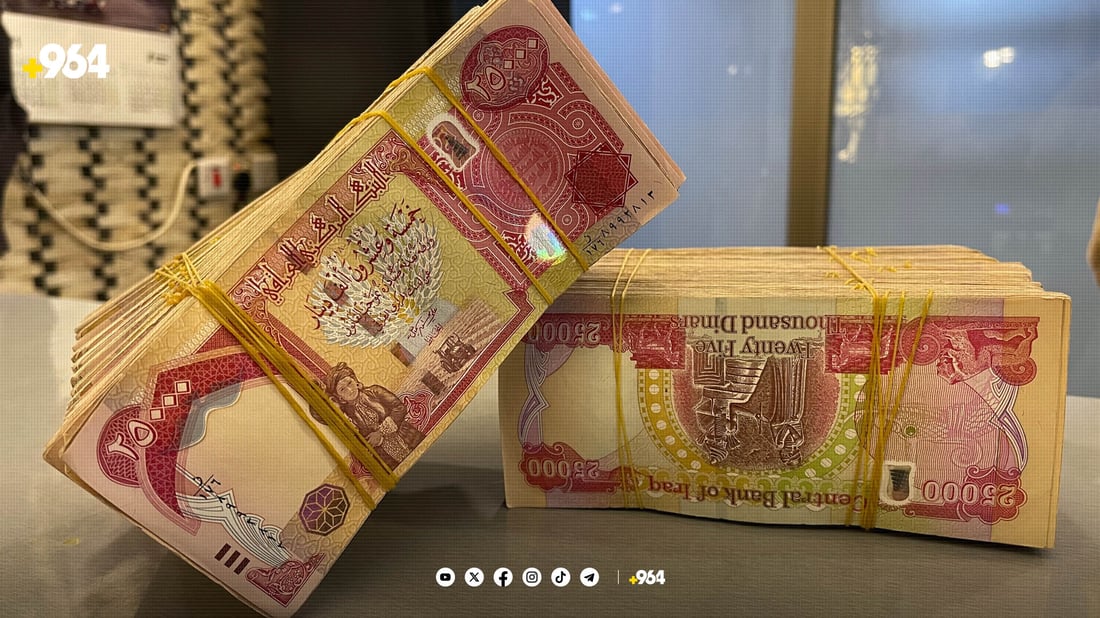
Bundles of Iraqi dinars. (Photo by 964media)
Friday preachers in Najaf and Ramadi urge government to reverse devaluation
BAGHDAD — Friday preachers in Najaf and Ramadi called on the government to reverse the devaluation of the dinar, with the Najaf preacher proposing that public employees be paid in dollars if the currency keeps falling and the Ramadi imam accusing officials of lying to the people.
“We join our voices with those of the people and call on the government to reconsider this decision,” Sadr al-Din al-Qabanji said in his sermon in Najaf. Oil provides about 90% of state income and religious tourism around 3%, he said, and the government should find other solutions despite the disruption to exports, “especially since the Iraqi government has announced that the Strait of Hormuz is open to large Iraqi tankers.” The state tanker company said last Saturday that it had moved 2 million barrels through the strait on a very large crude carrier, its first such voyage in decades. “If the value of the Iraqi currency must decline, then the government should pay employees’ salaries in dollars,” Qabanji said.
In Ramadi, Osama Abdul Alim al-Saadi, imam of the Mohammed Arif Mosque, accused officials of broken promises and failing health care and services. “It is shameful and disgraceful for a state official, regardless of their position, to lie to the people,” he said. “The government has slaughtered its people from vein to vein.” He asked how low-income families were meant to cope, and whether the decision had been properly studied or had been out of the government’s hands. “The suffering of the poor should not be the price of officials’ failure to fulfill their obligations,” he said. In Mosul, imam Subhi al-Anzi said on Thursday he would use his sermon to urge merchants and customers to cooperate, comparing the hardship to the sanctions years of the 1990s.
Prime Minister Ali al-Zaidi told the parliament speaker and committee chairs on Thursday that devaluation was necessary to keep paying salaries without more borrowing, after the government had weighed three alternatives: compulsory savings deducted from salaries, paying public employees every 45 days, and taking on more debt. Economist Ziad al-Hashimi said Friday that Zaidi had sidestepped the causes of the crisis, accusing the government of taking the easiest option at citizens’ expense rather than tackling waste, corruption and an overstaffed public sector.
Since Wednesday, the Central Bank buys dollars from the Finance Ministry at 1,500 dinars, sells to banks at 1,510 and sets the public rate at 1,520, up from 1,300, 1,310 and 1,320 since February 2023. The parallel market closed Thursday at 1,660 to 1,680 dinars per dollar, about 10% above the new official rate, after passing 1,700 in Baghdad on Wednesday.
Revenues covered only 76% of salaries and welfare in the first seven months of the year, leaving a gap of 29 trillion dinars, economist Nabil al-Marsoumi said on Sunday. Oil provides more than 90% of federal revenue, and exports have recovered to about 2.6 million barrels a day after collapsing when shipping through the Strait of Hormuz was disrupted in March, against 3.3 to 3.5 million before.