
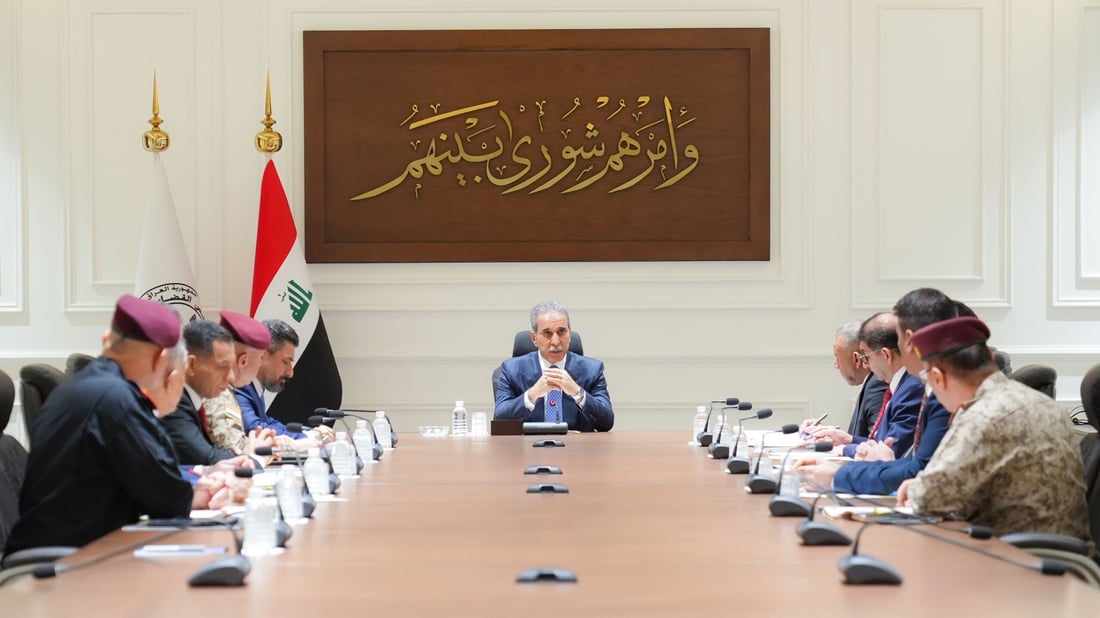
(Photo: the Supreme Judicial Council)
Iraq to handle foreign Islamic State detainees case by case on reciprocity
BAGHDAD — Iraq will deal with the cases of foreign Islamic State suspects transferred from Syria according to bilateral agreements with each detainee’s country, Iraqi law and the principle of reciprocity, officials agreed at a meeting chaired by Supreme Judicial Council president Faiq Zaidan.
The meeting was called to formulate a unified Iraqi position on the foreign detainees and convicts, the council said. Baghdad’s First Karkh Investigation Court has completed the investigation and interrogation stage, begun in February, with each defendant referred according to the evidence in their case, and the cases now move to trial.
The National Center for International Judicial Cooperation will examine any initiative or proposal from those countries or from international organisations offering Iraq aid or assistance in connection with the cases.
The approach follows Iraq’s approach to 61 countries last month about repatriating nearly 6,000 foreign prisoners to serve their sentences at home, which the Justice Ministry said would proceed on reciprocity or under bilateral agreements.
Iraq finished questioning all 5,704 suspects transferred from northeastern Syria earlier this month and is releasing 466 for lack of evidence — 457 Syrians to be returned through the Syrian embassy in Baghdad, seven Iraqis, and one Finnish and one American detainee to be handed to their governments, about 8% of the total. The detainees hold 67 nationalities, among them 3,497 Syrians and 474 Iraqis. Biometric evidence including fingerprints, iris scans, DNA and palm prints was cross-checked by an intelligence analysis centre drawing on the Interior Ministry, the National Intelligence Service, the National Security Service and Military Intelligence.
Iraq began receiving the detainees in January after instability raised concerns about facilities guarded by the Syrian Democratic Forces, with 5,703 transferred by mid-February. They were held at Karkh Central Prison and classified using information from the international coalition.