
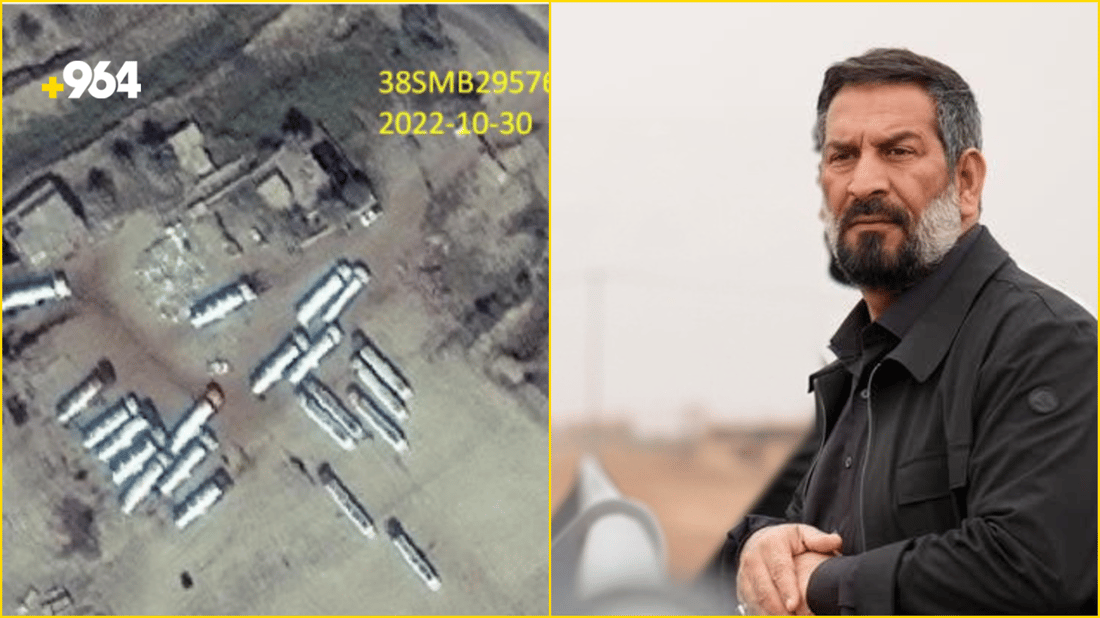
Satellite image from a disputed oil-smuggling report alongside former Babil Governor Ali Turki, who resigned Nov. 12, 2026.
Intelligence Report Controversy
Khazali pressed Babil governor to quit over Jurf al-Sakhar, source says
BAGHDAD — Babil Governor Ali Turki resigned Thursday under pressure from Asaib Ahl al-Haq leader Qais al-Khazali, two days after publicly rejecting an intelligence report that alleged oil smuggling in Jurf al-Sakhar, a source told 964media.
Turki told the state-run Iraqi News Agency on Thursday that he was submitting his resignation. Later in the day he told Al Jazeera that he had left office over the Jurf al-Sakhar oil-smuggling case. He gave no details of the circumstances and did not name anyone involved in the alleged smuggling.
Khazali was angered by Turki’s statements rejecting the report, which alleges that oil was smuggled through two pipelines in Jurf al-Sakhar, and pushed for his removal, the source said. The resignation was accepted the same day, according to the source, who did not say by whom.
964media could not independently verify the account, and Khazali had not commented publicly on it by Thursday evening.
Asaib is an Iran-aligned armed faction with brigades in the Popular Mobilization Forces, the state-sanctioned umbrella of mostly Shiite armed groups formed in 2014 to fight the Islamic State group. Turki, a former lawmaker, was elected governor by the Babil Provincial Council in January as the candidate of Sadiqoun, Asaib’s political wing. The United States designated Asaib a Foreign Terrorist Organization in 2020 and Khazali a Specially Designated Global Terrorist.
Turki on Tuesday rejected the smuggling allegations after an unannounced visit with journalists to the site named in the report. He said it was an old fuel station called al-Madina al-Munawwara, which had been used for about four years to fuel Federal Police and PMF vehicles.
Checks had found no irregularities on nearby pipelines, and the site was not connected to the Musayyib oil pipeline network, Turki said. He called the allegations inaccurate and urged the media to verify information before publishing it.
Security expert Sarmad al-Bayati disputed the governor’s account Wednesday in an interview with presenter Yasser Amer. “This report was issued by a respected Iraqi government agency, the people behind it are professional officers, and they submitted it three months ago,” he said. Bayati said the agency’s logo could be seen in the report’s images.
The report, which began circulating Monday, alleges that oil is drawn from a pipeline in Jurf al-Sakhar through an unauthorized opening and carried away in tanker trucks that hold 36,000 liters each. The documents include images presented as evidence. 964media could not verify the report or the images, or confirm which agency prepared them.
Jurf al-Sakhar, in northern Babil, was officially renamed Jurf al-Nasr in 2014 after Iraqi forces and allied armed groups recaptured it from Isis. It is widely regarded as a stronghold of Kataib Hezbollah, another Iran-aligned faction, which the United States designated a terrorist organization in 2009.
The area has remained under tight security restrictions since 2014, and many of its displaced residents are still unable to return.
Zaidi on Wednesday ordered an investigative committee to examine the suspected smuggling. It is made up of the Federal Police, the Energy Police, the Federal Commission of Integrity, the Federal Intelligence and Investigations Agency and the Popular Mobilization Commission, the state body that runs the PMF.
Parliament Speaker Haibat al-Halbousi ordered a committee of lawmakers the same day to investigate the report, along with intelligence on oil smuggled from the Kirkuk fields and the Kurdistan Region through Iran to Afghanistan. The committee will report to parliament’s leadership.
The row has also become a point of contention within the Coordination Framework, Iraq’s ruling alliance of Shiite parties. A source in the alliance told 964media on Thursday that the leaked report was among the issues holding up leadership meetings, along with disputes over armed factions, border crossings and the Kurdistan Region’s budget share.
Turki also offered his resignation in May after an armed group blocked work on a bridge project in the governorate. The provincial council unanimously rejected it.
Neither committee has announced findings.